
Category Archives: Documentary

Chain Reactions (2024)

Having grown up sheltered and overprotected, I saw Tobe Hooper’s The Texas Chain Saw Massacre at the house of the kid across the street. Because his single mom let him rent any VHS he wanted. My junior-high self felt so dirty and so guilty, I never wanted to see it again. And didn’t, for decades.

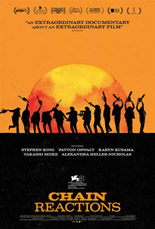
Turns out, the experience of losing my TCM virginity is hardly unique, bearing similarities to the guests discussing theirs in Alexandre O. Philippe’s Chain Reactions. As renegade filmmaker Takashi Miike recalls, “For the first time, I felt that movies could be something dangerous.” (Check.) Comedian Patton Oswalt remembers encountering stills in an issue of Fangoria: “These looked like crime scene photographs that had been stolen and then Xeroxed.” (Check.)

Told in five “chapters,” Chain Reactions is that type of documentary, asking you to commit to creatives waxing nostalgic for 15 minutes or so apiece. I gave myself over willingly and pleasurably.
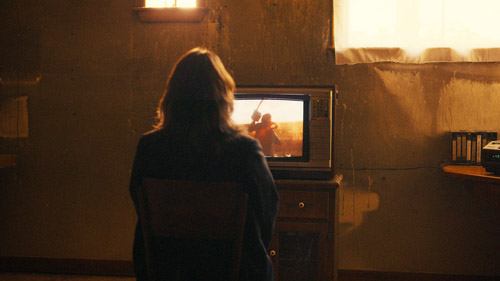
Leave it to Oswalt to liken Hooper’s grimy, gutsy film to Terrence Malick, Stan Brakhage and Gone with the Wind, of all things. Later, Stephen King, in what plays like pages from his nonfiction classic Danse Macabre come to life, says Texas feels like a Cormac McCarthy novel. Film critic Alexandra Heller-Nicholas remarks that Leatherface “moves like Buster Keaton,” while director Karyn Kusama (XX) proclaims, “It has poetry, beauty.”

They’re all correct, and Philippe keeps up with them, slicing in not only glimpses from the scenes in question, but skillful, side-by-side juxtaposition to influences both concrete and fanciful. Past Philippe documentaries on terror benchmarks include Memory: The Origins of Alien and the wonderful 78/52: Hitchcock’s Shower Scene, yet Chain Reactions is my favorite of his works so far — and I don’t adore TCM like I do the source material of those studies.

Perhaps it helps not to have a space in your heart carved for the work of art; the distance and difference of perspective just might cause you to view it in a new light — human mask of skin blessedly optional. —Rod Lott
Get it at Amazon.

Charlie Victor Romeo (2013)

Since its release, Charlie Victor Romeo is a film I’ve always wanted to see and never wanted to see. “Always” because it employs a unique creative concept in documenting reality; “never” because that reality is aviation disasters.

For the sake of my blood pressure and anxiety, I was wise to postpone viewing until I’d safely returned home from a transatlantic flight. Sully, this is not. 

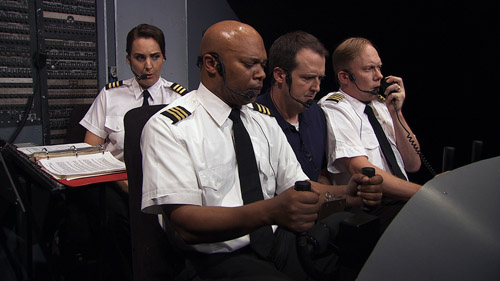
Charlie Victor Romeo presents six reenactments of then-recent airplane crashes, word for word from transcripts from the cockpit voice recorder, or CVR. (The film’s title translates that acronym via the industry’s phonetic alphabet — one that still annoys me today when I ask my dad, a retired navigator, to spell something.)

The movie is deceptively simple, as actors from the NYC-based Collective:Unconscious portray these black-box recordings in a black-box theater environment. Vignettes run as long as a teasingly stressful half-hour to an alarmingly abrupt one minute.

From severe turbulence and faulty parts to mechanic error and birds birds birds, the cause of each situation varies. At first, it’s reassuring to see the intricate, data-based methods the pilots follow. Then, when danger arrives, witnessing the differences in reactions is terrifying. (Certainly Nathan Fielder had to have seen this before embarking on HBO’s second season of The Rehearsal.)

No narrators, no talking heads and, other than a slide totaling the casualties, no explanations. Charlie Victor Romeo is both forensically sober and fucking intense. Prepare for takeoff all you want, but you’ll never be the same afterward. —Rod Lott

Get it at Amazon.

Pay Dirt: The Story of Supercross (2024)

Caveat emptor time, kids. The sports documentary Pay Dirt: The Story of Supercross should be subtitled Some Stories of Supercross in No Particular Order. After priming the pump with an adrenaline-edited prologue of defied gravity and severed spinal cords, Paul Taublieb’s feature goes into scattered mode, leaping from subject to subject like a dog who’s just had a dozen squeak toys thrown its way.

Want to know how the dirtbike arena competition started? Well, first, we watch a profile of Jimmy Button, a champion who bounced back from paralysis — inspiring, but wholly out of place; given its emotional weight, it arguably would work best at the other end. The whole movie is like that. With each title card rebooting the narrative starting line, the experience is like watching the full contents of a YouTube channel’s playlist.

In quick succession, Pay Dirt’s segments (really documentary shorts) surface-level examine a rivalry among two riders, the amateur kids’ competition at the Loretta Lynn Dude Ranch, another rivalry among two other riders, the dirt on the track, the sport’s version of stage parents, riders without factory sponsors and, buttering its own bread on both sides, Monster Energy’s current sponsorship of Supercross.

As an occasional casual viewer of the X Games and any Olympic event that irks old people, I’m open to this sort of thing. But an ESPN 30 for 30, this is not.

And not for lack of opportunity, as Pay Dirt absolutely chokes when it comes to the single most interesting story: Supercross creator Mike Goodwin being convicted for murdering former business partner Mickey Thompson and the man’s wife. From a prison phone, Goodwin recalls that he “was flabbergasted” and hoped he wouldn’t be blamed. What he doesn’t provide is a reason to believe him. In fact, Taublieb is so unconcerned with the crime, he gives it a minute.

I mean that literally: one minute. To a double homicide. Committed by the guy who started the sport you’re telling the “story” of. Adding insult to fatal injury, the narrator even botches the dead woman’s name as “Judy” instead of “Trudy.”

That narrator? Just one Josh Brolin, whose participation in a project far beneath his Oscar-nominated talents suggests either a big favor or a bet make-good. —Rod Lott

Get it at Amazon.

Lost in the Shuffle (2024)

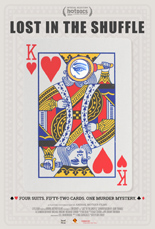
Now here’s a twist on the true crime genre: the solution to a 525-year-old murder mystery hidden in the art on a deck of cards. That’s what world-champ magician Shawn Farquhar believes, at least. In Lost in the Shuffle, documentarian Jon Ornoy follows Farquhar simultaneously investigating his theory and creating an elaborate card trick based on the crime. 

The cold case at hand (as it were) involves the suspicious death of France’s King Charles VIII, perhaps killed by his queen, Anne of Brittany. Farquhar’s quest takes him to Belgium, Britain and beyond, with the occasional and fully intentional tangent into magic theory. 

Ornoy and his globetrotting star almost magically transform deep-niche nerd shit into an engaging detective story, with wonderful animated segments subbing for reenactments. Although not as Da Vinci Code-y as initially set up, their symbol-conspiratorial Shuffle holds appeal to history geeks, homicide geeks, game geeks, travel geeks, sleight-of-hand geeks and even just process geeks.

To whichever group(s) among those you belong — and even if you find Farquhar’s ultimate assertion to be a mighty leap of assumption — you’ll probably fall into the movie’s net. —Rod Lott

Get it at Amazon.

¡Casa Bonita Mi Amor! (2024)

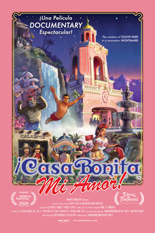
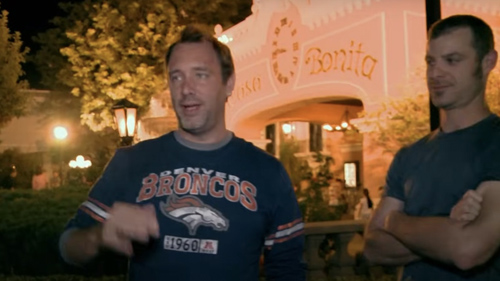
In the department of “Careful what you wish for, because you just might get it … provided you’re willing to part with $40 million,” we have ¡Casa Bonita Mi Amor! The documentary follows South Park creators Trey Parker and Matt Stone — but mostly Parker — as they save the Denver, Colorado-area restaurant from extinction following its COVID-hurled bankruptcy.

Rescuing Casa Bonita is the easy part; restoring it to the beloved kitsch eatery of their childhood memories is another. After all, Casa Bonita — actually started in Oklahoma City, which the doc ignores — was renowned not for its Mexican food, but its amusement park touches, from cliff divers and a built-in haunted cave to a gorilla on the loose. Parker and Stone seek to add their own ideas as well, like an animatronic bird that poops bad fortunes. Which is all fine and good, except the building of “beans and chorine” turns out to be a rotted money pit of disrepair and disaster — some potentially lethal.

Captured by How’s Your News? director Arthur Bradford, a frequent collaborator of Parker and Stone, ¡Casa Bonita Mi Amor! is largely a contractor’s remodelmentary; aside from the F-bombs, the piece could be mistaken for any renovation hour on HGTV. That’s not necessarily a knock, unless you’re expecting a story as wild and crazy as, say, Class Action Park. Given the famous backers at play here, you might.

But you might also be surprised how sad the doc becomes in its final minutes, as reality catches up to Parker. The turn may qualify as too-little-too-late, but anyone standing in their middle-age era will recognize the folly of chasing your past … the ennui of life passing you by … the acknowledgment of your impending doom …

Anyway, who’s ready for sopapillas? —Rod Lott

Get it at Amazon.