Category Archives: Intermission

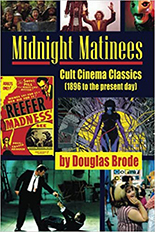
Midnight Matinees: Cult Cinema Classics (1896 to the Present Day)

I was looking forward to reading Douglas Brode’s Midnight Matinees: Cult Cinema Classics (1896 to the Present Day so much, I didn’t realize until after reading that its main title is — like “jumbo shrimp” and “military intelligence” — a true oxymoron. Intended or not, this catchy term operates in the spirit of many of the movies featured, from absurdist to rebellious. I welcome that attitude of levity.

What the world doesn’t need now — or tomorrow — is yet another introduction on what makes a cult film. At least Douglas Brode frames his intro with his personal experiences growing up, so we get it from a specific POV vs. a one-size-fits-all overview. That’s one of the three things I like about the book from BearManor Media, which published his 2015 appreciation of the movies’ femme fatale, Deadlier than the Male. Before we get to the other positives, let’s get the negatives out of the way. They number a few.

As mentioned in my review of Deadlier, Brode has a chronic spelling problem with names; for example, witness “Caesar” Romero, Frank “Miler,” “Cybil” Shepherd, “Rickie” Lake and, as noted in his entry on The Cabin in the Woods, that star Chris Hemsworth soon joined the Marvel Cinematic Universe as the superhero “Thorn.”

It’s especially disheartening to see the errors spread to the headers for some of the featured films’ reviews. For example, the piece on Requiem for a Dream botches the first word as “Requium.” Meanwhile, Tangerine becomes “Tangarine” and Teaserama becomes “Teasearama.”
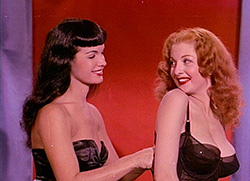
Maybe that’s why Brode chose to abbreviate titles after first mention? While not present in the two Brode books I’ve previously read, such a practice is perfectly understandable when those abbreviations are known and logical, like “ID4” or “T2” (neither of which are in Midnight Matinees, for the record). But, for example, has anyone ever referred to When Dinosaurs Ruled the Earth as “W.D.R.T.E.”? And abbreviating single-world titles is just lazy, such as “F.” for Fitzcarraldo. Not even people are immune! Just ask “S.T.” (Oh, Shirley Temple.)

More baffling to me is the way each film is rated, which is to say multiple, complicated and overly specific ratings on the five-star scale. No description would better convey what I mean than just showing you. Here are his ratings for The Doors:

Val Kilmer Fan Rating: *****
Jim Morrison Fan Rating: ****
Doors (The Band) Fan Rating: ** 1/2
Oliver Stone directorial Rating: *

And for Hard Candy:

Ellen (now Elliot) Page Afficionado Rating: *****
General Cult Rating: *

In either case, I’m unsure what purpose the ratings serve. Since they’re rarely directly explained in the reviews, I started ignoring them. Or maybe I just became more distracted by several of Brode’s picks: a lot of Oscar bait. Marriage Story is a cult film? Little Miss Sunshine? Hugo? Roma? Crash? (Haggis, not Cronenberg.) Really?
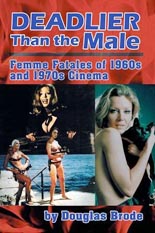
deadlierthanEnough complaining. Now for the rest of Midnight Matinees’ positives. As I already knew from Deadlier than the Male (as well as Brode’s Fantastic Planets, Forbidden Zones, and Lost Continents: The 100 Greatest Science-Fiction Films, not from BearManor), Brode is fun to read. Although he’s taught film at the collegiate level, his writing doesn’t reflect hallowed halls — meaning it’s neither pompous nor stodgy; in fact, it may not curry favor in the academic world, especially when it’s as zero-fucks-given as his recounting of Andy Warhol’s Bad: “Hideous looking females slowly stab adorable dogs to death and toss innocent babies from rooftops.”

Speaking of Warhol, the artist’s eight-hour shot of the Empire State Building, Empire, is among the 500-plus titles chosen for inclusion. Yes, so are the usual suspects — basically almost everything on the cover — but he also tosses in the unexpected, such as the 1945 musical Ziegfeld Follies, the Spanish snuff thriller Tesis and the 1901 short What Happened on 23rd Street, New York. Those types of picks are the discoveries one hopes to get from such books. He also throws a couple of curveballs in the form of the critically reviled box-office bombs The Dark Tower and Welcome to Marwen. He may be before the curve there, but at least he’s taking a risk. —Rod Lott

Get it at Amazon or BearManor Media.
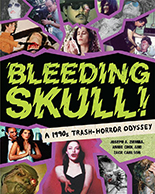
Bleeding Skull! A 1990s Trash-Horror Odyssey

While the rest of the country meme-watches its way through the Friends reunion special, the true ’90s nostalgia awaits in the Fantagraphics-published Bleeding Skull! A 1990s Trash-Horror Odyssey.

The long-awaited, much-anticipated sequel to Joseph A. Ziemba and Dan Budnik’s Bleeding Skull! A 1980s Trash-Horror Odyssey, unleashed to molten minds by Headpress in 2013, this sophomore (and proudly sophomoric) follow-up gives ink to the absolute oddest of no-budget obscurities video stores had to offer, most shot on VHS camcorders. With jackers, crystal forces, death metal zombies, psycho sisters, killer clowns, killer nerds and mad scientists named Dr. Kill, the contents are every bit worth the brand’s fractured exclamation point.

This time, Budnik is nowhere to be found, replaced by Annie Choi and Zack Carlson, whose styles meld better with Ziemba’s. (Please note that’s not a slam on Budnik, whose 2017 book, ’80s Action Movies on the Cheap: 284 Low Budget, High Impact Pictures, is a howlingly funny must-have for every B-movie enthusiast’s library.) The trio’s tag-teamed intro states these virtually unseen movies are deserving of cheers, not sneers … even if the 250 reviews don’t quite carry out this credo, as many flicks are most decidedly mocked — with exuberant affection, but mocked nonetheless.

After all, it’s not until the 10th entry (Asylum of Terror) that readers will arrive at anything resembling a “good” review, albeit one in which Ziemba writes, “no one appearing on-screen seems to understand that they’re being filmed.”

Of course, Bleeding Skull! wouldn’t be the tremendously fun read it is without the writers’ often brutal — and brutally hilarious — observations:
Bad Karma: “The design is one part Etsy, three parts Dollar General.”
Bloodscent: “The music is the finest junior varsity jock rock that western Pennsylvania has to offer.”
Blood Slaves: “Looks like it was cast at a baseball card shop.”
The Laughing Dead: “If a pair of slit wrists got together to make a movie, it would be this one.”
Psycho Pike: “If you like to watch people drive around in a Jeep Wrangler, Psycho Pike is your movie.”
The Witching: “The Witching is a saxophone kicking in for 64 minutes straight.”

More or less escaping ire are the DIY directors whose filmographies number beyond “1.” For example, the authors’ collective championing of the Polonia brothers (one of whom provides the foreword) nears idolatry. Fervent enthusiasm also falls to the Jesus-influenced gore of Todd Sheets, the “monstah” movies of David “The Rock” Nelson and the infidelity-themed slashers of Tim Ritter. Not so much for Todd Cook, whose prolificness is overshadowed by his stream-of-semiconsciousness works’ puerility. No matter where the opinions fall, however, the book is never not informative or entertaining; never before has so much thought been placed on explaining why choking is the laziest of murder methods.

No rave for this book is complete without praise for who may be considered its fourth author: designer Keeli McCarthy. With an aesthetic heavy on Magic Markers, highlighters and the purposeful cut-and-paste sloppiness of zines, her design is more aligned with Carlson’s seminal (and sadly out-of-print) Destroy All Movies!!! The Complete Guide to Punks on Film than Bleeding Skull!’s aforementioned ’80s edition. Either way, it’s now in glorious, garish full color. —Rod Lott

Like shot-on-video movies themselves, taking in A 1990s Trash-Horror Odyssey all at once could be overkill — or simply unfortunate, since we’re eight years away from A 2000s Trash-Horror Odyssey if the current between-books gap between holds. If Camp Blood of all things can get 10 installments, I hold out hope Bleeding Skull! at least merits a third. —Rod Lott

Get it at Amazon.

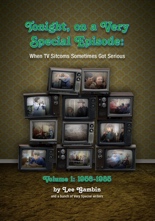
Tonight, on a Very Special Episode: When TV Sitcoms Sometimes Got Serious — Volume 1: 1957-1985

If you can’t look at a bottle of vanilla extract without thinking of Tom Hanks, I get it. Same. And have I got a book for you!

Every book bearing Lee Gambin’s name on the cover is worth purchasing, but Tonight, on a Very Special Episode: When TV Sitcoms Sometimes Got Serious — Volume 1: 1957-1985 is the only one whose mere introduction gave me goose bumps. Those initial pages aim to define what constitutes a “Very Special Episode” (hereafter abbreviated as “VSE”), but also weave a big, warm blanket of nostalgia for members of a certain generation or two: those weaned on afternoon reruns of sitcoms older than we were, and whose evenings were determined — if not outright dictated — by the grids in that week’s TV Guide.

As Gambin (We Can Be Who We Are: Movie Musicals from the 1970s) explains, the VSE represented a break from the show’s norm to present something different, whether a backdoor pilot, a series finale or a character’s life milestone, from the birth of the baby to a wedding or funeral. But more often than not, the VSE saw a seismic shift in tonality, however temporary, to tackle a Big Social Issue; the laugh track was given seven days’ rest so the creative powers could address not-funny situations of real life, like getting cancer, hating minorities, contracting the herp — you know, that sort of thing.

Nowadays, an entire network series can be built upon such a single hot-button issue (yes, you, Law & Order: Special Victims Unit), but in more sheltered times, devoting a half-hour to STDs or ICBMs was considered a risky movie best left for parents, schools and churches to handle quietly … if handled at all, which may account for why the boob tube — increasingly the nation’s babysitter — stopped every now and again to take up the cause, to face reality with bravery, to stand up for what’s right, to fight the good fight, to give Barney Miller a werewolf.

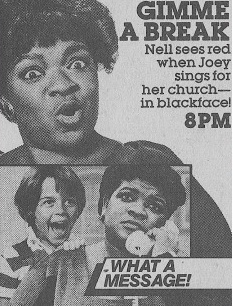
Gambin’s overview ticks through some of the greatest hits, conjuring memories of treasured shows and particular VSEs I must have seen four or more times growing up. I remember learning about child molestation from Diff’rent Strokes, cerebral palsy from The Facts of Life, blackface from Gimme a Break!, speed (and the alcoholic properties of the aforementioned vanilla extract) from Family Ties and media manipulation from The Brady Bunch. (That Jesse James was one bad hombre. Who knew? Mike and Carol, of course.)

All those and more are here — many, many more: 124, if I counted correctly. Each episode in Tonight, on a Very Special Episode merits a stand-alone essay from Gambin or one of his contributors. (Bittersweetly, one is the recently departed and much-loved Mike McPadden, author of Teen Movie Hell, who takes the good and takes the bad of a couple Facts of Life episodes.)

The contents — which, honestly, could really use a detailed table of just that — include an expected surfeit of Norman Lear creations, namely All in the Family and Maude, both giants in the VSE field. As enlightening as the pieces on those VSEs are, I found the best to be about half-hours I somehow missed or forgot.

Four of these essays stand out as tops in terms of being informative, critical and passionate, all while detailing and deconstructing scenes that make one think, “This actually aired?!?“:
• the Beav palling around with a booze-soaked hobo (Leave It to Beaver);
• Tabitha and a Black playmate switching races, much to the chagrin of Darren’s racist client (Bewitched);
• Fred and the boys unknowingly auditioning for a porno movie (Sanford and Son);
• and Monroe being repeatedly raped by two obese women (Too Close for Comfort).

The Bewitched one won awards; Comfort, yanked from syndication.

From examinations of M*A*S*H to transmissions on WKRP, Gambin and friends pour their hearts into their work, because these shows mean as much to them as they mean to you. If Tonight, on a Very Special Episode leaves you wishing it didn’t end in 1985, great news: BearManor Media has simultaneously published Volume 2: 1986-1998, so The Golden Girls can co-exist beside your Good Times. Ain’t we lucky we got ’em? —Rod Lott

Get it at Amazon or BearManor Media.
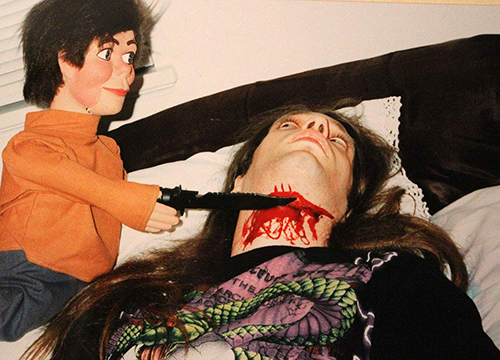
Roger Corman’s New World Pictures (1970-1983): An Oral History

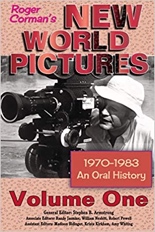
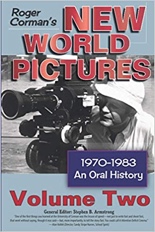
Stephen B. Armstrong’s two volumes of Roger Corman’s New World Pictures (1970-1983): An Oral History are likely not what you think them to be, thanks to the “oral history” label. Today, we associate that term with a chronological narrative weaved together from quotes from varying sources, as one finds in untold numbers of internet articles and pop-culture books (e.g., I Want My MTV or Live From New York: The Complete, Uncensored History of Saturday Night Live).

What you get from Volume One and Volume Two, however, isn’t a story, but a collection of Q&A interviews (published by BearManor Media) separated by the interviewee and not presented in any order — other than starting with Roger, of course.

With that carp out of the way, know this: There are some great stories for the reader to discover within these interviews (and it’s kind of amazing how many made their way to Corman via Martin Scorsese). Jonathan Kaplan recalls getting one day’s notice to direct his first film, Night Call Nurses. Lewis Teague talks about his assignment to figure out how to get some sex and action scenes cut into Monte Hellman’s Cockfighter. John Sayles reveals eye-rolling details from the Piranha script he rewrote, such as the killer fish seeking menstruating swimmers.

No one is more self-congratulatory than actor Martin Kove, while no one is more entertaining than actress Grace Zabriskie. It’s less about her #MeToo remembrance of Galaxy of Terror co-star Ray Walston and more about her blunt frustration and annoyance with the interviewer’s inquiries (“Dear God in heaven, I just can’t get interested in that question”), not to mention bafflement over why anyone wants to talk about Galaxy of Terror.

Others submitting to the hot seat include Sid Haig, Dick Miller (but just barely), Joe Dante, Allan Arkush, Mary Woronov, Robert Englund, Jack Hill and many more, several of whom are behind-the-camera personnel with names you won’t recognize. That’s not a bad thing, other than not always being properly introduced to the reader; in fact, I’d argue the single most informative conversation is with Corman attorney Barbara Doyle, who details her process for acquiring acclaimed foreign films for U.S. distribution, which gave Corman serious credibility to offset his miserly reputation.

On that note, a throughline emerges, with many acknowledging the low-as-possible budgets while also praising the flip side to that: real-world training and creative freedom. Not for nothing was the man awarded an honorary Oscar in 2009 … although it sure wasn’t for Galaxy of Terror. Armstrong makes sure to celebrate both, as one should! —Rod Lott

Get it at Amazon or BearManor Media.
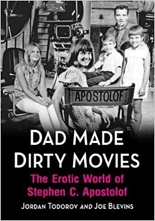
Dad Made Dirty Movies: The Erotic World of Stephen C. Apostolof

Jordan Todorov’s 2011 documentary, Dad Made Dirty Movies, is a wonderful introduction to one of cult film’s best-kept secrets. But Todorov’s new book on the topic, Dad Made Dirty Movies: The Erotic World of Stephen C. Apostolof, is even better. Although the ideal is to consume both media, 58 minutes face a sheer disadvantage against 336 pages.

Written with Joe Blevins and published by McFarland & Company, the book serves as not just a full biography of Apostolof, but the definitive source of information on this unheralded sexploitation pioneer. Even in death, Apostolof continues to live in Ed Wood’s shadow, thanks to their partnership on a handful of films — most notably, 1965’s immortal Orgy of the Dead. Todorov’s work goes a long way in restoring the proper amount of luster to Apostolof’s contributions.

Tracing his transformation from Bulgarian by blood to vulgarian by trade, the book functions best once Apostolof starts making softcore skinflicks. However, don’t dare skip the initial few chapters, because he led quite a life before becoming an off-color/off-Hollywood director, from working for tips as a whorehouse piano player to being sentenced to a concentration camp — all before fleeing his homeland for a fresh start in America.

With Orgy of the Dead marking his directorial debut, the riotous stories from behind the camera are, naturally, like something out of Ed Wood (a biopic that raised Apostolof’s ire, by the way, upon not being invited to take part and not being recognized himself). The contrast of the two men is fascinating, with Apostolof all business and the total pro, and Wood a full-blown alcohol constantly teetering — literally and metaphorically — toward a sad, self-made demise.

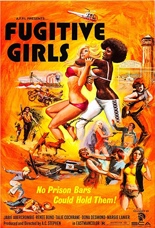
Sure, the thrice-married Apostolof had his failings, too, but they were largely about his inability to financially plan for the future, especially after the market for his breasty brand of bread-and-butter dried up with the proliferation of hardcore pornography. Today, more eccentric cineastes continue to discover and celebrate the relative joys of Fugitive Girls and College Girls Confidential, but in Apostolof’s time, the life for these films was fleeting — petering out shortly after viewers’ collective refractory period.

Despite carrying over the documentary’s title, the book is not framed from the Apostolof children’s point of view, although they certainly provide memories, clear up misinformation and dispel rumors. I found myself envious of son Steve, entering puberty as he visits the set of Dad’s Lady Godiva Rides, a vehicle for the buxom blonde Marsha Jordan.

Film by film, milestone after milestone, Todorov and Blevins tell their subject’s story with reserved reverence — unclouded by rose-colored fanboy glasses — and a fair amount of good humor. Some of the funny bits sneak up on the reader: “[Drop-Out] composer Jaime Mendoza-Nava provided another part-Latin, part-Muzak score. This time, he was billed as J. Mendozoff, a pseudonym that sounds like an over-the-counter sleep aid.” Other instances are more expected, but no less effective: “There are several unproduced Wood screenplays from this era whose titles tell you all you need to know about their contents: The Teachers, The Basketballers, The Airline Hostesses. You don’t need to read them to guess that they respectively concern teachers, basketballs and airline hostesses screwing their brains out.”

With more than 100 photos throughout, Dad Made Dirty Movies closes with a novel appendix offering a peek behind the curtain: two outlines for Apostolof’s never-realized The Immoral Artist, all of four combined pages. You don’t need to read it to guess that it concerns an artist who wants to screw his brains out. —Rod Lott

Get it at Amazon.