Category Archives: Intermission

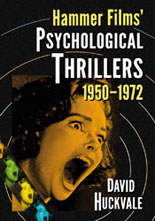
Hammer Films’ Psychological Thrillers, 1950-1972

hammerthrillersWith Hammer Films’ Psychological Thrillers, 1950-1972, you know David Huckvale has done his job when I fill up my Amazon Wish List with titles I don’t yet own and move those that I do and haven’t seen — several found on The Icons of Suspense Collection — to the top of my DVD viewing pile.

When people think of Hammer, they think “horror”; some misinformed fans don’t even realize the legendary UK studio made anything but fright films. Thrillers, it did even better — at least that’s my purely subjective view, but Huckvale would seem to agree, calling them “more than catchpenny essays in suspense.”

His book examines all 17 of them — the psych-focused ones, anyway, and then only those falling between the golden years of 1950 and 1972. (Sorry, Hilary Swank and The Resident!) But first, he lays the groundwork by discussing the classics that informed Hammer’s approach to the genre: Henri-Georges Clouzot’s Diabolique and four from Alfred Hitchcock. That said, when it comes to one of the former’s famous twists, Huckvale contends that “Hammer got there first,” with 1950’s The Man in Black.

Barely a chapter goes by — one, literally — without mentioning cribs from Hitchcock, whether birds and baths, mirrors or mothers. Huckvale reserves perhaps his highest praise for what arguably looks the most overtly Hitchcockian of them all: 1963’s Maniac.

From start to finish, the author delivers smart, insightful readings, comparing the films to one another, analyzing them in relation from Shakespeare to Sigmund Freud, yet remains standing on the opposite side of dullsville. There is more merit and credibility on any given page than in the whole of Randy Rasmussen’s Psycho, the Birds and Halloween: The Intimacy of Terror in Three Classic Films, a fellow new release from McFarland & Company.

Huckvale may veer often, but he always has a point, and he is as comfortable teasing the prospect of Cary Grant playing the Phantom of the Opera as he is at referencing Kierkegaard. —Rod Lott
Buy it at Amazon.

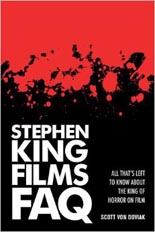
Stephen King Films FAQ: All That’s Left To Know About the King of Horror on Film

skingfaqBeing born in 1971, I’m just the right age to have experienced the dawn of Stephen King. My middle-school love for his books extended to the movies based on those books, and I have fond memories of so many of them, including:
• renting George A. Romero’s Creepshow over and over (on big-box VHS!) from Sound Warehouse,
• lining up at the Northpark Cinema 4 for the opening weekend of the anthology Cat’s Eye
• and catching Brian De Palma’s Carrie one weeknight on some local UHF channel, only to be jolted into fright by that last scene — one of the rare times a film genuinely has scared me.

All these memories and more came flooding back while reading Stephen King Films FAQ. It’s the first in Applause Theatre & Cinema Books’ ever-growing FAQ series for author Scott Von Doviak, but not his first for the publisher; he wrote the best-so-far entry in its other pop-culture series, If You Like, so my high hopes here were not dashed.

Let’s get my one problem with the book right out of the way, because it resides at the beginning: The first 40 pages offer a brief history of the horror-movie genre at large. If this were Horror Films FAQ, that would be fine, but it’s not and that book already exists, so here, it just seems like stalling, like those advertisements that run in theaters before the real fun begins.

And the rest is real fun for fans. Von Doviak covers the wide territory chronologically (saving sequels and spin-offs for later chapters of their own), weaving a well-researched narrative that’s informative, thorough and not lacking in his own opinions. As shown in his two prior film books, especially 2004’s Hick Flicks: The Rise and Fall of Redneck Cinema, the author exhibits a boisterous sense of humor, and I don’t think I laughed louder than his summation of the made-for-TV miniseries It: “The cast could have been confused with that of a 1990 Hollywood Squares episode. … How seriously can we take an ensemble comprised of Jack Tripper, Venus Flytrap, the wacky judge from Night Court, and John-Boy Walton in a dorky ponytail?”

I love that Von Doviak isn’t blindly fawning over King, as I can see lesser writers doing; he loves what he loves, hates what he hates, and isn’t afraid to share those thoughts, no matter to what degree they are shared by the collective audience. (While we’re on the subject of objectivity and bias, I should note that one of my pieces of film journalism — an interview with Children of the Corn director Fritz Kiersch — is quoted on page 88, of which I had no prior knowledge and alters my opinion of this book not one iota.)

One of the greatest chapters finds Von Doviak hosting an all-night Corn marathon, painful sequel by painful sequel, and the book deviates from the King features to include looks at the “Dollar Baby” shorts, adaptations that never made it out of development hell, the Marvel comic books and the occasional Broadway fiasco. The paperback comes packed with photos and poster art, although not as fully as Stephen Graham Jones’ enjoyable Creepshows: The Illustrated Stephen King Movie Guide, a 2002 release in serious need of an update it’s unlikely to get, so consider this FAQ that. —Rod Lott

Buy it at Amazon.

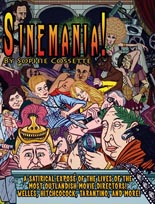
Sinemania!: A Satirical Exposé of the Lives of the Most Outlandish Movie Directors: Welles, Hitchcock, Tarantino, and More!

sinemaniaA few images from Canadian cartoonist Sophie Cossette’s delightfully naughty Sinemania!: A Satirical Exposé of the Lives of the Most Outlandish Movie Directors threaten to stick with me for a while:
• Quentin Tarantino’s monstrous Franken-forehead;
• Bela Lugosi tweaking, jutted tongue and all;
• Erich von Stroheim as a spider, writing “I’m fucked,”
• and Rainer Werner Fassbinder’s furry testicles.

Yes, furry.

See, in her comic-book collection of biographical sketches of Hollywood directors, she takes on everyone and spares no one. Unless you’re one of her subjects, that’s a good thing.

sinemania1A talented satirist but a more talented illustrator, Cossette spends a few pages to send up each target, including such auteurs as Roman Polanski, Sam Peckinpah, Woody Allen, Pier Paolo Pasolini and Werner Herzog. Fritz Lang’s sexual peccadilloes result in him being portrayed as a vampire (“And I can only reach orgasm with the taste of blood in my mouth!”), while the career of Tim Burton is encapsulated into a board game (“You feel the alienation of suburbia so go hang yourself!”).

Only in her imaginary tête-à-tit with Russ Meyer does Cossette go too far, calling the dead man an “Alzheimer’s retard.” It’s a low blow made lower because most of her lines read far wittier. I laughed a great deal through Sinemania! and, when I didn’t, thoroughly enjoyed the experience with a smile. The lone exception is “Love at First Bark,” an extended piece that pits Marlene Dietrich against Madonna, to no earned payoff.

But the rest? I’m crying out for sequels, plural. In structure, ECW Press’ trade paperback reminded me of DC Comics’ late, lamented The Big Book of series the company released through its Paradox Press imprint, but in execution, it should be viewed as a hard-R issue of Mad magazine or a cartoon version of Kenneth Anger’s underground classic Hollywood Babylon. Either way, the cynical film buff in you wins. —Rod Lott

Buy it at Amazon.

The $11 Billion Year: From Sundance to the Oscars, an Inside Look at the Changing Hollywood System

11billionyearIn her first book, The $11 Billion Year, intrepid film journalist Anne Thompson takes the reader through the annual life cycle that awaits Hollywood studios’ products and scrappy indies: a circus of festivals and awards in which a movie’s success is far from a sure thing. No matter a film’s fate, its story is never dull, and the book serves as a time capsule of those projects vying for supremacy — critically and culturally, but above all else, financially — in 2012.

In its structure, her book reminded me of Peter Bart’s The Gross of 2000, which chronicled the hits and flops in the summer slate of 1998 with a juice-packed insider’s view. The difference is Thompson’s scope is IMAX-sized compared to Bart’s.

It’s also more than just a tale constricted to a finite timeline. The author utilizes the gaps of months between such chapters on Sundance and SXSW to insert essays on other factors driving the way Tinseltown works today. Thus, we get essays that delve into the game-changing rise of digital streaming, the kowtowing to rabid fanboys at Comic-Con, and the ever-increasing importance of the almighty franchise, focusing on what went right with The Hunger Games and what went wrong with Disney’s $200 million write-off known as John Carter.

She also uses the release and subsequent controversy of Kathryn Bigelow’s Zero Dark Thirty to examine the extra challenges awaiting women directors who dare play the Hollywood game, where the clubhouse door still all but sports a “boys only” sign.

Regardless of the film being discussed — from Silver Linings Playbook to Safety Not Guaranteed — Thompson’s account of each reads like a mini making-of article, taking the reader from conception to, ultimately, fortune or failure. You can appreciate The $11 Billion Year by individual pieces or as a whole — either way, its 320 pages prove deliciously addicting.

My only quibble with it is that appears to have gone through a rushed editorial process. I can forgive the rare occasional misspelling of a name (whether Nicolas Cage or Paul Feig can, I do not know), but other errors are far more egregious, from referring to the animated Mars Needs Moms as Mars Loves Moms, to this statement: “Films that have nabbed both Best Actress and Foreign Language nominations belong to an elite club indeed: Life Is Beautiful, Z, and Crouching Tiger, Hidden Dragon.” Not a single one of those pics earned a Best Actress nomination. —Rod Lott

Buy it at Amazon.

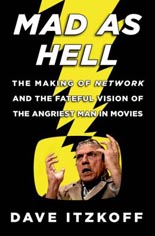
Mad as Hell: The Making of Network and the Fateful Vision of the Angriest Man in Movies

madashellYes, the subtitle of Dave Itzkoff’s Mad as Hell promises a behind-the-scenes chronicle of Sidney Lumet’s Network. Yes, the reader gets that, but the author delves deeper than that, to the point of telling not just the making of the 1976 film, but its conception, release, impact, blowback, legacy and continuing influence.

Part of that is because the book is as much as story about Network‘s celebrated screenwriter, Paddy Chayefsky, as it is about the Oscar-winning movie. A magnificent writer of television, stage and screen, Chayefsky was also an incredible control freak who ironically had no control over his family life; he clearly cared more about the written word than his flesh and blood.

Always waiting for the other shoe to drop, Chayefsky could not ever truly enjoy his incredible success — Network would bring him his third Academy Award for screenwriting — and harboring a near-extreme paranoia couldn’t help matters; he believed a second Holocaust was imminent. Nevertheless, he was able to function to do his job, starting with his much-abhorred boob tube. But it was film we forever will associate him with, especially the one with which Itzkoff’s book is concerned.

Network, we know now, was prescient — and continues to be more so as the years tick by — and even in scenes that never made it past the page, which Itzkoff details. One such case I found astounding is when the UBS execs dream up programming that is supposed to be considered wild: a show adapted from The Exorcist and a soap about homosexuals. We already have the latter; the former is being developed.

That’s one of many juicy bits the Mad as Hell reader will learn, thanks to Itzkoff’s judicious digging. Others include the revelation that Peter Finch could not complete two takes of “the” speech, that Lumet considered firing Faye Dunaway well after filming had begun, the pronunciation error that the to-the-letter Chayefsky failed to catch, and how Ned Beatty lied his way into a role. (I’d include how Dunaway did her damnedest to alienate most everyone, but everyone already knows that.)

If you haven’t seen Network — first off, shame on you — do not read this book until you do. Those who have may not want Mad as Hell to end, particularly knowing the fate of a reinvigorated Finch before the film could be fêted as that year’s Oscars. Only in a coda examining how Finch’s Howard Beale character has given rise to the likes of Glenn Beck does Itzkoff — turning from storyteller to social critic — produce a paragraph that’s not intensely readable. —Rod Lott

Buy it at Amazon.