
All posts by Louis Fowler

Chariots of the Gods (1970)

Based on the famed book by Erich von Däniken, the documentary Chariots of the Gods was always from the school of thought that if a white man couldn’t do it, then it had to be aliens.

Throughout, we’re given otherworldly examples of astounding architecture in Egypt, stone wonders in Mexico and so on throughout the non-white world, learning that it was impossible for these ancient cultures — that, quite honestly, we still have barely an idea about — to build them in their wholly primitive and desperately unknowing ways.

The simple solution? Aliens, of course!

Hey, it was the ’70s, as the world was deep into the Mondo Cane-structure of many popular documentaries. Chariots of the Gods was probably on the low end of this somewhat fantastical spectrum, utilizing more of a science class film strip approach to telling its tall tales of universal visitations and, apparently, community rebranding.

The usual suspects are all here, including the famous Easter Island statues and the not-as-famous Nazca Lines, which, we learn, were used to guide incoming spacecraft to the burgeoning brown civilizations. While these ideas, though mildly racist these days, can still be fascinating to hear, they’re also extremely quite dated and filled with mostly made-up facts, like said science class film strip.

Chariots of the Gods takes us back to a time when we so desperately wanted to believe in extraterrestrials that helped to shape the then-Earth, except that it’s viewed through a whites-only telescope that really doesn’t — and really shouldn’t — hold up today. —Louis Fowler

Get it at Amazon.

Camino (2015)

The Spanish word camino translates to “road” in English, which is a very apt title for this primo action flick, as it travels down many bloody South American streets, all of them barely lit by a flickering streetlight as stuntwoman extraordinaire Zoë Bell tries to make it out of a green inferno with her life.

Bell is prizewinning photojournalist Taggert, who is sent on assignment to follow a group of heavily armed missionaries through the dense jungle. At first glance, the team seems as nice as a group of guerillas possibly can be, with leader Guillermo (Oscar-nominated director Nacho Vigalondo) providing much of the group’s capable bluster as their likably annoying leader.

However, in a drug deal that is witnessed by Taggert — and photographed, no less — Guillermo slits the fucking neck of a small child for fun. Spotted, she goes on the run as the charismatic leader and his soldiers are after her, wherein she unleashes her masterfully choreographed martial arts capability on much of the offending party.

With Camino mixing important social critiques with blistering ass-kicking potential — the best way to get any kid to learn, if you ask me — Bell is at the top of her B-movie game, with a surprising turn from Vigalondo, helmer of films like Timecrimes and Colossal, portraying a truly despicable general who, at times, is kind of likable.

Camino is a road I’d definitely like to travel again, even if it means pulling over to get kicked a couple of times. —Louis Fowler

Get it at Amazon.

Dead & Buried (1981)

Over the years, I have had so many opportunities to view Dead & Buried. Sadly, something I thought would view even better took precedence and, typically, wasn’t even that good. But now, after viewing it, I feel like a jerk because Dead & Buried is good. Really good.

In the coastal village of Potters Bluff, the seafaring community has a weird way of welcoming visitors: by burning them alive. While that would hurt most places — how did the tourism bureau cover this shit up? — more and more visitors visit and more and more are horribly manhandled, mangled and murdered by the fisherman and their lone blonde seductress.

It’s a crime that has local sheriff (James Farentino, The Final Countdown) increasingly puzzled, as his attractive wife (Melody Anderson, Flash Gordon) goes about her business, teaching witchcraft to her interested middle-schoolers. It seems almost no one cares about this death and destruction — and those who do, like the area’s kindly mortician (Jack Albertson, Willy Wonka & the Chocolate Factory), find themselves either strictly murdered or fraudulently useless.

Even weirder still, the bodies of the deceased are soon brought back to life and join the murderous rampage. What is going on here, guys?

Written by Alien’s Dan O’Bannon and Ronald Shusett (although O’Bannon later disowned it completely) and directed by Poltergeist III’s Gary A. Sherman, Dead & Buried is one of those blissful horror films from the early ’80s that manages to continually toy with the audience, switching between subtle mystery and graphic horror to — as the corpses are stripped to the bone and re-animated — ghoulish cinema.

With its shocker ending offering no rhyme or reason — just a black screen followed by credits — if I had seen this as a kid, I would still be gushing about it today. Instead, I’m gushing about it now. —Louis Fowler

Get it at Amazon.

Confessions from the David Galaxy Affair (1979)

In Confessions from the David Galaxy Affair, the third film to star sexy British siren Mary Millington — but just barely — we enter immediately into the ultimately sleazy conquests of decidedly non-sexy psychic David Galaxy (Alan Lake) as he hosts a beauty pageant filled with mostly topless women. Apparently, if you’re into sexually harassing women, late-1970s Britain was the place to be!

Part James Bond (the worst part) investigative police are hot on his tail, apparently for a 1930s robbery a few years back that really makes no sense. Still, Galaxy goes from the bare bosoms of women with low self-esteem to the creamy thighs of women with even lower self-esteem, for reasons that are unknown to me, extreme horniness aside.

One of the said buxom broads includes the famed Millington as a society debutante, complete with a Cockney accent. While there is very little backstory to her with exception of “she’s rich,” their highly horny encounter has a bar full of lecherous perverts listening via ham radio as she duly shags his brains out, not that he really had any.

Maybe I’m expecting far too much from late ’70s British softcore pornography — let’s call a spade a spade, right? — but Galaxy is such a smirking dullard that you actively cheer on the cops, hoping they bust him then take him to a back alley and beat his brains in with a truncheon, paying for his crimes against women with life in prison and a permanent limp.

And, I assume, for the dated robbery as well. —Louis Fowler

Get it at Amazon.

12 Monkeys (1995)

I’ve said it once and I’ll say it again: Terry Gilliam has always been a true visionary who has never received the full credit he truly deserves, and I’m not talking about Monty Python.

While he has done some truly great movies like Time Bandits, Brazil and The Fisher King, I feel that he reached his absolute mainstream height with 1995’s 12 Monkeys, a truly original take on time travel inspired by the absorbing French short film La Jetée, told mostly in photographs.

Bruce Willis stars as James Cole, a prisoner chosen for a dangerous experiment to travel from 2035 to 1996 to stop a deadly disease that was supposedly started by a group known as the 12 Monkeys. However, during his first attempt, he ends up in 1990 in a mental institution, with Jeffery Goines (Brad Pitt) as a bunkmate, giving him — who happens to be the leader of the 12 Monkeys, natch — the idea for starting the simian insurrection.

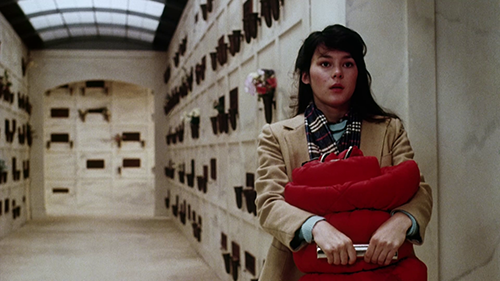
Mistake (somewhat) fixed, Cole is sent to 1996, for real, kidnapping one of his former doctors from the asylum, Kathryn Railly (Madeleine Stowe). He attempts to stop the 12 Monkeys — and the virus in general — but through a series of continually turning and twisting spheres, we soon learn that Cole can’t change the future, no matter how hard he tries. But he doesn’t know that.

Filmed with Gilliam’s masterful hand, 12 Monkeys presents a claustrophobic underground future, yet somehow makes the then-present feel even grimmer and grimier. That’s one of his specialties, with everything he’s ever done coming together, almost knowing that the end of the world — and the end of his career due to money-hungry studio heads — was coming. —Louis Fowler

Get it at Amazon.