All posts by Louis Fowler

The Cannibal Man (1972)

Despite having little to no connection with actual cannibalism, that didn’t stop unscrupulous investors from marketing The Cannibal Man as an absolute gut-muncher, because the original title of La Semana del Asesino (The Week of the Killer) didn’t have the exploitative innards they thought the film needed.

In truth — or retrospect — the film didn’t really need it, because Eloy de la Iglesia’s haunting story of a man who slowly feels the threads of sanity become more frayed with each passing day is a truly terrifying tale that should have given the Spanish director far more attention outside of cult film circles.

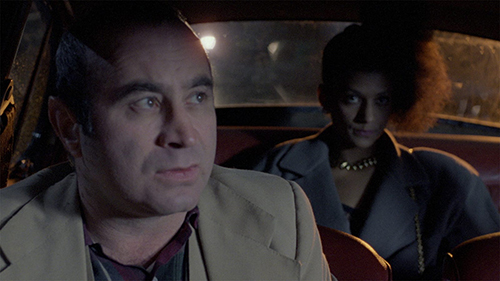
Spending his day working at a slaughterhouse, Marco (Vicente Parra) kills a taxicab driver one evening in self-defense, which inexplicably awakens something inside him that leads to him murdering everyone from his brother and girlfriend to others who might come around his den of squalor, situated outside a lavish apartment building.

Over the course of the week, as the house begins to smell of death and guilt — always a reactive combination — Marco takes the body parts to work, basically to turn them into liquid mush. I don’t think it gets turned into food and, to be fair, when the prospect of eating the human meat is presented to him, he becomes exceedingly nauseous. Maybe a better title would have been Almost a Cannibal, which sounds like a great romantic comedy.

Director de la Iglesia throws in numerous jabs at the then-oppressive Spanish government — most notably in dutifully homosexual swimming scenes, mildly erotic for the time. When viewed through those rebellious eyes, The Cannibal Man is indeed a film of absolute protest that, through a semi-graphic lens, makes it far more important than most give it credit for. —Louis Fowler

Get it at Amazon.

Oh, God! You Devil (1984)

Thanks to the Oh, God! films I grew up with, when I think of the Lord Almighty in his human form, for better or worse, it’s typically in the guise of late comedian George Burns. In the trilogy, he aided grocery store produce manager John Denver, rode in a motorcycle with the single-monikered Louanne and, in his grandest casting ever, battled a doppelgänger devil over Ted Wass’ eternal soul.

It’s the third one, Oh, God! You Devil, that casts Burns as his own worst enemy, Satan. But instead of a devil who wants to murder and maim the world over, he instead uses evil to commit rather irritating pranks, usually the kind where someone falls into a wedding cake or pushes a couple of people into a pool.

Going by the name of Harry O. Tophet — “Tophet” is the Hebrew word for “hell,” so kudos on that — he comes across the path of failed songwriter Bobby (Wass, not to be confused with Craig Wasson, a regular mistake of mine), who, as you can guess, wants to make it big. He makes a deal with Tophet for instant stardom.

Being a deal with the devil, things don’t go exactly as Bobby thought. He is inserted into the body of rock star Billy Wayne and, for a while, things are great: fame, fortune and all the threesomes he can handle. Until, of course, he runs into his wife, who has no idea who he is; this meeting has him wanting to back out.

Too bad! As expected, the Prince of Darkness is a total asshole. With about 20 minutes of the film left, Burns enters the film as the deity you’d expect, God. They wager a game of high-stakes cards over Bobby’s soul, with stakes that make me feel a little uneasy.

Having not seen this entry since the constant HBO airings circa 1985, I was surprised by how much I actually liked it, despite it seeming like the cheapest film in an already cheap series. Wass — not Wasson! — is a decent enough foil for these satanic shenanigans, but Burns is likable even as the devil, even if he’s really not that far off from his interpretation of God.

I wonder how the actual God liked these movies though. I don’t want to step on any supernatural toes, mostly for the fear of eternal damnation. —Louis Fowler

Get it at Amazon.

One Dark Night (1982)

One dark night, sometime in the early ’80s, I remember watching a film with HBO with my father, like I usually did almost every night when he got off work as a policeman. With its scenes of a downright creepy mausoleum, electric-eyed corpses and toothbrush-chewing schoolgirls in oblivious danger, this was seemingly a one-and-done airing, never to be viewed again, the title lost to the reanimated corpses of my mind.

It has haunted me forever, with searches at every video store I ever worked, coming up typically with only Mortuary, released the next year, but sadly, not the rotting videotape I was looking for. Recently, One Dark Night turned up in my mailbox, a movie I put on one afternoon for some background noise.

As it continued on behind me, a rush of putrid prepubescent memories came flooding back, as the puzzle of flesh and bones began to come together to form a horrid whole picture: One Dark Night was the movie I had visions of long in the back of my mind for almost 40 years; now I had it in my Blu-ray player, feasting on the insides for all eternity, or at least the next 90 minutes.

Starring a very cute Meg Tilly as good girl Julie, she’s looking to join a group of trashy girls, one of whom is played by E.G. Daily and another is constantly chewing on a toothbrush throughout the flick — it’s all coming together! They tell Tilly that for her initiation, she has to pull an all-nighter at the local mausoleum, which isn’t all that bad.

Well, normally it wouldn’t be all that bad, but earlier that day, renowned evil psychic Raymar — who was found dead in a room next to a pile of dead teenagers — was laid to temporary rest there. I say that because, as discovered by his daughter (and her hubby Adam West!), he was trying to harness his mental abilities through death and, good for him, it works.

For the teens, however, it’s not so great, as you can probably assume.

Directed by Tom McLoughlin (the highly entertaining Friday the 13th Part VI: Jason Lives), One Dark Night is an entertaining piece of ’80s trash that still works, especially with the corpse-filled finale managing to deliver a shrill scare up my spine all these years later, betraying its low-budget roots to give us a cold slab of ancient horror that absolutely lives up to the demonic memories it bred.

Now, that I know what flick it is and have seen it as an adult, I can finally lay One Dark Night to rest in the annals of my mind under six feet of broken images and numerous tries. —Louis Fowler

Get it at Amazon.

Chariots of the Gods (1970)

Based on the famed book by Erich von Däniken, the documentary Chariots of the Gods was always from the school of thought that if a white man couldn’t do it, then it had to be aliens.

Throughout, we’re given otherworldly examples of astounding architecture in Egypt, stone wonders in Mexico and so on throughout the non-white world, learning that it was impossible for these ancient cultures — that, quite honestly, we still have barely an idea about — to build them in their wholly primitive and desperately unknowing ways.

The simple solution? Aliens, of course!

Hey, it was the ’70s, as the world was deep into the Mondo Cane-structure of many popular documentaries. Chariots of the Gods was probably on the low end of this somewhat fantastical spectrum, utilizing more of a science class film strip approach to telling its tall tales of universal visitations and, apparently, community rebranding.

The usual suspects are all here, including the famous Easter Island statues and the not-as-famous Nazca Lines, which, we learn, were used to guide incoming spacecraft to the burgeoning brown civilizations. While these ideas, though mildly racist these days, can still be fascinating to hear, they’re also extremely quite dated and filled with mostly made-up facts, like said science class film strip.

Chariots of the Gods takes us back to a time when we so desperately wanted to believe in extraterrestrials that helped to shape the then-Earth, except that it’s viewed through a whites-only telescope that really doesn’t — and really shouldn’t — hold up today. —Louis Fowler

Get it at Amazon.

Camino (2015)

The Spanish word camino translates to “road” in English, which is a very apt title for this primo action flick, as it travels down many bloody South American streets, all of them barely lit by a flickering streetlight as stuntwoman extraordinaire Zoë Bell tries to make it out of a green inferno with her life.

Bell is prizewinning photojournalist Taggert, who is sent on assignment to follow a group of heavily armed missionaries through the dense jungle. At first glance, the team seems as nice as a group of guerillas possibly can be, with leader Guillermo (Oscar-nominated director Nacho Vigalondo) providing much of the group’s capable bluster as their likably annoying leader.

However, in a drug deal that is witnessed by Taggert — and photographed, no less — Guillermo slits the fucking neck of a small child for fun. Spotted, she goes on the run as the charismatic leader and his soldiers are after her, wherein she unleashes her masterfully choreographed martial arts capability on much of the offending party.

With Camino mixing important social critiques with blistering ass-kicking potential — the best way to get any kid to learn, if you ask me — Bell is at the top of her B-movie game, with a surprising turn from Vigalondo, helmer of films like Timecrimes and Colossal, portraying a truly despicable general who, at times, is kind of likable.

Camino is a road I’d definitely like to travel again, even if it means pulling over to get kicked a couple of times. —Louis Fowler

Get it at Amazon.