All posts by Rod Lott

The UFO Incident (1975)

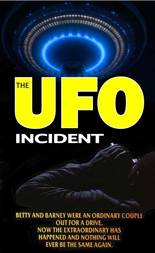
Based on a purported true story, The UFO Incident dramatizes the alien abduction of Barney and Betty Hill on Sept. 19, 1961, in New Hampshire — rural New Hampshire, of course.

After their close encounter of the made-for-TV kind, Barney (James Earl Jones, Exorcist II: The Heretic) and Betty (Estelle Parsons, Bonnie and Clyde) have amnesia, but also enough of a memory to not want to discuss it. Easier said than done since Betty experiences nightmares out the wazoo, while Barney sprouts warts on his groin.

Under hypnosis, however, they start to recall specific details of What Went Down on that silver saucer — no anal probe mentioned, but Betty shares taking a pregnancy test by way of a needle through the navel.
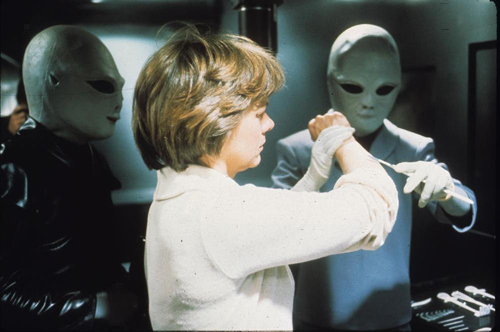
For the remainder of the telepic, director Richard A. Colla (Fuzz) cuts between Jones and Parsons’ separate sessions with the doctor (Barnard Hughes, The Lost Boys) and flashbacks to the night in question. While the visitors may look silly by today’s standards, youngsters watching live in ’75 were collectively traumatized. It’s hard to convey how much more powerful and terrifying a quick and partial glimpse could be when “pause” and “rewind” weren’t buttons on the remote control.

What’s most interesting are not these sequences aboard the ship, but the Hills’ recounting of such, thanks to Jones’ and Parsons’ skills as stage-trained actors. Jones in particular is able to go from sweat to full-on snot and tears on cue. Although I’m uncertain whether Betty is supposed to be as “special” as portrayed, there’s no denying Parsons sells her character’s unconditional love for Barney, a barrel of a man.

I’d even argue the movie works best before they undergo hypnosis, when Colla simply lets us into their normal life, including the everyday challenges they face from mankind. That the couple’s biracial aspect goes without comment makes The UFO Incident more progressive than the tube offered at the time, outside of a Norman Lear sitcom. —Rod Lott

Get it at Amazon.

The Acid House (1998)

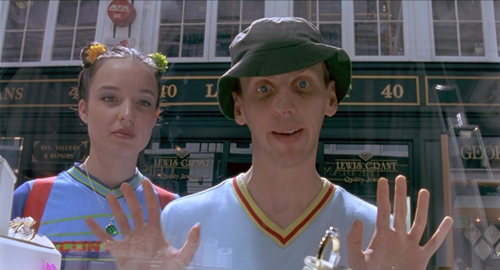
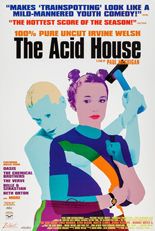
Arguably, The Acid House wouldn’t exist without the international phenomenon of Trainspotting two years earlier. While both are based on Irvine Welsh books, The Acid House is an anthology and arrives adapted by Welsh himself, so “cunt” utterances abound.

“The Granton Star Cause” details the terrible, horrible, no-good, very bad day of Boab (Stephen McCole, Rushmore). In quick succession, the “lumpen proletariat malcontent” gets booted from his soccer football team, kicked out of his family’s house, dumped by his girlfriend, thrown in jail and fired from work. Nursing his wounds in a pub — where else? — he meets God (Maurice Roëves, Judge Dredd), who gives him the powers of revenge … albeit as a housefly. Let the scatological parade begin!

Joviality downshifts into “The Soft Touch,” a working-class love-ish story of newlyweds/new parents Johnny and Catriona (Trainspotting’s Kevin McKidd and Doom Patrol’s Michelle Gomez, providing the movie’s strongest performances). Here, Welsh dwells in Mike Leigh kitchen-sink squalor, detailing Johnny’s heartbreaking misery as a skeevy, alpha neighbor (Gary McCormack, Valhalla Rising) moves into their building and near-immediately into Catriona. More depressing than funny, the segment at least gives the film an emotional core — one best exemplified by the shoegaze melody of Belle & Sebastian’s “Leave Home,” a number so moving, the soundtrack uses it twice.

Finally, there’s the titular story, starring Ewen Bremner, practically reprising his Trainspotting role of Spud. In a body-swap scenario Hollywood wouldn’t dare touch, his Coco does a hit of acid and switches souls with a newborn baby — no explanation given or needed. Via an animatronic infant more unsettling than those of most horror films, Coco thoroughly enjoys breastfeeding, asks Mum (Jemma Redgrave, Dream Demon) for a beej and pleasures himself from his crib as his parents get frisky in the sheets.

Like “Granton,” this third bit revels in shock value and succeeds, even if first-feature director Paul McGuigan (Victor Frankenstein) lets it go on so long, it’s perilously close to schoolyard juvenilia. Then again, with arrested development running a throughline, that may be the point. To varying degrees, each story overstays its optimal welcome, leaving The Acid House too loose and unfocused to become a classic for the UK’s chemical generation, yet diverting enough for one go-round. Scottish accents come unvarnished, so lest the likes of “nippy wee winger” and “daft sow” reside atop your tongue, subtitles are encouraged. —Rod Lott

Get it at Amazon.

Express to Terror (1979)

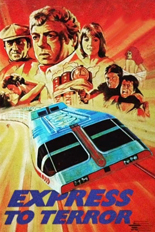
Don’t judge a movie by its cover. In the case of Express to Terror, the reason is because it’s actually the feature-length pilot of NBC’s legendarily colossal failure of a television series, Supertrain, which lasted all of nine episodes. (Okay, now you can judge it.)

Possessing a boner for rail travel, the CEO of TransAllied Corporation (Keenan Wynn, The Crowded Sky) accepts the U.S. Department of Transportation’s request to construct an atomic-powered choo-choo train with unlabeled gumdrop-button controls to make it go coast to coast in 36 hours. The end result, aka Supertrain, is so luxurious, it has everything: a bar, a gym, a sauna, a swimming pool, a discotheque, red carpet, an elevator, Nina Talbot and a flaming hairstylist with two electric dryers!

Well, almost everything — as we learn, it lacks ashtrays, Maalox and suspense.

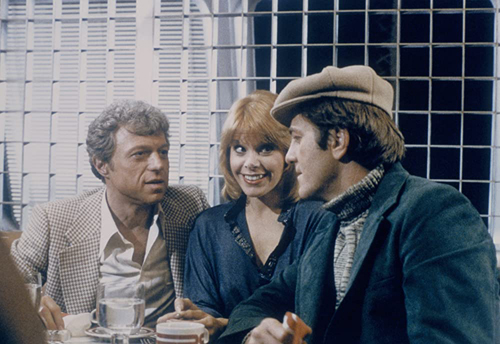
Add “competent security” to the list, considering Supertrain’s maiden voyage is fraught with repeated attempts on the life of Mike (crooner Steve Lawrence), a gambling-addicted passenger in debt to the mob. Meanwhile, Mike falls for the ditzy, abused wife (Char Fontane, The Night the Bridge Fell Down) of his would-be assassin (Don Stroud, Slaughter’s Big Rip-Off). Mike’s dandy, Peaky Blinders-capped pal (Don Meredith, Mayday at 40,000 Feet!) condemns the romance, because she looks like she “reads Corn Flakes boxes.” (To be fair, he’s not wrong.)

Also aboard Supertrain are Stella Stevens, George Hamilton, Robert Alda, Vicki Lawrence and Fred Williamson. None sticks out because all play second fiddle — if not relegated to last chair — to Steve Lawrence’s pickle of a primary storyline. He brings all the intensity and nuance he would to his finest performance: as himself, hosting TV’s Foul-Ups, Bleeps & Blunders. Only if director Dan Curtis (Burnt Offerings) were helming a game show could his leading man fit snugly in the role’s demands.

By comparison, The Love Boat looks like James A. Michener. Strangely, this disaster-adjacent pilot is written by two people who should have known — or typed — better: soon-to-be Oscar-winning scribe Earl W. Wallace (Witness) and crime-fiction icon Donald E. Westlake. Whether they were just taking a check or network interference gummed up the works, Express to Terror is, ending aside, slow enough to qualify as a sedative. All a-snore! —Rod Lott

Get it at Amazon.

Moonfall (2022)

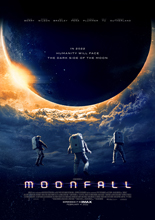
When I read Michael Crichton’s 2002 killer-nanotech novel, Prey, I thought it would make a great movie. Now that I’ve seen Roland Emmerich’s Moonfall, featuring a similar villainous swarm, I second-guess my decision.

Ten years ago, while arguing over Toto lyrics, Space Shuttle astronaut Brian Harper (The Conjuring patriarch Patrick Wilson, born to look the part) lost a fellow crew member to an attacking cloud of sentient particles that put the “AI” in “hentai.” Now a disgraced former space cowboy and current deadbeat dad, Harper gets a shot at redemption when British and bearded conspiracy theorist KC Houseman (John Bradley, 2018’s Patient Zero) notices something NASA has not: The nanotech has forced the moon’s orbit outta whack!

Corralling Harper’s former partner (a wasted Halle Berry, Catwoman), they embark on a world-saving mission: Nuke the nanotech. All they need is a Space Shuttle; good thing a decommissioned one sits in an abandoned museum, if you don’t mind “FUCK THE MOON” graffitied on the fuselage. They don’t.

As stupid as all of this is, Moonfall is fairly watchable in its first hour, wringing a money shot out of the orbital shift triggering an L.A. flood. The second hour — the one in space — is where the movie becomes one big Moonfail. Emmerich sends our heroic trio into the moon’s craters, where what they find makes Mission to Mars’ much-derided “PowerPoint” climax look distinguished by comparison. Emmerich stretches his reveal into full-blown prequel potential with unneeded mythology that unspools like Stargate fanfic.

Meanwhile, back on Earth, family members in Colorado flee inbred rednecks in a chase sequence so overblown, it’s remarkable F9 hadn’t already laid claim.

Hoping to relive his box-office glory days of Independence Day and The Day After Tomorrow, Emmerich recycles every page from his playbook: fractured family drama, meteorological porn, a melting-pot cast, regular-dude heroics, unspeakable dialogue (“I’m an astronaut, not a soldier!”) and, of course, upturned U.S. monuments. It’s all too much and yet not enough. —Rod Lott

Get it at Amazon.

TV Gothic: The Golden Age of Small Screen Horror

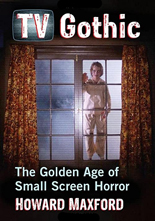
Two things about the title of TV Gothic: The Golden Age of Small Screen Horror could limit the trade paperback’s potentially fervent audience. First, “TV Gothic” suggests it only covers Gothic horror, whereas author Howard Maxford covers horror in general.

Second, “The Golden Age” suggests it covers only a finite range of years — possibly the 1970s, based on the Salem’s Lot image adorning the front — but in truth, Maxford truly scours tube history for seemingly every relevant show to hit the airwaves shortly after the medium’s inception. A boo show here and a boo show there, everywhere a boo show — many more exist than you think, and while some may merit a mere sentence or two, inclusion is the name of Maxford’s game. If the subject interests you, roll the dice!

Now, if you’re hoping for an episode guide of the genre’s most prominent series, don’t, because TV Gothic is not that book. (However, that book already exists, as John Kenneth Muir’s Terror Television, highly recommended and also from McFarland & Company.) It’s also not an encyclopedia as Maxford’s 2018 book, Hammer Complete: The Films, the Personnel, the Company (yep, McFarland again), was.

So what is this one? Reading TV Gothic is akin to sitting Maxford in the comfiest chair possible and asking him to tell you the complete story of the previous millennium’s cathode-ray chillers. The result: a fact dump that might annoy if it weren’t so damned thoroughly, meticulously researched. He includes everything you expect: Dark Shadows, those wonderful ’70s made-for-TV movies, Kolchak: The Night Stalker, all the anthologies, The X-Files, the UK Christmas ghost stories and the kiddie cartoons. Each short-lived show I recall from my youth — Cliffhangers, Darkroom, et al. — is covered.

Along the way are more shows since forgotten, if you noticed them at all — Shirley Temple’s Storybook, anyone? TV Gothic is such a wealth of information, it should be unbelievable … yet here it is. My largest point of dissent is that Maxford stops at 2000, other than including a list in the appendix. Certainly I’m not the only one wanting to reminisce about Garth Marenghi’s Darkplace and Harper’s Island? —Rod Lott

Get it at Amazon.