
All posts by Rod Lott

Phil Herman’s Doomsday Stories (2023)

Even if only for marketing purposes, the possessive movie title is usually reserved for your Alfred Hitchcocks and John Carpenters and your Stephen Kings — you know, your name-brand filmmakers and creatives. Nonetheless, here’s Phil Herman’s Doomsday Stories.

For this multidirector microcinema anthology, Herman (behind such SOV faves as Burglar from Hell) hosts as Zorack, one of a mere 8,000 people remaining worldwide, following the apocalyptic “Meanies” virus. As savages outnumber humans, Zorack roams the earth, occasionally stopping to read from a clutched composition book containing “stories from the old world.” Of the five, one entertained me and another impressed me. Also, three characters are named James.

The entertaining one comes from Florida’s prolific Joel D. Wynkoop, offering a possessive of his own: “Joel D. Wynkoop’s 187 Times.” Attempting to prevent the virus, Wynkoop’s nebbish protagonist hops throughout a 30-decade time span, up to 2050. Each time he thinks he succeeds, the ol’ butterfly effect rears its wings. Its slight comic tone, breathless pace, clever premise and good-enough computer effects make it endearing.

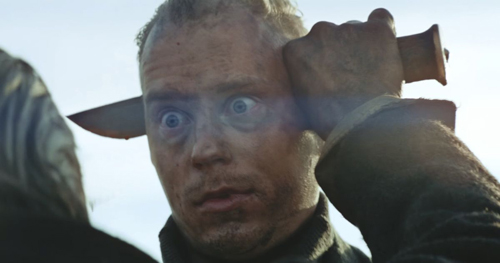
The most impressive is “A Broken Promise” from Derek Braasch (Murder for Pleasure). Approaching an epic sweep with a Western flair, Justin Bower’s crawfish-capped Rick Butts and his canine companion scavenge for food in rural Illnois. They encounter everything from kid zombies to rednecks with a hankering for “dog steak.” The short may look like Paul Blart: Last Man on Earth at first glance, but for being so hamstrung, its sheer scope is mighty accomplished.

Lesser segments involve an organ recruiter and a fevered phone call between siblings. And in “Bomb Threats” from Hollywood Warrioress’s James Panetta, a woman (Debbie D, Herman’s Jacker) wrongly decides to seek emergency shelter at the home of a man she just met at a bar (Jim Ewald, Nacho Mountain); W.A.V.E.-style torture ensues. Its high point is her hysterical retort, “You’re a sick, sick weirdo! And a rapist!”

In between each, Herman cuts back to hosting duties — sometimes with the wind beating the crap out of the camera’s microphone — and waxes nostalgic, e.g., “Man, that brings back some memories. Some bad memories.” At two hours and then some, though, there’s enough variety that to leave with a couple of good ones. —Rod Lott

Get it by contacting Phil Herman or Joel D. Wynkoop on Facebook Messenger.

The Welder (2021)

In merging horror with racial politics, Florida-based filmmaker David Liz seems to draw inspiration from Jordan Peele’s Get Out. After all, Liz’s The Welder is about a Latina woman and her Black boyfriend in fear of a white man who can’t get over the death of his Black wife. The movie affixes these labels, not I, then presses hard to make their corners don’t peel. Subtlety is not found in The Welder’s toolbox.

Eliza (Camila Rodríguez) and Roe (Roe Dunkley) play the respective girlfriend and boyfriend. With her PTSD growing more intense, he books them a much-needed weekend ranch getaway: ATVs! Horseback riding! Godforsaken science projects!

The ranch owner, Dr. Godwin (Vincent De Paul, Rottentail) screams “sinister” upon greeting his guests. Despite enough red flags to cover a used-car lot on inventory-clearance month, Eliza and Roe stay.

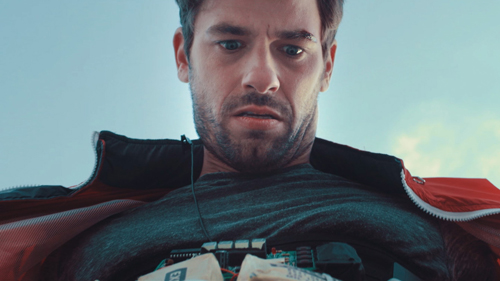
Dr. Godwin’s on a personal mission to “cure the blight of racial hate” vis-à-vis an experiment that’s downright Frankensteinian. While I won’t disclose the deets, viewers will see Leonardo da Vinci’s iconic Vitruvian Man drawing with one slight change: He wears a welder’s mask. It’s not meant to elicit the giggles it did.

So obvious it’s oblivious, The Welder is 90% a drag. No amount of poetic slow-motion scenes with music swelling can convince otherwise. Liz’s film is deeply hindered by poor acting from almost everyone in a cast numbering precious few. As the female lead, Rodríguez’s groggy performance proves contagious to her audience; as her male counterpart, Dunkley displays more energy, perhaps attempting to distract from consistently demeaning dialogue, e.g., “We gotta hella recharge these phones.” He at least appears to be aware of something the movie does not: its own ludicrousness. —Rod Lott

Get it at Amazon.

The Long Dark Trail (2022)

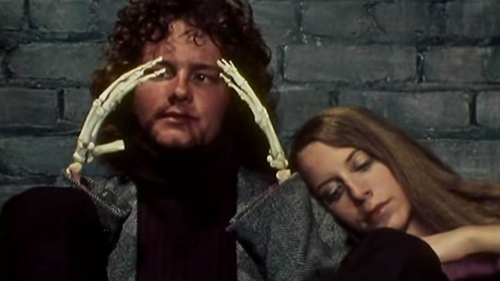
Teen brothers (newcomers Carter and Brady O’Donnell) escape their abusive, alcoholic father (Mick Thyer) and bike through the wilderness of Northwest Pennsylvania. They’re in search of their mom (Trina Campbell), who left them for a satanic cult into pig heads, fireside rituals and human sacrifice via sharp, wooden stakes.

Although adult in themes, The Long Dark Trail is structured not unlike a YA adventure novel, presented in eight short chapters bearing a one-word tease of a title (e.g., “Absconded,” “Lake,” “Salvation”). Our two protagonists are likable, yet deliver their lines rather flatly, void of personality.

However, the true star is nature, which co-directors Kevin Ignatius (My Best Friend’s Famous) and Nick Psinakis (who plays the cult leader) treat more than a mere backdrop. It bears the brunt of establishing and building a pervading sense of doom. Despite all the portents, a satisfactory payoff isn’t found at the end of the map. At least one can appreciate the elements that are first-rate — namely, Ignatius’ score and Mitchell Kome’s cinematography. —Rod Lott

Get it at Amazon.

The Incredibly Strange Features of Ray Dennis Steckler

After covering the filmographies of Herschell Gordon Lewis and Ted V. Mikels, Christopher Wayne Curry turns his completist’s eye to a more difficult subject with The Incredibly Strange Features of Ray Dennis Steckler. Certainly this is the only text to draw a dotted line between the director of Rat Pfink a Boo Boo and Luis Buñuel. After all, Steckler was the kind of low-low-budget filmmaker who thought nothing of ending a movie “with three characters the viewer knows and five they do not.”

Published by McFarland & Co., the book is a thorough examination of the man’s nearly 50-year outré oeuvre in — but mostly on the fringes of — Hollywood. As Curry puts it, “Hollywood was not answering and Steckler was tired of calling.”

Those aware of the psychotronic legend largely do so for his early pictures, including the Arch Hall Jr. vehicle Wild Guitar, the aforementioned accidental superhero spoof Rat Pfink a Boo Boo and the mouthful-titled, monster-musical madness from which Curry’s book takes the most opportune pun, The Incredibly Strange Creatures Who Stopped Living and Became Mixed-Up Zombies!!?

The author takes readers through each in an amazing amount of detail, essentially scene by scene. This would be frustrating if not for Curry using the opportunity to weave in behind-the-scenes stories and facts, historical context, interview quotes and related minutiae all the while; thus, the effect is akin to listening to a solid DVD commentary, both informative and lively. Naturally, his own opinions play a great part. While Curry sees many of Steckler’s deficiencies as a plus, it’s hilarious when he doesn’t, as in his coverage of the padded slasher Blood Shack (aka The Chooper): “Simply put, there should never be protracted conversations about irrigation and filtered water in a horror film.”

A shameless self-promoter, Steckler (who died in 2009) would no doubt be overjoyed with being the focus of an entire book. But no doubt he’d be livid over the chapter devoted to the roughly 75% of his directorial career he not merely disowned, but denied: the dozens and dozens of hardcore pornos. Curry covers them all, but only in brief, because they’re so bad, they don’t merit, er, probing. (And considering how bad Steckler’s legit pics could get, that says a lot.)

Curry’s all-encompassing description of the X-rated fare says it best: “These films contain the usual humping, bumping and pumping, all of this augmented by mounds of unkempt curlys, arcing ropes of reproductive fluids, pimples, cold sores, in-grown hairs and lots of sweat. … The viewer’s sense of smell is spared, but for the eyes and earls it is an all-out assault.”

The book would not be complete without looking at this sordid bulk of Steckler’s work. Same goes for his oft-leading lady, the beautiful Carolyn Brandt (Body Fever), detailing Steckler’s marriage-wrecking infidelities. Without venom, Brandt sheds a light on their personal life to a degree of candidness I’ve not seen reported (not to mention shares a curious tidbit about Ilsa star Dyanne Thorne’s nipples). Curry deserves commendation for telling the whole story, proving a writer can show reverence without being disingenuous.

The only knock against the book is one of unavoidable timing: Severin Films’ recent Steckler box set, in which Curry participated, renders some of the contents out of date, in that projects regarded as lost no longer are. However, these are few and minor.

If you’ve never experienced the uniqueness of a Steckler film, you’re not ready for Incredibly Strange Features. For everyone else, it’s fascinating and fun. —Rod Lott

Get it at Amazon.

Free to a Bad Home (2023)

After a woman is fatally shotgunned in her sleep, her belongings are dumped into a curbside cardboard box marked “Free to a Good Home.” Kameron and Scott Hale’s Free to a Bad Home follows a possessed ring plucked from said trashed stash as it moves from person to person to person, telling three stories in total.

Amy (Miranda Nieman) is given the ring in marriage, as the jewelry is surreptitiously swiped by her beau, even after watching her recoil by feeling “bitten” by trying on a necklace from the box. This intriguing-enough setup leads to undue padding and an anticlimactic conclusion.

Next, a burglar (Jake C. Young) finds the ring after silently exploring a targeted house for 10 minutes, flashlight in hand. Eventually, the ring is taken by his sister, Julia (Olivia Dennis), who heads to a costume party with three friends — cue an eight-minute drive, complete with eyedropper drugs. Once there, the ladies wander for eight more minutes before running across anything resembling a story point. That gives way to a lengthy monologue and more confusion than the scene’s neon-dream lighting can mitigate.

The cursed-object concept has been done before, none as ineffectually as Free to a Bad Home. As the previous two paragraphs hammered home, nearly nothing happens in the segment, individually or in total. Although the Hales found a credible method for threading one central character to the next, none is developed enough to merit focus. Each story seems to have been built with a clear beginning and desired ending, but little attention paid to plot the all-important middle. In concocting the passed-property gimmick, the Hales gave themselves a fuse they never get around to ignite. —Rod Lott

Get it at Amazon.