
All posts by Rod Lott

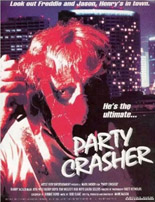
Party Crasher: My Bloody Birthday (1995)

Henry Primo’s turning a suh-weet 16! And thanks to his wealthy parents, he’s throwing quite the rager at a local motel, complete with live band, swimming pool and rented rooms. Maybe — just maybe — Henry (Randy Ackerman) will finally get that cute Becky (Laura Sellers) into the (possibly bedbug-ridden) sack.

Or perhaps Henry’s drink will be drugged, causing him not to pass out, but to slaughter seven classmates. After all, the movie under examination is called Party Crasher: My Bloody Birthday, suggesting creator Mark Mason (2003’s The Prize Fighter) couldn’t pick between two titles, so he used both.

Fast-forward 15 years, the now-obese adult Henry (Mason himself) and his Hannibal Lecter half-face mask are discharged from a high-security loony bin to his parents’ home. They’ve “spared no expense” to turn a wing of their abode into a replica of the mental hospital for Henry’s comfort. Because he no longer speaks, Henry communicates solely via pen and paper, like when he’s hungry and writes, “BIG MACS.” His mother asks, “How many?” and he responds with the number “8.”
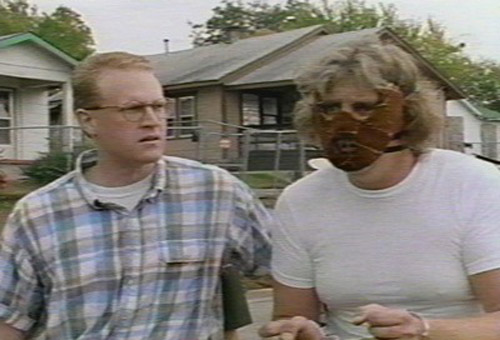
Perhaps his atrocious dietary requests fuel his ESP abilities? Yes, Henry also possesses the power of ESP. It never comes into play.

Well, Mom and Dad must have skimped on something in the security features, because police are called to investigate a message left on the now-married Becky’s front door … in his own poop: “BECKY WHY DID DO THIS ME.” So many words scrawled so large must have required a great deal of fecal matter, but remember: eight Big Macs. The math tracks. (Plus, this thing was shot in Tulsa, in a state with an obesity rate near 40%.)

Anyway, everyone’s on edge until Henry saves a little girl from a dog mauling and all is forgiven. Naturally, his former classmates — well, the surviving ones — decide to bestow him with an award of courage at the high school reunion. This goes over great until Kizay (Tom Wescott), the Mickey-slipper from the jinxed birthday party, is able to surreptitiously attach jumper cables to Henry’s wheelchair, shocking him into a hulking monster of rage that no amount of all-beef patties can pacify.

You can’t blame Mason for trying. But you can blame him for failing. He’s not just the “star” of Party Crasher: My Bloody Birthday, but also its producer, editor, writer, director and, somehow, second-unit director. —Rod Lott

Get it at Amazon.

The Old Woman with the Knife (2025)

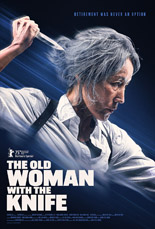
With believable stoicism, Lee Hye-yeong (2008’s The Devil’s Game) plays the title character of The Old Woman with the Knife, the arthritic assassin Hornclaw. She’s prepping for One Last Job for her employer, which bills itself as a pest-control agency specializing in “eradicating malignant vermin” — in other words, translated to Dexter-ese, people who deserve it.

Or at least that’s how it used to operate, giving the noble Hornclaw another reason to get out of the hit-lady game. She holds distinct disdain for their latest hire, the young, brash, arrogant and unpredictable Bullfight (Kim Sung-cheol, Search Out). Director and co-writer Min Kyu-dong (Memento Mori) wants to keep you guessing whether Bullfight is friend or foe. And guess you will because the movie suffers from a narrative so scattershot, the story doesn’t settle into place until its first hour passes.

Needlessly convoluted, this South Korean film isn’t strong in the engagement department. Sure, the action sequences give it an occasional bump, such as Hornclaw’s version of Oldboy’s famous hallway brawl or being buried alive with thousands of maggots atop her. But these respites stand little chance of sticking when Min’s primary concern is shoving recurring metaphors under our noses again and again.

As if the title, Hornclaw’s impending retirement, Hornclaw’s involuntary shaky hands or Bullfight belittling her with the “hag” label don’t already give it away, our protagonist is elderly. Uncertain you got that and what aging means, Min fills The Old Woman with the Knife’s script with persistent and repeated discussion of bruised fruit no one purchases, injured strays no one adopts and expired waste awaiting disposal. It’s like italicizing what’s already in bold, then underlining it, circling it in red and highlighting it in neon yellow. And maybe even pink and orange, too, jussssst to be safe.

We get it. Boy, do we get it. As Bullfight utters, “So much for being a legend.” —Rod Lott

Get it at Amazon.

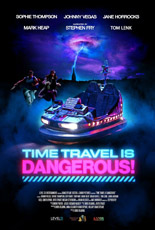
Time Travel Is Dangerous! (2024)

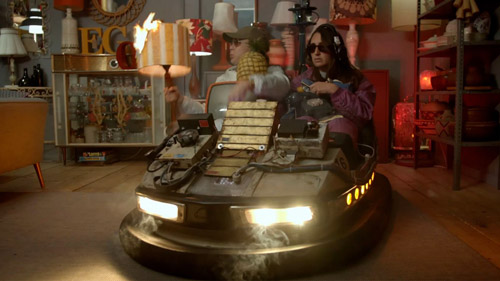
For a few years — or thousands, if you choose to look at it that way — besties Ruth and Megan have stocked their London thrift store with antiques and antiquities purloined with the help of a time machine. It looks like a pimped-out bumper car. They didn’t invent the gizmo; they found it outside discarded near the trash bins. 

What they don’t know — but soon learn — is time travel is dangerous. (It’s even the name of the movie, look: Time Travel Is Dangerous! See?) In actuality, they don’t know much. “We’re not scientifically minded,” says Ruth (Ruth Syratt), attempting to explain their find and how it works. “I’d say it’s a wormhole, but I don’t know what a wormhole is.”

Shot handheld, The Office-style, as a mockumentary, Chris Reading’s film resists doing the expected to forge its own whacked path. Any other comedy with this premise would follow Ruth and Megan (Megan Stevenson) on their unusual shopping trips through an entire history book’s worth of countries and eras, but Reading relegates that to a montage or two. The real story is how their ruse is discovered by its gobsmacked inventor (Brian Bovell of Robert Zemeckis’ The Witches), how they manage to function when banned from using the machine (they don’t) and the consequences of breaking their promise. 

In British comedy tradition, humor is sandpaper-dry and droll in a manner so confident in itself, it verges on cozy. These things usually do not click with me — see (or don’t, really) 2005’s The Hitchhiker’s Guide to the Galaxy, also narrated by Stephen Fry, incidentally — yet I was bought-in by the first scene. That’s all due to the winning duo of Stevenson and Syratt.

In real life, they actually run the ChaChaCha vintage store serving as Time Travel’s home base. Neither woman appears to be an actress, yet both are funny and indelibly deadpan, with a chemistry so potent, it can’t be manufactured. Reading really struck gold with this pair, so naturally, when the third act separates the characters, the movie’s juice starts to sour. I’d watch a TV series of them just hanging out in their shop, no sci-fi (or any type of fi) necessary. —Rod Lott

Get it at Amazon.

Home Movie (2008)

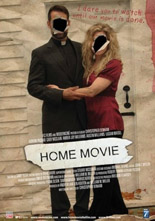
Through camcorder footage, Home Movie follows the foibles of the Poe family from Halloween to Easter. Shortly after moving to their wooded Connecticut home, Claire (celebrated soap star Cady McClain) and David (Adrian Pasdar, House of Frankenstein 1997) notice their children (real-life siblings Austin and Emily Joy Williams) aren’t acting like their usual selves.

Like how, you ask? Like throwing rocks. Like not using their words. Like … well, as Claire records on her video diary, “Yesterday morning, the 25th of December … Christmas … Jack and Emily crucified the family cat.” Ho-ho-holy shit, kids!

That’s small stuff compared to the rest. Although Shutter Island actor Christopher Denham’s first feature as writer and director breaks no ground, especially for the found-footage subgenre, he does two things really right. The first is how differently Claire and David — respectively, a child psychologist and a pastor — approach possible solutions to their offspring’s disturbing behavior: She hopes to prescribe an answer; he spritzes holy water and shouts commands at imagined demons.

And the second is how Denham doesn’t wuss out on taking his established dark path to its logical end, making the down and dirty Home Movie mean-spirited in the best of ways. The last 15 minutes are something else, with a final shot dripping in hand-wringing eeeevilllll. It almost makes up for Pasdar’s Annoying Dad with No Off Switch routine, what with his silly voices, cartoon accents and more fart talk than the annual convention of the American College of Gastroenterology. —Rod Lott

Get it at Amazon.

Delusion (1981)

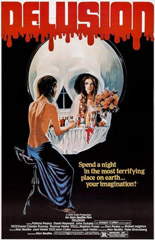
No sooner has live-in nurse Meredith Stone (Patricia Pearcy, Squirm) joined the payroll of cranky old paraplegic inventor Mr. Langrock (Joseph Cotten, Shadow of a Doubt) than she’s told only a single room of his estate is off-limits. Specifically, the one that’s locked up. The same one she spotted someone in, standing at its window, upon her arrival via Yellow Cab. The one she should never, ever enter under any circumstances whatsoever. 

“Ooh, how Gothic: a locked room!” coos a minor character played by Death Race 2000’s Simone Griffeth, and she’s not wrong. But whereas most movies of this ilk would spin such a setup across three dark and stormy acts, Delusion unlocks that riddle in its first 15 minutes, which is to say of course Meredith enters the room.

The real mystery kicks in after Mr. Langrock’s teen grandson (Jaws 2’s John Dukakis, son of Michael) arrives from being raised on a commune. That’s when people at the estate start to die, in classic whodunit fashion. Certainly a kid so far removed from society that he doesn’t recognize a skateboard must be the culprit, right?

Unassuming in nature (especially when shorn of its alternate, oxymoronic title, The House Where Death Lives), Delusion is two-thirds Agatha Christie, one-third Michael Myers and all-around quietly nifty, marking a promising debut for director Alan Beattie. However, some of its advantages might be accidental. For example, the abode’s small doorways lend a discomforting, cramped feel … but that’s how the house was built. For another, the main actors’ unfamiliarity to viewers (the legendary Cotten excepted) mean audiences’ preconceived notions can’t apply … likely a budgetary necessity than a calculated play.

Supporting my theory, the only other movie Beattie helmed, Stand Alone, is as formulaic as you’d expect from a mid-’80s Death Wish imitation. That sophomore slump lacks the well-constructed script first-timer Jack Viertel delivered for Delusion: tense and peculiar, with the kind of kink Brian De Palma would’ve maximized for a field day of a film. Strange that Viertel never wrote another movie, abandoning La-La Land for enormous success on the Great White Way.

Most cruelly, Pearcy doesn’t waste her leading-lady opportunity, yet her face hasn’t graced a screen any larger than a television — a mystery in itself. —Rod Lott

Get it at Amazon.