
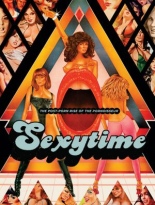
 Hard as it may be for you to believe from a guy who named a book-review site after an orgasm, I don’t watch porno movies. However, this dared not stop me from picking up Sexytime, which rounds up poster art from the X-rated genre’s porn-chic heyday of the 1970s and VHS breakthrough of the early ’80s.
That’s only because it comes (tee-hee) from Jacques Boyreau, whose previous exploitation-art exhibits in book form, Trash and Portable Grindhouse, have earned permanent placement on my shelf. The guy has a knack for picking images; much like Supreme Court Justice Potter Stewart and hardcore porn, Boyreau knows it when he sees it.
And luckily, he shares it, this time from the visual-presentation experts of Fantagraphics Books — a match made in poster-art heaven. Whereas FB’s packaging of Portable Grindhouse was appropriately the size and shape of a VHS tape, this hardcover book measures 14 inches tall, and that’s … well, you know.
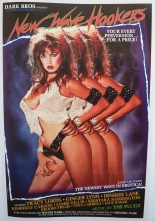 Writes Boyreau in his balls-out introduction, “The idea of Sexytime is that these posters are more satisfying than the movies they advertise.” And the results suggest that’s for damn sure.
Presented in full-color, naturally, they range from photography to paintings to cartoons; from purposely artful and well thought-out to crude and thrown-together. They carry straightforward titles like New Wave Hookers, Blazing Zippers and Flash Pants; they also boast more eyebrow-raisers like Hugo’s Magic Pump, That’s My Daughter! and Librianna, Bitch of the Black Sea.
 Little Orphan Dusty apes Farrah Fawcett’s iconic bikini poster, right down to a lookalike startlet. American Sex Fantasy is a “red, white & BLUE movie” whose cartoon image is meant to be the squeaky-clean teen star of Archie Comics. With its looming dinosaur, One Million AC/DC could be mistaken for an AIP sci-fi cheapie of the ’70s, until you notice the bare-breasted beauties underneath the beast.
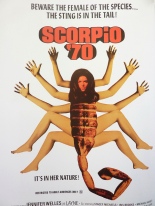
Some are really classy; I’d frame the cutout composite image of Scorpion ’70, if not for the explanation I’d have to give to every visitor. While several are gaudy, only a select few are disgusting; in that latter category falls Juice (“It’s Suck-U-Lent!”), whose bloated red title appears to be dripping in spermatozoa.
Arguably the most clever poster of all turns out to be a fake; see if you can spot it. Here’s a hint: It focuses on a woman’s crotch. What, that doesn’t help? —Rod Lott
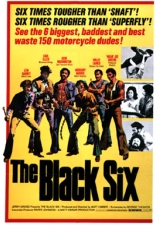
 A nice, young black man is killed by a group of racist white bikers because he’s been dating the sister of one of the gang members. When his older brother, Bubba (Gene Washington), gets the news, he and his roving motorcycle posse of five other burly black guys roll into town for some payback. Together, they are … wait for it …

 Also known as The Time Shifters,

 One could read the second word of