
All posts by Rod Lott

The Most Dangerous Game (1932)

mostdangerousgameFrom the makers of King Kong the following year, 1932’s The Most Dangerous Game is one of the most influential and imitated movies in history, and for good reason: It’s a splendid, Prohibition-era adventure with a concept that transcends time. And that concept is that, unequivocally, rich people are assholes.

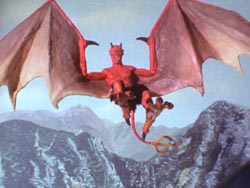
Based on Richard Connell’s excellent 1924 short story of the same name, the RKO Radio Picture begins with a ship capsizing in shark-infested waters. The only survivor, Bob (Joel McCrea, Alfred Hitchcock’s Foreign Correspondent), washes ashore on an island and arrives at the only home around, belonging to one Count Zaroff (Leslie Banks, Hitch’s The Man Who Knew Too Much of 1934). As if the host’s name isn’t scary enough, his door knocker is a demon holding a woman. In life, we call such things “a red flag.”

mostdangerousgame1Zaroff is crazy, all right. Having lost his love of life, the man has resorted to big-game hunting, but hunting humans. Bob and another “guest,” the alluring Eve (Fay Wray, King Kong), are to be his latest prey. If they can survive from midnight to sunrise in the jungle, Zaroff will give them keys to the boathouse so they may float their way to freedom.

Bob and Eve believe staying alive is a swell idea, so they build traps in the hopes of turning the tables. And therein lies the fun. Utilizing a mix of backlot sets and rear-projection tricks, co-directors Irving Pichel and Ernest B. Schoedsack pull off an exciting exercise exploring man’s inhumanity to man, via swamps and caves and dogs, and waterfalls for those dogs to tumble down. It’s not politically correct; it’s not meant to be. —Rod Lott

Buy it at Amazon.

My Soul to Take (2010)

mysoultotakeWes Craven’s My Soul to Take arrives with such a preposterous premise: that seven premature babies born the night of the death of a serial killer grow up as mirrors of his personality. (Granted, the dude did expire at midnight sharp, but c’mon!)

However, his kitchen-sink prologue makes me think the ludicrous nature of it all is intended, like a self-parody that was perhaps two notes too subtle for mass audiences to notice. Scream, it is not — but it is better than what would be Craven’s follow-up, 2011’s Scream 4.

mysoultotake1Sixteen years after that over-the-top opening, the so-called Riverton Ripper — he of the cruelly curved blade emblazoned with the word “VENGEANCE” — is back. This time, his targets are those birthday boys and girls, including the asshole jock, the blind minority, the Jesus freak (“If things get too hot, just turn on the prayer conditioning”), the abused misfit and our protagonist, the unpopular and possibly schizophrenic Bug (Max Thieriot, TV’s Bates Motel).

The Ripper is easy to spot: He resembles a prematurely bald Rob Zombie and soup-kitchen hobo. It’s an unsettling and decidedly odd choice for a villain, but the misunderstood My Soul to Take is nothing if not a picture that bops along on its own unusual, discordant rhythms. Love it or hate it, you haven’t quite seen this film done this way before. It’s wildly imperfect, but interesting in its insanity, which is enough for me. —Rod Lott

Buy it at Amazon.

Legend of Horror (1972)

legendhorrorPurportedly based on an Edgar Allan Poe short story, this film is just about as much Poe’s as some scoutmaster spinning tales around a campfire. The Argentine/American patchwork oddity Legend of Horror throws the young Pierre — he of the Elvis sideburns — into a dank prison cell with the wacky-ass, hygiene-neglecting Sidney. This Sidney fellow cackles like a hobo on ripple and has forged an unhealthy friendship with a mouse, predating The Green Mile by a good three decades.

As the two cellmates plot their escape, Sidney entertains Pierre with a story about how ended up in this good-for-nuthin’ place. Switch to a “flashback” (really a dubbed, sizable chunk of another movie altogether, 1960’s Masterworks of Terror) in which a then-strapping Sidney visits his uncle, a clock salesman with a bad eye and a piss-poor attitude toward customer service.

legendhorror1In due time, Uncle Freaky-Eye pushes Sidney to the breaking point, whereupon young Sid smothers the bastard with a pillow. As the cops interview him regarding his uncle’s disappearance, Sidney is driven to a confession by hearing the heartbeat of the corpse. (All ties to Poe begin and end in that one scene.)

Jump back to our prisoners, who have busted out of the joint and seek refuge. Sidney kills a couple of guards who come after them, but to the delight of the audience, does so via the magic of “Magicmation” — a fancy cinematic term for “stop-motion!” At the end, all the people Sidney has killed come back to life and cause him to be impaled in a graveyard. For no discernible reason, the film abruptly ditches the black-and-white format for a splash o’ color. Never you mind — it just makes it that much more of a hoot. —Rod Lott

Buy it at Something Weird Video.

Jack Reacher (2012)

jackreacherOne fine day in Pittsburgh, a sniper perched in a parking garage fatally shoots five people at a park before driving away. The man hauled in by police, Barr (Joseph Sikora, Safe), enacts his right to remain silent, but does scrawl on a notepad, “GET JACK REACHER.”

Who’s Jack Reacher? A former military policeman for the Army, Reacher (Tom Cruise) is an off-the-grid drifter who just wants to be left alone. He knew the accused from the service, and has no intention of helping the guy get away with murder, but does want to know just what the hell is going on.

Barr’s defense attorney, Helen (Rosamund Pike, Wrath of the Titans), convinces Reacher to be her lead investigator. She also doesn’t want to see Barr go free, but does want to see him get a fair trial. Needless to say, Reacher’s sniffing around opens up an enormous can of worms — plot twists, really.

jackreacher1Based on One Shot, the ninth novel in Lee Child’s best-selling thriller series, Jack Reacher didn’t get a fair shake upon release. For one, the violent pic arrived in theaters less than a month after the Sandy Hook Elementary massacre, when the nation wasn’t exactly in the mood to see a bunch of big-screen gunplay. And that’s understandable.

What’s not is Reacher fans’ outcry over the 5-foot-7 Cruise being cast as the series’ 6-foot-5 hero. Cruise conveys 100 percent of Reacher’s attitude; he’s intimidating and bone-crunching believable in the ass-kicking department. To his credit, he also plays the role far differently than Mission: Impossible‘s Ethan Hunt.

Written and directed by Christopher McQuarrie, who previously teamed with Cruise by scripting Bryan Singer’s Valkyrie, the film chalks up many positives: a truly exciting chase, dialogue that replicates Child’s rhythms to a T, an acidic wit and a real stroke of genius in casting potentially insane German director Werner Herzog (Bad Lieutenant: Port of Call New Orleans) as a villain minus a few fingers because he ate them. Reacher would’ve twisted them off anyway. —Rod Lott

Buy it at Amazon.

Revenge (1986)

revengeFour years before Kevin Costner got Revenge, John Wayne’s second son got his. You wouldn’t know it from the title, but 1986’s Revenge is the sequel to the previous year’s Blood Cult, thought to be the first feature film made expressly for home video. Both chapters were shot on the cheap in Tulsa, Okla., by director Christopher Lewis, but rather commendably, he doesn’t settle for a simple rehash. Instead, he tries harder.

Whereas Blood Cult was an out-and-out slasher set partly at a sorority house, Revenge is a follow-up investigation of the murders two months later. Mike Hogan (Patrick Wayne, Beyond Atlantis) returns to town after his brother’s homicide by the sheriff’s daughter. His old farm neighbor, Gracie (Bennie Lee McGowan, reprising her stereotypical Okie-hick role in which “killed” is pronounced “kilt”), is pleased as punch at the reunion: “I ain’t seen you since you was knee-high to a grasshopper and sneakin’ in my watermelon patch!”

revenge1Herself a fresh widow thanks to that dadgurned there blood cult, Gracie joins Mike to take down them there sumsabitches. A few early scenes excepted, the slasher element is traded for a supernatural one à la Scanners, as members of the blood cult can choke a bitch and/or cause a cerebral hemorrhage without using any physical contact whatsoever. The switch in approach aids tremendously in letting Revenge stand on its own two feet.

That’s not the only change. Production values vastly increased (from Betacam to 16-mm film); they shelled out enough money to get Hollywood legend John Carradine in for a supporting role as an evil senator (redundant); and Lewis clearly exudes more confidence in moving the camera. Unlike the last time, Lewis penned the screenplay, resulting in humorous touches such as juxtaposing a girl’s leg being hacked outside against her friend slicing raw sausage for breakfast. For all the improvements, however, the pacing is slower and Revenge doesn’t taste as sweet. —Rod Lott

Buy it at Amazon.