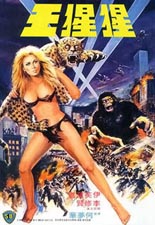
 Hong Kong King Kong! This Shaw Brothers take on the giant-monkey-gone-ape story is so unintentionally hysterical that even joking about it in print doesn’t do it justice.
In a remote jungle, an earthquake — simulated via unbelievably bad rear-screen projection — unleashes a giant gorilla from the mountain. If you’re fishing for an explanation as to why, how or what a giant gorilla was doing in the mountain in the first place, forget about it. Just know that he doesn’t care much for being out of the mountain, so he steps on a lot of screaming villagers and destroys a lot of obviously miniature miniatures.
The Mighty Peking Man (I’m not sure how he got that name, either, but I’ll just call him “Peking” for short) befriends Samantha, a little girl whose parents’ plane crashes in the jungle (or rather, lands pretty gently for a toy model). Thanks to Peking’s unparalleled parenting skills, she grows up to be quite the sexpot. Played by Evelyne Kraft (The French Sex Murders), she looks like Farrah Fawcett crossed with a Barbie doll, which I admit is kinda redundant. Samantha wears nothing but an all-too-skimpy loincloth and (inexplicably) makeup. She communicates only through primitive words and grunts, but since she’s not shy at showing her ass, the guys who meet her don’t mind her language limitations.
 Specifically, I speak of Johnnie (Danny Lee, City on Fire), the helmet-haired man sent by some organization to find this Peking man, reputed to be mighty. Johnnie succeeds — and then some, as he mates with Samantha in no time, making Peking jealous when he catches them mid-coitus. (Do you really want to be copulating with a woman who’s lived in the jungle all her life and, therefore, doesn’t have access to all the fine hygiene products we take for granted?) The lovebirds celebrate their coupling by taking part in a syrupy, slow-motion montage, in which they twirl tigers draped across their backs and run across sun-bathed fields, so that Kraft’s nipples can slip in and out of her costume and preserved for historical posterity.
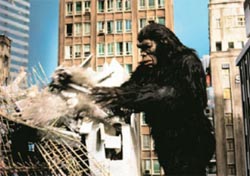
Then they chain Peking to a large boat and take him to Hong Kong, where they will reap riches by showcasing him in a variety of games in a stadium setting, like a monster truck pull — literally a monster truck pull, as what is Peking but a monster, and he is shown yanking on several trucks chained to him. Combined with all the prodding with sticks, this pisses Peking off to the point where he escapes and goes loco in downtown Hong Kong, ultimately climbing atop a tall building so that — having seen any King Kong movie — the viewer knows exactly what will happen.
And it does, but in such a laughably cheap and shoddy technique, in order to stay within the context of this incredibly goofy, incredibly fun film, known in some circles as Goliathon. —Rod Lott
Buy it at Amazon.

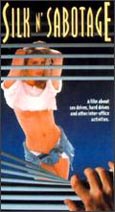
 Even at just over an hour, the erotic comedy Silk n’ Sabotage proves unwatchable. A dim-bulb blonde with surgically enhance girlie features (Julia Kruis) has created a computer game that an iron-jawed lothario steals while seducing her.
  Since that plot leaves the film ripe with endless possibilities, virgin director Joe Cauley throws in a roommate who holds lingerie parties four nights a week, another roomie whose pastime is writhing in front of a mirror and a couple of guys who break into the girls’ house on a near-nightly basis for sexual congress.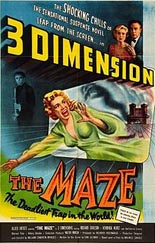
 Originally shown in 3-D, the “old dark house” thriller The Maze should be called The Castle, or The Castle with a Maze, if they wished to be more specific. Directed by William Cameron Menzies (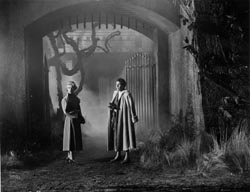
 On the night of a full moon, poor Arlene is murdered. One of her socks is missing from the scene, proving we live in such a