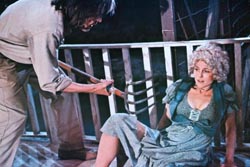
 Twenty years after the death of tortured painter Legnani (Tonino Corazzari, Le strelle nel fosso), a restorer is hired to complete the artist’s mural on a church wall in a small, picturesque Italian village. Stefano (Lino Capolicchio, The Bloodstained Shadow) arrives to find a disturbing portrait of a saint whose naked, tied-down body bears seeping wounds from being daggered several times over.
Not for nothing was Legnani known around town as the “Painter of Agony,” for he liked to depict men and women at the precipice of meeting their maker. Stefano finds a tape recording of Legnani droning on, near-orgasmically, about the “purity of death,” which leaves our protagonist with an eerie feeling that he’s not being told everything surrounding this temporary gig. Of course, his inclination is spot-on.
 As Stefano sets out to stick his nose into Legnani’s legacy and history, not to mention the story behind this unfinished fresco, death rears its head — suicide or murder? The path of Stefano’s unofficial investigation is paved with an elderly paraplegic woman, two hot-to-trot teachers, a rat-eating altar boy, a fridge full of live snails, untold numbers of shadows and secrets, and eventually, The House of the Laughing Windows.
At one point, Stefano’s love interest (Francesca Marciano, Seven Beauties) remarks, “The gloomy darkness is romantic. Right?” — a line which nails much of the appeal of the Gothic film by Pupi Avati (Revenge of the Dead), which takes a turn toward horror in its final moments. There’s not much to the easily solvable mystery, but it’s fun to watch it unfold — or flop out, as the case may be. As with many Euro shockers of the period, atmosphere mitigates shortcomings. —Rod Lott

 In Bangkok, 32-year-old Yamaha instrument salesman Phuchit — “Chad” in the English dub — is fired at the most inopportune time: when he is in debt to the tune of tens of thousands. Potential salvation arrives in the form of an anonymous cellphone call inviting Phuchit (Krissada Sukosol,

 Parents, as tempting as it is, do not conduct an autopsy on your spouse in front of your 6-year-old boy. He’ll only grow up to be the kind of man who kills prostitutes just so he can slice off their faces and wear them over his own like dime-store Halloween masks. This probably goes double if your last name is Skinner.