
All posts by Rod Lott

The Argento Syndrome

argentosyndromeAs a fan of Dario Argento myself, I feel as if Derek Botelho wrote The Argento Syndrome just for me. Although Maitland McDonagh’s Broken Mirrors/Broken Minds is arguably the definitive book on the director famously dubbed (and derided) as “the Italian Hitchcock,” Botelho’s has the edge for pure entertainment value. Both books are musts for the filmmaker’s followers, as each takes a different tact.

While Botelho curiously fails to delineate Argento’s films on a year-by-year timeline, he covers Argento’s directorial efforts chronologically. Whether largely or nominally giallo (with one sex comedy sticking out like a sore penis), each movie merits its own chapter, from 1970’s wildly influential The Bird with the Crystal Plumage to 2012’s imperfect but harshly judged Dracula 3D.

The result? A thoroughly winning, armchair-style examination of a distinguished career, supplemented by wonderfully stylistic illustrations by Micha Maté to introduce each chapter and interviews of key players when the author could get them. Bonus points are due to Botelho for including Argento’s TV work, particularly 1973’s four-episode Door into Darkness anthology series, and for actually having something to say. Sadly, many indie film books lack this latter element, opting instead for fanboy service instead of genuine introspection.

Published by Bear Manor Media in a oversized paperback format as splashy as the director’s saturated colors, The Argento Syndrome sports a nifty design that complements the text. Only one thing bugged me about Botelho’s book: the chapters in which he recounts his face-to-face meetings with Argento and his famous daughter, Asia (xXx). These come off too starstruck, which I’m guessing was not the first-time author’s intent; the problem is not a fatal one because he calls Argento’s turds when he sees them, so his objectivity appears to remain intact. —Rod Lott

Get it at Amazon or Bear Manor Media.

What the Peeper Saw (1972)

whatpeeperBoobies. In a word, that’s What the Peeper Saw.

In the British pervo-chiller, the Peeping Tom in question is named Marcus (Mark Lester, Oliver!), a 12-year-old just home from boarding school, presumably due to a chickenpox outbreak. This gives Marcus an opportunity to finally meet his hot stepmother, Elise (Britt Ekland, The Man with the Golden Gun), and perhaps even bond with her, since Dad is stuck in Paris. As the saying goes, while the cat’s away, the mice will feel up New Mom.

To be honest, she doesn’t exactly discourage the “attention,” either. In fact, the day after Marcus reaches from his bubble bath to cop a clothed feel, Elise practically rushes to towel him off as he emerges from the pool. That’s nothing compared to the movie’s most infamous scene, in which Elise strips nude for the tween in exchange for information. (For all the unsimulated squeezes she endures in an hour and a half, poor Britt deserved hazard pay.)

whatpeeper1But, hey, S-E-X is only part of Peeper’s picture. Its real thrills — benign they may be — stem from Elise’s increasing suspicion that Marcus may have murdered his own mother years ago, which means she may be next. And thus unfolds a tale of mistrust, jealousy, voyeurism and pussycat torture.

And it’s not like Elise hinders the kid’s psychopathic tendencies, either: “Hello, genius. What are you reading? De Sade?” she cracks. “Did you love your mother?”

Bottom line: Elise may have been born without maternal instincts, but Marcus is, unquestionably, one odd duck. So is this flick, co-written and co-directed by Andrea Bianchi, who, believe it or not, went even more unnerving in the department of incestuous overtones with 1981’s Burial Ground: The Nights of Terror. If you’ve seen that slice of zombie sleaze, you know The Scene. (And if you don’t, you owe yourself a nip of rectification.)

For all its bizarre themes and, um, touches, What the Peeper Saw barely qualifies for one viewing. Bianchi and cohort James Kelley (The Beast in the Cellar) appear to have written themselves into such a corner, they decided the best route for a wrap-up was to go off the rails. En route to the end credits, they deliver an utterly baffling ending that, while leaving questions floating, at least retains the film’s oh-so-sour disposition. —Rod Lott

Get it at Amazon.

Eyes of a Stranger (1981)

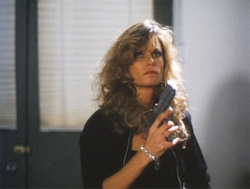
eyesstrangerJane Harris (Lauren Tewes, best known as Julie, Your Cruise Director on TV’s The Love Boat) is your stereotypical big-haired anchor for the local news in Miami, except for her bad habit of cutting off her male counterpart and going off-script to editorialize about the serial rapist/killer terrorizing the city. As she tells her boyfriend, “This rapist thing is really getting to me!”

And how. Spotting a suspicious fat guy (John DiSanti, The Presidio) changing clothes in their twin-tower apartment building’s parking garage, Jane assumes he’s the hosiery-headed culprit, starts sniffing around his business and eventually gives him the Rear Window treatment.

eyesstranger1Eyes of a Stranger, as if you needed telling, is no Rear Window. Nor is it supposed to be. Ken Wiederhorn, director of the Nazi-zombie chiller Shock Waves (clips of which can be seen on the tubes of a couple of characters), knows he’s making a B-level psycho-thriller — no more, no less — and thus makes Eyes watchable. For all its genericness, it’s almost comfort food in how utterly every-step-predictable it plays, right down to each victim’s teasing display of nudity and other elements watered-down from the era’s slashers.

That he gets a good performance from Jennifer Jason Leigh (The Machinist), however, as Jane’s blind and deaf sister, seems accidental. That’s all her. —Rod Lott

Get it at Amazon.

Death on the Fourposter (1964)

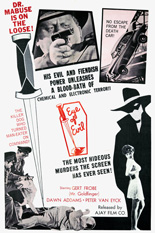
deathfourposterA pre-giallo obscurity, Death on the Fourposter plops six couples into a bona fide castle for one swingin’ weekend. The place is a “mansion of pleasure” as far as the guys are concerned, but maybe not so much for the ladies: It has only one bathroom.

Co-directed by Jean Josipovici and Ambrogio Molteni, neither prolific, this Italian mystery also saw release as Sexy Party, which although silly-sounding, is absolutely apt. Perhaps the film’s embodiment of the sensual is Serena (Antonella Lualdi from Claude Chabrol’s A Double Tour), who livens up the shindig beyond mere dancing to jazz LPs on the hi-fi when she proposes a rather carnal take on Truth or Dare, such as betting the boys she can seduce them within seconds. If she can — and she knows she will because she’s pretty hot and knows that, too — their girlfriends must submit to the desires of another man there for a few minutes. Gambling has never been so erotically charged.

deathfourposter1So, uh, where does the Death come in? Without revealing too much, Serena’s head games give way to a séance; it works, and not everyone lives to see the sunshine. Viewers’ unfamiliarity with the no-star cast works to the distinct advantage of this rough gem, in that conceivably, anyone could make an early exit. The lone exception might be John Drew Barrymore, star of the JD-flavored teenpic High School Confidential and father of Drew, but could you pick him out of a lineup? Not likely, even after exposure here. —Rod Lott

Get it at VCI Entertainment.

Long Weekend (1978)

longweekendRecipe for a Long Weekend? Easy!
• Ingredients: one bickering married couple.
• Place in: car for road trip to Australian beach.
• Add: some really pissed-off wildlife.
• Serves: ’em right!

In this well-regarded, man-vs.-nature chunk of Ozploitation, Peter (John Hargreaves, Sky Pirates) and Marcia (Briony Behets, 1980’s Nightmares) attempt to repair the shambles of their shit-can marriage by going on a holiday — that’s “vacation,” Yanks — of smokin’, swimmin’, sunnin’, shootin’ and maybe — just maybe — sexin’! You know it’s not going to go well because they barely can stand each other’s presence, run over a kangaroo, trespass on private property, throw trash in the ocean, chop down trees for the hell of it and bring his-and-her Adidas jackets.

longweekend1Halfway through, an eagle attacks — not without damn good reason — and Long Weekend becomes an Aussie version of William Girdler’s Day of the Animals, but with even more of an ecological message (i.e. “humans are assholes”) — so much so that Rachel Carson might see the film as a screwball comedy.

A hint of the supernatural is at work here, and honestly, director Colin Eggleston (Cassandra) should have employed much more of that and much less of the spouse’s verbal firebombs (“self-indulgent maggot”). Peter’s a jerk; Marcia’s a jerk; and their dog, Cricket, is the only likable character. You may even root for the canine to turn against his masters.

Why not, Cricket? Every other member of the animal kingdom does. That very conceit is what sells viewers on embarking on a Long Weekend, yet the film doesn’t use it enough. Eggleston seems more interested in hammering home an obvious point by cutting away to ants swarming over bacon in increasing stages of decomposition. As Marcia herself bursts, “Spare me the grotty symbolism!”

Aside: Did Everett De Roche write every horror-thriller pic that made its way from Down Under to the United States? Besides this, he penned Patrick, Road Games and Razorback—Rod Lott

Get it at Amazon.