
All posts by Rod Lott

Abraham Lincoln: Vampire Hunter (2012)

abelincolnVHFour score and seven years ago — or was it 2012? — two studio pictures, each budgeted around $65 million, portrayed our nation’s 16th president as a larger-than-life, all-American hero. Whereas Steven Spielberg’s Lincoln could boast of taking home two Academy Awards, only Timur Bekmambetov’s Abraham Lincoln: Vampire Hunter portrayed him as an ax-twirling ass-kicker.

Let’s see you do that, Daniel Day-Lewis! If he had, it wouldn’t make the movie any better; sitting through this Lincoln log is like a night at Ford’s Theatre in Washington, D.C., and you’ve got an upper-right box seat. (Too soon?)

By day, a pre-politics Lincoln (Benjamin Walker, Kinsey) works as a shopkeeper, attempting to woo regular customer Mary Todd (Final Destination 3’s Mary Elizabeth Winstead, here looking like a porcelain doll and/or a Campbell’s Soup Kid). And largely by night, he is devoted to killing the monsters who deprived him of a mother since childhood.

Despite the apparent novelty of putting the red stuff in the White House, Abraham Lincoln: Vampire Hunter suffers from being just another watered-down vampire movie. Seeing the bloodsuckers fling live horses at those who wish to stake them is new. Then again, so is stopping the movie cold for a rousing speech by abolitionist Harriet Tubman (Jaqueline Fleming, Contraband), as if to lend PC integrity to soulless fantasy. Our leading man is as wooden as the trees Lincoln chops; on the other hand, Winstead acts her heart out, as if no one told her the project was junk.

As with Wanted, Bekmambetov nurtures a directorial flair that is not just style over substance, but style smothering it. Tim Burton producing only encourages the Russian filmmaker’s worst sensibilities, and your reaction to this flick is tied directly to your tolerance for his affinity to take an action move from regular speed to slow motion and then back to regular speed again, all within the same edit. The mashup of horror and history is a joke that should have ended with screenwriter Seth Grahame-Smith’s 2010 novel, and that long-in-the-tooth best seller should have been a short story.

But other than that, Mrs. Lincoln … —Rod Lott

Get it at Amazon.

Octopussy (1983)

octopussyWhat I remember most about seeing Octopussy in the summer of 1983 is that my overprotective mother actually took me, then 12, and my 9-year-old brother to see a movie titled Octopussy. This was, after all, a woman who forbade us from rewatching Grease 2 because it was “too racy,” and yet here was a film more or less bearing the name Eight Vaginas. I guess because it was a 007 adventure, it was deemed okay.

The only other things I remember about it was that James Bond snuck through a lagoon in a tiny submersible disguised as a crocodile, which is pretty cool, and that James Bond dressed up as a goddamn circus clown, which is not. So how in the hell did I forget the most cringeworthy part: James Bond swinging on jungle vines as Johnny Weissmuller’s famous Tarzan yell yodel-ay-hee-hooed on the soundtrack?

I have a theory: Because Octopussy makes for a dreadfully dull picture. If it isn’t quite the single-worst entry of the franchise, it can take a quantum of solace that its Rita Coolidge theme song is.

octopussy1Officially the 13th 007 installment — and the penultimate go-round for Roger Moore — the pic gets off to a good start as our secret-agent hero pilots a one-man plane out of a horse’s ass, but in this series, those pre-credit sequences — all part of the tried-and-true formula — have zip to do with the story that follows. That to-do involves Fabergé eggs, nuclear weapons and Maud Adams’ nether regions — a full seven uteri short than what’s promised.

The only Bond Girl to play two leads, having brightened The Man with the Golden Gun, Adams fills the role of villainess and, of course, but one of Bond’s conquests; every woman with whom he comes in contact wants to bed him — even the menopausal ones. (Yes, you, Miss Moneypenny.) How did 007 not contract the AIDS virus?

Because he’s a master of escape, duh. Those chase scenes are when John Glen (in his second of five turns as 007 director, from For Your Eyes Only to A View to a Kill) seems to wake up and rouse the film along with him. Standing out is the sequence in which Bond, in a three-wheeled taxi, is pursued through a crowded marketplace in India and utilizes the stereotypical sword swallowers and fire walkers to best his enemies. Those bits are intentionally amusing, but shoved among them is a supremely silly sight gag on tennis that has no business being here; I suspect producer Albert “Cubby” Broccoli stuck it in just to nudge and wink at his buddies back at the club. —Rod Lott

Get it at Amazon.

The Human Centipede III (Final Sequence) (2015)

humancentipedeIIIFrom the start of his highly peculiar and “100% medically accurate” franchise, writer/director/producer Tom Six promised that The Human Centipede III (Final Sequence) would make the previous two films appear tame. While I disagree with that statement — for sheer gross-outs, 2011’s The Human Centipede II (Full Sequence) still takes the urinal cake — Six has succeeded in making this concluding chapter as unique as II was to the 2009 original.

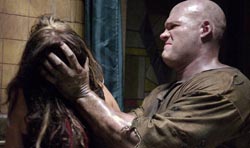
For this bitter-tasting end, Six goes meta, casting the madmen of parts I and II as the co-leads of III, albeit playing completely different characters who comment upon those movies and their mouth-to-anus concept as a hole. Er, excuse me: as a whole. All the action goes down (as it were) at Texas’ most inefficiently and ineffectively run penitentiary, the George H.W. Bush State Prison. That concrete jungle is ruled with a Teutonic fist by the vile, megalomaniacal Bill Boss (the first Centipede’s Dieter Laser, still channeling Christopher Walken and a lizard), a bald bully of a man who takes less pleasure in sexually harassing his secretary (porn star Bree Olson, Not Bill Cosby XXX: Puddin’ My Dick Where It Don’t Belong) than he does torturing his inmates: waterboarding, castration, breaking a guy’s “masturbation arm.”

humancentipedeIII1Boss’ predilection for abuse negatively impacts the facility’s medical budget, thus annoying its roly-poly accountant, Dwight (Laurence R. Harvey, Centipede II’s miserable copycat). As a solution toward solvency, Dwight pushes Boss to consider taking a cue from the Human Centipede films and build their own 500-prisoner version as “the ultimate deterrent.” Posits Dwight, “It’s brilliant! We don’t gotta deal with their shit no more. They just gotta deal with each others’.”

That the Centipede trilogy isn’t for everyone is an understatement, but its poopy-and-goopy reputation as irredeemable trash has been overstated by those who never have seen it, never planned to and never will. As abhorrent as you think them to be — and I’m not denying their explicitness in shock value, although more goes unseen than you’d expect — there’s an art to them. Really. And it does not lie beneath the surface, either.

In this capper, what Six — who plays himself, brought in to consult for the en masse surgical procedure — has amped up is not the red-and-brown gore, but the black comedy. Every minute of this Final Sequence is played for laughs as a post-Guantanamo satire of capital punishment, criminal rehabilitation, politics for profit and, to a lesser degree, meme culture. Whereas the first film actually showed remarkable restraint (believe it), going over-the-top is entirely Six’s point here. And the point is more than made; the message is impossible to miss. That it is told with jokes about stoma and Chron’s disease attached is … well, “brave” is one word for it.

With Final Sequence’s final sequence, the trilogy achieves closure, even if that leaves us with an infinite loop. And sew it goes … —Rod Lott

Get it at Amazon.

The Blind Swordsman: Zatoichi (2003)

zatoichiThe Blind Swordsman: Zatoichi, Takeshi “Beat” Kitano’s brilliant update of the enduring Japanese cult hero, is quite an achievement — not just for the writer/director/actor, but contemporary Asian cinema as a whole. All too often in the continent’s genre pictures, arguably even more so than America’s dumbest rock-’em-sock-’em blockbusters, the story takes such a backseat to the action — if there’s even a story for starters — that it renders itself impenetrable or invisible.

With wave-of-the-hand ease, the 2003 Zatoichi could have done the same thing, lazily relying on its target audience’s fond memories of the character as shorthand (as he has no fewer than two dozen features built around him, starting with The Tale of Zatoichi in 1962 and later followed by a popular television series). Instead, Kitano (perhaps best known on these shores as the teacher of 2000’s Battle Royale) first infused the character with a real emotional pull and then fashioned a plot around it that fits as well as a sword in its custom sheath.

zatoichi1More or less homeless, the aging masseur Zatoichi wanders village to village, coming upon a farming community where he settles with a kind family. He soon finds enemies, however, at the local gambling parlor. As the title reveals, Zatoichi may be blind, but wields a mean sword — as swift as it is sharp — only when he needs to. And when he does, the combat is brief — a few seconds and it’s over; no massive, Kill Bill-style set pieces as showdowns to be found here.

What really makes this Blind Swordsman adventure work with Greenwich Mean Time precision is Kitano’s utterly charming and even funny performance. He’s wholly winning. I loved the film so much that even its decision to end in a musical number failed to change my mind. Hell, it even cemented it. —Rod Lott

Get it at Amazon.

My Name Is Modesty: A Modesty Blaise Adventure (2003)

mynamemodestyDespite toiling as a sexy spy, the comic-strip character Modesty Blaise never quite caught on in America. A 1966 movie based on Peter O’Donnell’s creation, Modesty Blaise, was made anyway, with Monica Vetti and Terence Stamp. It tanked.

A few decades later, Miramax had the great idea of reviving Blaise for an intended series of action-packed films; arbiter of pop-culture taste Quentin Tarantino agreed, hopping aboard as a producer. Whereas Natasha Henstridge and Reese Witherspoon were mentioned for the role, no one was cast until Miramax’s rights were due to expire. Only then did the indie studio rush a Romanian-lensed prequel into production. Shot in 18 days by Tarantino pal Scott Spiegel (From Dusk Till Dawn 2: Texas Blood Money), it stars neither Henstridge nor Witherspoon, but the unknown (and, looking malnourished, unsexy) Alexandra Staden (Alexandra Staden, The Task). Is this any way to start a franchise?

mynamemodesty1The answer is, as My Name Is Modesty makes painfully clear, no. The string-beaned Modesty pulls double duty as a casino card dealer and bodyguard. When its owner is brutally murdered and the joint’s fully vested employees taken hostage by the killer Miklos (Nikolaj Coster-Waldau, Mama), Modesty keeps her cool and makes a wager with him. They play roulette, and whoever wins the round earns a reward: she, a released hostage; he, personal intel about Modesty.

This being fiction, Miklos has absolutely incredible luck at the wheel, as he wins nearly every spin. Thus, Modesty fills him in on her upbringing — cue the flashbacks! — as a filthy orphan saved by a kindly old professor (Fred Pearson, 1994’s Priest) who taught her reading and kung fuing.

Modesty and Miklos talk and talk and talk and talk. And talk! Then, at the movie’s tail end, some half-assed gunfire and utterly weak martial arts erupt. Sad to say, but this tiny film — one that, at just 78 minutes, barely qualifies as one — takes place in one room and sorely lacks action, suspense, espionage or intrigue. And yet the powers that be at Miramax still had the gall to subtitle it A Modesty Blaise Adventure. (To be fair, that four-word subtitle is 75 percent representative of the flick’s contents.)

The one-room set isn’t the only tip-off that Miramax didn’t shell out more than a pittance for this sluggish mess. Another big one is its look, bearing the drab visage of a syndicated TV action hour. Worse, with the generic music, the chintzy title sequence that incorporates scenes we’ll soon see, the questionably attractive actresses and the swarthy-looking muscular males, the secret-agent origin story threatens to turn into softcore Cinemax fare at any moment.

But don’t go looking for flesh. Her name is, after all, Modesty. —Rod Lott

Get it at Amazon.