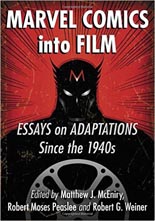
 You kids have no idea how good you have it! Avengers fighting Avengers in an all-out superhero melee in Captain America: Civil War? The comics-obsessed, grade-schooler me would’ve cut a bitch to see that! Alas, ’twas the ’70s, when we had to make do with Reb Brown on a star-spangled motorcycle — made for TV, no less! And yet, memories of those “golden years” are what makes McFarland & Company’s Marvel Comics into Film: Essays on Adaptations Since the 1940s such a blast to read. Edited by Matthew J. McEniry, Robert Moses Peaslee and Robert G. Weiner, the collection could just focus on the current Marvel Studios product and have plenty to write about, but luckily casts its net wider, to a point that may put off this generation’s fanboys weaned purely on the Phase One / Phase Two marketing initiatives alone — their loss! Being that kid who had to dream of a world of superhero movies, the standout pieces for me were those by Arnold T. Blumberg, David Ray Carter and Jef Burnham on, respectively, “the First Marvel Television Universe,” the aforementioned early Cap movies (including Cannon’s ill-fated 1990 version) and the “Small Screen Avengers.” That’s not to say other chapters didn’t tickle my four-color fancy, either, whether digging into the Conan the Barbarian franchise, Ghost Rider’s connection to Goethe’s Faust, Japan’s live-action Spider-Man series, George Lucas’ infamously character-misjudging Howard the Duck feature or David Hasselhoff’s turn as Nick Fury: Agent of S.H.I.E.L.D. Look, any textbook that unironically compares the Punisher performances of Dolph Lundgren, Thomas Jane and Ray Stevenson clearly is one kick-ass textbook. ’Nuff said.
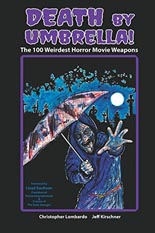 Machetes, finger blades, butcher knives? So passé. Menorahs, breasts and bongs are really where it’s at. And by “it,” I mean the means used to kill guys and gals in terror-tinged cinema. Co-authors Christopher Lombardo and Jeff Kirschner are like an overly morbid Casey Kasem, counting ’em down in Death by Umbrella! The 100 Weirdest Horror Movie Weapons, released by BearManor Media in the indie publisher’s usual dual hardcover and paperback editions. Separated by category (kitchen utensils, sports equipment, etc.), each tool of execution earns its own description of the gory details, but in setting up each kill, the co-authors actually are providing a full-fledged review of the movie in question, thus making the book more than a mere list. Lovingly written with verve for the viscera, Death by Umbrella is fun and funny as it covers scenes both iconic (Happy Birthday to Me’s shish kebab, which doubled as its poster art) and arcane (Discopath’s slabs of vinyl). Only a few times do the guys pull from outside the genre (Paul Thomas Anderson’s Oscar-anointed There Will Be Blood being the most egregious non-slasher), but we’ll forgive. After all, they can sate your curiosity surrounding DTV trash like Super Hybrid in order to save you from sitting through it.
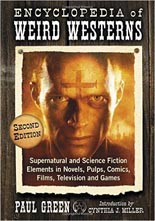 Paul Green’s Encyclopedia of Weird Westerns: Supernatural and Science Fiction Elements in Novels, Pulps, Comics, Films, Television and Games — Second Edition obviously aims for a niche-of-a-niche readership, and luckily for it, this reviewer happily counts himself among that group and, therefore, welcomes such a project that others may dismiss as “why bother?” waste. First published in 2009, this McFarland trade paperback moseys into your TBR pile with 47 additional pages so now we can read about more recent items, like the Jonah Hex movie. Green is not a critic — at least not within the confines of this book, which is a true encyclopedia as the title claims. Arranged from A to Z, entries are strictly factual in nature, ranging from one sentence to half a page. Success of these highly specialized reference texts is measured twofold: 1) that it includes every test you throw its way (the indie Western Tales of Terror comic book is here, as is NBC’s 1979 anthology show Cliffhangers), and 2) that it introduces you to obscurities so esoteric, they sound invented (Action Comics #311, the issue concerning “The Day Super-Horse Became Human”). Richly illustrated, most pleasingly with comic-book panels and pages, Weird Westerns errs only in the occasional questionable inclusion: Avatar, Mr. Green? —Rod Lott
Get them at Amazon.

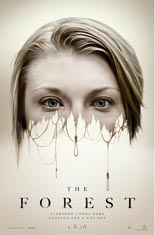
 If a tree falls in The Forest, well … that might wake this lumbering giant of a horror picture. Lord knows it could use it.
  Unlike our heroine, viewers aren’t likely to get lost in The Forest, because first-time feature director Jason Zada (co-writer of The Houses October Built) follows the template established by nearly every PG-13 horror film funded by a major studio; everything you expect to happen, does. At best, The Forest is subpar supernatural, beginning with legitimate ambience (as did another American-girl-in-Japan tale, The Grudge), squandering that once Sara enters the titular site, and cribbing its lone good bit directly from Insidious.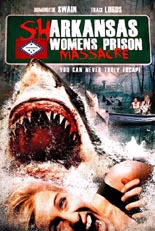
 A shark movie with no tension or thrills is like a Jim Wynorski flick with no nudity. Unfortunately,