
All posts by Rod Lott

In a Valley of Violence (2016)

invalleyFlying in the face of probability, Ethan Hawke has two Westerns in theaters at once: The Magnificent Seven and In a Valley of Violence. The difference? About $89 million and, here, Hawke screaming at a vulture.

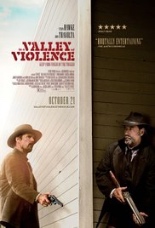
Moseying away from the genre that established his often-brilliant career, indie-horror darling Ti West (The Innkeepers) saddles up for a simple tale of a Civil War vet en route to Mexico. Accompanied by his trusty attack dog (Jumpy, Pups United), Hawke’s Paul stops in the one-horse town of Denton, Texas (where the traffic has yet to suck), to sit a spell. The local bully, Gilly (James Ransome, Sinister 2), takes offense to this stranger not showing him the respect he believes he is owed, all because his bum-legged father is the town marshal (John Travolta, whose recent I Am Wrath revels in similar vengeful themes). Gilly and his yellow-bellied trio of lackeys commit two horrific acts of violence (true to the title), for which Paul vows revenge … assuming he lives through it.
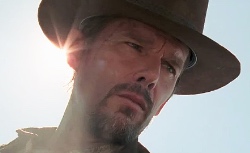
invalley1There is not much to this Valley, which is entirely West’s intent as writer and director — not just here, but his work in general. The picture is streamlined, efficient — a straight-and-narrow cowboy’s hat tip to Sergio Leone’s Dollars trilogy of spaghetti Westerns, starting with co-opting its animated credits. It is John Wick set in the 19th century, trading neon for dust, business suits for boot spurs.

“Those men left me with nothin’,” Paul says. “I’m gonna leave them with less.” And the film shines as an example of less being more. While not totally giving up elements of horror (read: blood spurts and spills with gory aplomb), West proves his minimalist approach to visual storytelling works as well on the frontier as it does in provoking fright. Hawke is reliably strong, while Travolta is tempered from his tendency to ham. The pic, however, belongs to Ransome, stealing the spotlight as he adds another role of weaselly menace to his mantle. —Rod Lott

Get it at Amazon or Focus World.

Die Hard: The Authorized Coloring and Activity Book

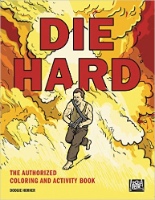
diehardcolorMethinks this coloring-book craze for adults has gotten way out of hand, and it was questionable to begin with. Now we have Die Hard: The Authorized Coloring and Activity Book welcoming itself to the party, pal, and it is at once a coattails-riding cash grab for 20th Century Fox and a knowing parody of the fad by stand-up comedian Doogie Horner, who wrote and illustrated and clearly has more talent than should be allowed for one human.

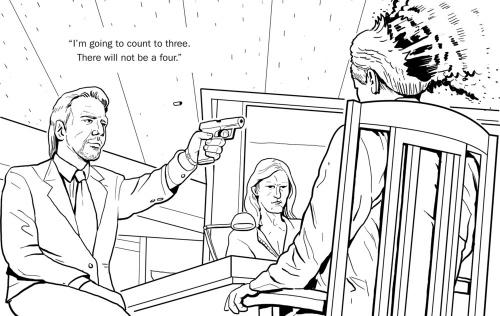
Here, in 80 oversized pages, Horner (author of 2010’s amusing Everything Explained Through Flowcharts) retells the tinsel-and-terrorists tale of Bruce Willis’ smash hit of the summer of 1988, through ready-to-color iconic scenes of the Christmas Eve siege on Nakatomi Plaza.

diehardcolor1

What sells the joke, however, are its activity pages, such as:
• connecting the dots to find out what message Willis’ John McClane wrote on a dead terrorist’s shirt,
• maneuvering a barefoot McClane through a maze of broken glass,
• and “John just killed Karl’s brother. Draw Karl’s face to show how he feels about that.”

While not quite a yippee-ki-yay, it would make a fine gift for rounds of Dirty Santa this coming holiday season. —Rod Lott

Get it at Amazon.

When Nature Calls (1985)

whennaturecallsEasily one of the best flicks in the Troma Entertainment library, When Nature Calls looks like it was concepted, written and shot all within a day’s time. At any rate, it’s still fairly funny. Although it tries to be a scattershot spoof in the Airplane! vein, it works best when director and co-writer Charles Kaufman (1980’s Mother’s Day) doesn’t try to cram a jillion things into the frame.

No plot exists; the shell of the picture follows a suburban family as its members move from the big city to the great outdoors for no particular reason, other than to thumb its nose at many an outdoor family film, from Old Yeller to the Adventures of the Wilderness Family. For example, in one of its best sight gags, animals from the whole of both hemispheres reside together in the forest.

whennaturecalls1The daughter rapes a bear and becomes pregnant. Some four-legged friends are tortured. Stock footage of a vicious cougar threatens the family unit. C-level celebrities like Morey Amsterdam, Willie Mays, John Cameron Swayze and G. Gordon Liddy make pointless cameos. In an early-career role, future Oscar nominee and Bourne Identity franchise player David Strathairn plays Weejun, “the Kaopectate Indian,” who befriends the fam.
If you make it to the intermission sequence, you’ll be treated to a wickedly funny parody of that classic animated commercial that enticed drive-in patrons to hightail it to the lobby for sticky and/or sugary concessions. It begins with the usual dancing candy bars and soda cups, before a couple of frankfurters snort coke and commence bodily gratification. Although sloppier than a sloppy joe, When Nature Calls possesses enough good throwaway gags like that to merit a viewing. —Rod Lott

Get it at Amazon.

Two-Minute Warning (1976)

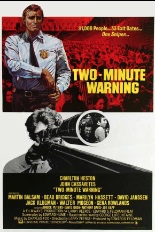
2minwarningNearly a quarter-century before he famously dared Washington, D.C. to pry his rifle “from my cold, dead hands,” Charlton Heston tried to separate a sniper from his weapon of choice in the sports-world thriller Two-Minute Warning. Talk about a political flip-flop!
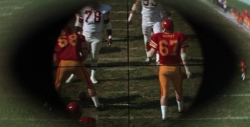
In his fourth disaster film (following Skyjacked, Airport 1975 and Earthquake), Heston stars as Capt. Peter Holly, in charge of the LAPD’s plan to foil a gunman’s plot to open fire on the L.A. Memorial Coliseum’s crowd assembled for a championship football game. Perched atop a scoreboard and in preparatory mode, the sniper (Warren Miller, Married to the Mob) is glimpsed first by the camera blimp overhead. Cops are alerted, and enter Holly and SWAT Sgt. Button (John Cassavetes, Rosemary’s Baby). The two talk strategy and mention no fewer than three times the unfortunate maintenance man who got “butt-stroked off the ladder.”

2minwarning1The sniper’s target? Oh, just about 100,000 pigskin fans, but to guess who will bite the bullet(s), place your bets on the bleachers’ numerous famous faces, including Walter Pidgeon (Forbidden Planet) as a pickpocket, Jack Klugman (TV’s Quincy, M.E.) as a gambler and Beau Bridges (Max Payne) as a hothead father who slaps the shit out of his young son for revealing Dad’s employment status (read: not) to the pennant salesman. Playing themselves are Howard Cosell, Frank Gifford, Merv Griffin and Andy Sidaris, then an Emmy-winning sports director vs. the Russ Meyer of action flicks he would become.

Per disaster-genre regulations, director Larry Peerce (1989’s Wired) continuously revisits the dozen or so subplots like so many spinning plates. It’s tough to tire of a film that walks that tightrope in double time. It is easy, however, to tire of Two-Minute Warning’s maddeningly repetitive musical cue. I forgive Peerce for dropping the needle on it so often, because the eventual melee triggered by the villain’s squeezed trigger is a smorgasbord of fallen (and falling) spectators. —Rod Lott

Get it at Amazon.

Monstrous Nature: Environment and Horror on the Big Screen

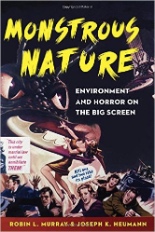
monstrousnatureIt took one childhood viewing of William Shatner taking on a small town’s Kingdom of the Spiders to make me an instant, lifelong fan of the horror subgenre of animal-attack films. Widening the scope to nature overall fighting back against an unappreciative and oblivious populace, Robin L. Murray and Joseph K. Heumann explore how these movies reflect how our culture grapples with our uneasy co-existence with flora and fauna, in their new essay collection from University of Nebraska Press, Monstrous Nature: Environment and Horror on the Big Screen. While I was primed for a highbrow take on a lowbrow topic, I was ill-prepared for how much fun it can be.

It’s important, however, to point out what this book is not: a reference guide, a few of which already exist, including William Schoell’s recently reprinted Creature Features: Nature Turned Nasty in the Movies. What it is is a sharply written, fiercely intelligent examination of their subject, which the co-authors approach from 10 angles and on many more films. It is likely the only book in existence that dares to straw a straight line from Darren Aronofsky’s Noah to Troma’s Toxic Avenger series.

Right away, Murray and Heumann surprise with their unique choices for chapters, contrasting the 1971 Oscar-winning documentary The Hellstrom Chronicle, which warns of insects inheriting the earth on an apocalyptic scale, with the 2009 experimental doc Beetle Queen Conquers Tokyo, a look at Japan’s quirky reverence for the bug; in both cases, the insects are ascribed human traits, but only in the former do they represent our worst. From the 1975 William Castle production Bug to 1988’s Roger Corman-produced The Nest, cockroach cinema — able to take a shortcut to present the vermin as evil by exploiting our collective disgust — goes under the microscope as well.

Monstrous Nature is hardly 100 percent insect-driven, as subsequent sections delve into parasites (e.g. Barry Levinson’s 2012 slapdash found-footage project, The Bay) and cannibals (à la Antonio Bird’s 1999 mismarketed flop, Ravenous, which the authors convincingly brand as “feminist”). From comedic takes on toxic waste (Troma’s Class of Nuke ‘Em High franchise) to body-modification tales (the Soska sisters’ American Mary, whose heroine’s actions earn an interesting comparison to the Cyclosa spider), the book is full of discussions that engage the mind as they trigger your six- and eight-legged fears. —Rod Lott

Get it at Amazon.