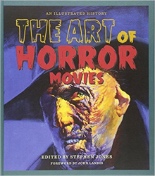
 Two years ago, editor Stephen Jones delivered a coffee-table book for the ages with The Art of Horror, and now he and his gang of talented writers and artists are back for another go-round, this time silver screen-cemented, with The Art of Horror Movies: An Illustrated History. Again published in a handsome hardback by Applause Theatre & Cinema Books, this full-color follow-up tackles its admittedly intimidating mission by slicing and dicing the subject matter into by-decade chapters, starting with a broader look at “The Sinister Silents.” In doing so, whether accidentally or purposefully, the book presents a compelling visual history of cinema’s bastard child, as we see its ad campaigns evolve before our very hungry eyes. While Jones and company primarily are focused on providing broad-stroke, bird’s-eye views, it’s also not unusual to see them get creative in themed pages that celebrate everything from Rondo Hatton and Sherlock Holmes to covers of fanzines and hand-painted flour sacks used in African villages!
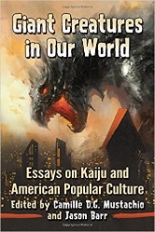 With Kong: Skull Island a massive hit earlier this year and sequels to Godzilla and Pacific Rim already on deck, the oversized-creature feature is enjoying quite the colossal resurgence, and Giant Creatures in Our World: Essays on Kaiju and American Popular Culture is but one piece of the proof. The McFarland & Company release comes co-edited by Camille D.G. Mustachio and Jason Barr, and while the latter dealt with this subject all by his lonesome in last year’s The Kaiju Film, this unofficial (but worthy) companion widens the net to let its contributors dig into the niche. Thus, while Barr theorizes about the nostalgia drive of the adult toy collector, Se Young Kim examines how American superheroes like Spider-Man become enemies of justice when incorporated overseas, and Karen Joan Kohoutek wonders if all those Gamera episodes of Mystery Science Theater 3000 aren’t maybe a wee bit racist. As Godzilla proved in his ’54 debut, rampaging monsters are to be taken seriously, and this collection does just that, examining these cultural giants with the gravity they deserve, but also the fun audiences expect.
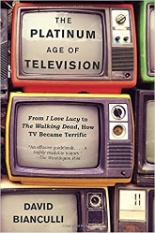 If there will be a better encapsulation of the history and evolution of the medium than David Bianculli’s splendidly penned The Platinum Age of Television: From I Love Lucy to The Walking Dead, How TV Became Terrific … well, I doubt it will occur in my lifetime. A longtime TV critic for NPR, Bianculli takes what had to be a bear of a self-imposed assignment by foregoing the expected chronological route in favor of genre. For each of those — workplace sitcoms, medical dramas, Westerns, miniseries, et al. — he chooses five series that best represent the forwarding of the format and explains not only what they did and how they did it (and, in the case of something like The Smothers Brothers Comedy Hour, how they got away with it), but also how their DNA thrives in the programs of today, in the style of this-beget-that. It’s rather amazing how essays so compact yield so much fascinating material; even the chapters on genres I have no interest in (like war) proved unskippable. Interstitial interviews with/profiles of key players — such as Carol Burnett, Carl Reiner, Ken Burns and, um, Kevin Spacey and Louis C.K. — make an already excellent book that much more rewarding. Tune in immediately.
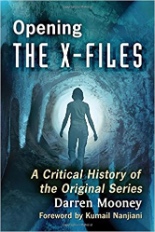 It is strange to remember a time when The X-Files was just another under-the-radar, possibly doomed-to-fail show on the fourth-ranked (and occasionally fourth-rate) Fox network, rather than the cultural touchstone it has been for, oh, two decades and counting. But Ireland-based critic Darren Mooney sure does, and lays out that progression in Opening The X-Files: A Critical History of the Original Series. From McFarland & Company, the book opens with a foreword from superfan Kumail Nanjiani (whose 2017 romcom The Big Sick practically gives the series a subplot) before a headfirst plunge. Admirably, rather than following an episode-by-episode formula, which would get dull, the author discusses each season largely in standalone terms, while weaving in the various spin-offs and 1998 feature film. I’m calling it a success because it made me eager to revisit the Blu-ray box set; in fact, if The X-Files studies were a college course (and I’m sure it is somewhere), Mooney’s book would have to be one of its essential texts. —Rod Lott
Get them at Amazon.

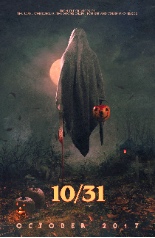
 For a terrific horror anthology in which several directors contribute stories themed around All Hallows’ Eve … stick with 2015’s Tales of Halloween. Sorry to say, but 10/31 is an embarassment for the parties involved, most of all the viewer. Heck, let’s throw the actual date of Oct. 31 in there, too, and encourage it to sue for defamation; the movie is that bad.
 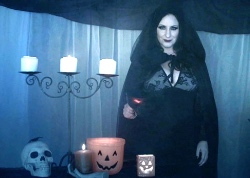 The five stories contained within fall prey to the severe limitations of so many microbudgeted projects of the horror genre: They appear to have been made by men who are fans first, and filmmakers a distant second. What this means is that in each of their shorts, the directors (Justin M. Seaman, Zane Hershberger, John William Holt, Brett DeJager and Rocky Gray) seem concerned only with gore and makeup and John Carpenter-esque synths, to the detriment of acting, pacing and storytelling.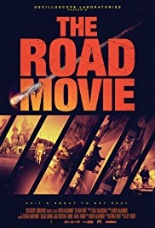
 Here now, something you may not mind the Russians for doing: