All posts by Rod Lott

Lucky Bastard (2014)

At the very least, Lucky Bastard approaches the found-footage trend from an angle I haven’t seen tried: inside the porno industry. Its “document everything” conceit allows us fly-on-the-fly access in HD as porn producer Mike (Don McManus, Paranormal Activity: The Ghost Dimension) persuades his supposedly hottest star, Ashley Saint (Betsy Rue) to, ahem, “do” her first episode of his Lucky Bastard series.

As one may surmise from the title, each installment recruits a fan to co-star, as it were, with the female talent — STD test results permitting, of course. After Mike wears down Ashley’s misgivings and protests, she agrees to have sex with the selected regular Joe — in this case, Dave (Jay Paulson, Black Rock). Well-meaning but socially awkward, Dave looks like the kind of guy whose Velcro wallet dutifully contains a punch card for Great Clips at the ready, perhaps adjacent to a condom he may never use.

In the run-up to rolling camera, their special guest does and says things that creep Ashley out — so many that she refuses to do the scene. He snaps, in what must be the world’s biggest case of blue balls. With LAPD footage of the grisly aftermath at a Van Nuys home, Lucky Bastard’s prologue tells us right away what the poster’s tagline only echoes: “This will not end well.” We just don’t know exactly how or when (although if you pay attention to the movie’s running time, you can make an educated guess as to when the sparks will hit wick’s end).

When the group stops for a quick lunch en route to set, Dave is so antsy to get depantsy, he complains to Mike that no one watches this portion of his Lucky Bastard series; they want to fast-forward straight to the sex. The movie Lucky Bastard, however, faces a contradictory problem: I wanted them to skip the sex for the storm.

Neither portion satisfies. Moving from the venerable (as an Emmy-nominated writer and producer of TV’s Law & Order) to the venereal for his directorial debut, Robert Nathan asks some interesting questions, like “What if a mentally ill man were chosen for an amateur porn shoot?” yet answers them with less curiosity. More attention seems placed on simulating (?) explicit acts — some pixelated despite an NC-17 rating — than sharing a fleshed-out story. To that end, one can claim Nathan’s picture is perhaps most porn-realistic in the one way a legitimate feature shouldn’t strive to be: dismissive of plot.

The three leads acquit themselves. Paulson is particularly convincing as the outcast powder keg; McManus, appropriately greasy and sleazy; and Rue looks every bit the damaged, button-cute part. Best known for her not-a-stitch performance in 3D in 2009’s My Bloody Valentine, she again demonstrates remarkable bravery in her immodesty, but this time for a project that neither deserves nor rewards her investment. —Rod Lott

Get it at Amazon.

Rampage (2018)

For moviegoers who have longed to see Dwayne Johnson literally arguing with an albino gorilla via sign language, including one flip o’ the bird, Rampage answers your prayers. It also reunites Johnson with his San Andreas and Journey 2 director, Brad Peyton, officially making it a hat trick. Maybe you were praying for that, too?

Based on the semi-classic arcade game of giant monsters destroying buildings, Rampage indirectly acquires its big bads from the heavens when an Energyne corporation space station explodes, raining a trio of canisters across America. Since the jars contain a genetically edited pathogen that causes rapid growth and mutation, each is consumed by and/or exposed to a different animal — conveniently, those of the game: a wolf, a crocodile and that aforementioned ape.

The latter lives at the San Diego Wildlife Sanctuary, where Davis Oyoke (Johnson) works as some kind of souped-up zookeeper. Because he has huge muscles that might also be the product of rapid growth and mutation, Oyoke is a shoo-in at saving the world — or at least the Windy City — when all three creatures converge on Chicago’s Energyne HQ, lured there by radio signals sent by the tech firm’s greedy CEO (Malin Akerman, 2009’s Watchmen) and her ineffectual brother (Obvious Child’s Jake Lacy, either overplaying dopiness or being the only one cognizant of the source material’s campiness).

Oyoke is assisted by Energyne’s former engineer/current whistleblower (Naomie Harris, Spectre), who explains just enough science behind her CRISPR research to make the exceedingly stupid premise plausible. What I didn’t know until after the film: “CRISPR” is actual DNA terminology and not some off-brand air fryer.

Porting his Jumanji-sm appeal straight to another family-friendly piece of IP, Johnson does what he does well, which is rely on his massive charm, even if he recognizes it only goes so far: to when the soullessness of CGI takes hold to render a triple-bout monster mash in that last third. Johnson can stare wide-eyed all he wants, but it doesn’t make the sequence fun. (A one-line exception: “Of course the wolf flies.”) An empty-calorie blockbuster that should play better, Rampage gives you no quarter. —Rod Lott

Get it at Amazon.

Ingagi (1930)

WTFOne has to admire the guts and gusto of the gang behind Ingagi — or would admire if director William Campbell’s very idea and execution weren’t so, well, racist. It’s a historical curio nonetheless.

A color-tinted stew of ethnography and chicanery, the film purports to be a documentary of a 1926 African expedition by one Sir Hubert Winstead. In actuality, Ingagi not only was faked, but much of its safari footage stolen from another movie, which explains why those scenes are of much lesser resolution.

As the opening crawl of exposition informs audiences, Winstead has heard wild stories of a remote village in Africa whose tribesmen adhere to a most unusual yearly ritual: sacrificing a woman to a sex-mad gorilla, simply because they believe the gods demand it. The gods must be crazy! So Winstead and his fellow British explorers head to Africa to take some time to do the things they never had.

Upon arrival, they watch a beggar perform cigarette tricks and play three-card monte with eggs — all a mere prelude to the zoo-as-menu shenanigans on which the bulk of Ingagi is built, from warthogs to wildebeest. Animals encountered and/or hunted include crocodiles, zebras, elephants, leopards, deer, giraffes, ostriches, vultures, rhinos, armadillos, hyenas and fairly tame impala. Many, if not most, of these creatures are killed, with retrieval of the bodies left to Winstead’s native “boys.” Maybe it’s my chronic back pain, but dragging a dead hippo looks like quite the chore.

We also witness a python denied a lunch of lemur, as well as Winstead’s crew setting traps for little monkeys; when one is caught, narrator Louis Nizor chuckles with a tinge of cruelty, “What a duffer!” (Nizor, who fulfilled similar duties a year later for Campbell’s follow-up, Nu-Ma-Pu – Cannibalism, is highly opinionated throughout, remarking on “grotesque baboons” and outright declaring, “Rhinos are stupid beasts.”) For good measure, they “discover” a new animal they dub the “tortadillo,” which is a tortoise affixed with phony wings and tail, looking not unlike a Pokémon precursor.

Infamously, Ingagi’s climax depicts Winstead’s cameramen catching footage of that fabled gorilla nabbing a topless native woman for some interspecies hanky-panky. The big ape is played by none other than Charles Gemora, who donned such a suit in more than 50 movies, including The Gorilla and Island of Lost Souls. After more than an hour of buildup, the sequence is deflating to expectations — fitting for what amounts to a no-taste National Geographic special and forebearer of the mondo mockumentary. —Rod Lott

Get it at Amazon.

Mortuary Academy (1988)

Police Academy’s success was so huge, it predictably led to a glut of slob-comedy imitators that could be pitched — and likely were — with the sentence “It’s Police Academy, but [insert training scenario here].” The best of these was arguably the screenwriters’ own Moving Violations (“at a traffic school”); the worst is a distinction among many contenders, including the leaden Mortuary Academy, appropriately late to the game.

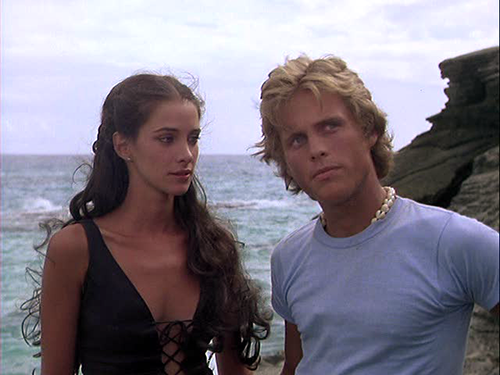
Brothers Max and Sam Grimm are due to inherit their deceased uncle’s Grimm Mortuary & Academy (“You kill ’em, we chill ’em”) on one only-in-the-movies condition: They first must graduate from it. Having no motivation, Sam (Jocks’ Perry Lang) has nothing to lose, but Max (The Blue Lagoon’s Christopher Atkins) dreams of becoming a doctor, not an embalmer. However, once he’s rejected in short order by med schools and his pretty-but-petty girlfriend (Megan Blake, Eyeborgs), Max suddenly has no other prospects. After all, a premise is a premise!

The hallowed institution is, per the film’s not-aged-well poster, “where the dearly departed meet the clearly retarded.” Per the demands of the subgenre, it’s chock full of misfits! They include Tracey Walter (Repo Man), who “revives” dead dogs with robot technology; Stoney Jackson (Angel 4: Undercover) as the token black character — rapping, no less; and Lynn Danielson (from director Michael Schroeder’s other 1988 movie, Out of the Dark) as a good-girl love interest for Max and superfan of Radio Werewolf, a band I didn’t realize was genuine until afterward. The group’s inclusion is tied to the movie’s “Special Appearance by Wolfman Jack” — the adjective is up for debate.

In charge of the academy are Eating Raoul power couple Mary Woronov and Paul Bartel as, respectively, the nymphomaniac professor and the necrophiliac owner with eyes on keeping the brothers Grimm from taking over. Bartel also co-wrote the script with William Kelman (Beach Babes from Beyond), but the satirically dark touch Bartel is known for (baby caskets, anyone?) isn’t employed nearly enough, drowned out by the easy-lay, low-hanging fruit of sophomoric and scatological jokes. The dialogue can be so clunky, it sounds like the work of an ESL student who hasn’t stuck to the lesson plan: “Your head’s swollen with baby vomit! You listen to me, you toxic vagina!”

At least Bartel presumably penned himself into Mortuary Academy’s one good bit, in which he falls hard for — and gets “engaged” to — a deceased cheerleader (Cheryl Starbuck, Pathology). After taking her corpse to a drive-in restaurant, they have a romantic encounter on the beach à la From Here to Eternity … if Deborah Kerr were dragged out to sea while Burt Lancaster zonked out in a post-coital snooze. —Rod Lott

Get it at Amazon.

Spidora (2014)

WTFMultiple reasons may exist for a carnival sideshow’s use of garish paintings and a curtain to curtail peeks from the ticketless, but I’m only interested in the most obvious: Because you don’t get what you pay for.

Legendary B-movie director Fred Olen Ray (Hollywood Chainsaw Hookers) knows this; in fact, he literally wrote the book on it. Amplified by the barker’s ballyhoo, the sideshow posters outside the tent promised one thing and delivered another on the other side of the admission booth: something always lesser, often phony. For example, what was depicted as a giant spider with a human woman’s head actually would be — zut alors! — an illusion achieved by the lady sticking her head through a prop atop of a web of rope, with everything below her neck concealed.

Which brings us to Ray’s carnival-set Spidora. Its key art and tagline — hell, its very title — prime the viewer for a fanciful, “eight-legged love story” of this so-called spider woman. This is not that.

As much of a con as the shows it emulates, this is about Princess Marina, the Lobster Girl (the Amy Adams-esque Megan Sheehan), she of the claws for hands. Now, she does don a mask to moonlight as Spidora, which we get in one all-too-brief scene. But the rest? The rest is Marina and the smitten, Shakespeare-quoting suitor (Bobby Quinn Rice from Ray’s Super Shark) who’s a regular to the Museum of the Weird, Strange and the Unexpected. (Try fitting that on a ticket.)

Ray’s affection for the state-fair “freak show” is evident and reverent, given the sheer amount of coverage allotted to Marina’s act, the introductions of the top-hatted host (Jerry Lacey, TV’s Dark Shadows), the coat hanger swallower (Grindsploitation’s Krystal Pohaku) and the fire dancer (Crystal Marie) who twirls nary a tassel, but lighted wicks dangling from her pasties.

Less-exotic-sounding subject switcheroo notwithstanding, more to interested parties’ detriment is Spidora’s running time, misleadingly labeled at “Approx 90 Minutes.” That number is accurate if you include — and the Retromedia Entertainment DVD does — 1952’s notorious Chained for Life among the bonus features. Separated from that vehicle for conjoined sisters Daisy and Violet Hilton, Spidora runs a pat 15 minutes, which is not enough time to achieve anything but a start. Ray may not have had the funding to expand the short into a full film, but he definitely had the story, however unexplored. —Rod Lott

Get it at Amazon.