The Amityville Horror / The Amityville Curse: Fact & Fiction

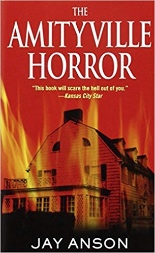
It is one of horror’s most classic premises: “George and Kathy Lutz moved into 112 Ocean Avenue on December 18. Twenty-eight days later, they fled in terror.” We speak, of course, of Jay Anson’s The Amityville Horror. If there’s one good thing about the less-than-successful film remake starring Ryan Reynolds, it’s that its 2005 release finally put Anson’s 1977 novel (?) back into print.

My first exposure to the book was shortly after its debut, when the young woman babysitting me and my brothers for the night brought it with her to read. I was creeped out by the illustration of the houseflies that occasionally dotted its pages (sadly missing from Pocket Star’s reprint edition). I read it a few years later, before I saw the 1979 movie, and – what with all the unexplained voices, toilet goo, evil faces, telephone interference, loud noises, dead Indians*, levitation and flaming red pig eyes – it scared the bejeezus out of me.

Revisiting it today, I’m not sure why. Anson’s documentary-style approach prevents it from approaching real terror. There’s simply no tension. Anson will be describing some utterly mundane activity for several paragraphs and then throw in an exclamation like “Father Mancuso returned to his apartment to find a stupefying odor of human excrement pervading his room!” It’s not shocking, because it comes from nowhere, but every time you spot an exclamation point, know that Anson wants goosebumps to follow.

Even though Anson’s you-are-there prose isn’t exactly lively, the story remains compelling after all these years. Even people who’ve neither read the book nor seen the movies can relay freely at least some details surrounding the Amityville legend. But even the initiated probably don’t recall how clunky the book actually is, like this doozy of a sentence, which would be laugh-out-loudable in any book: “Regardless of the weakness he still felt in his loins from the diarrhea, George wanted to make love to Kathy.”

And that mental image, my friends, is far scarier than any poltergeist or possession.
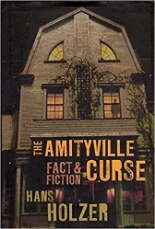
Parapsychologist Hans Holzer really hates Jay Anson’s The Amityville Horror. He refers to it as “sensational” – and not in a good way – and won’t even name its author. After all, Anson’s book is considered fiction, but Holzer believes in the spirits that reportedly have plagued the famous Long Island home. So he wrote his own version.

Long out of print, that nonfiction study from 1979 has been combined with Holzer’s two all-but-lost Amityville fictional efforts from ’82 and ’85 for Barnes & Noble’s three-in-one collection The Amityville Curse: Fact & Fiction. When it comes to competition from Holzer, Anson had nothing to worry about.

It opens with Murder in Amityville, a factual examination not of the Lutz family’s experience in the home (as depicted in the blockbuster ’70s movie) but of Ronald DeFeo, the 22-year-old man who took a shotgun to all six members of his family one night in 1974 (as depicted in the fiercely underrated and unjustly derided Amityville II). The reason? Spiritual possession!

“The only logical explanation for such behavior seems to be the transference of knowledge or skills from an outside source — an outside entity functioning in another dimension.” Why is this the “only” logical explanation? Because Holzer says so. “In all this uncertainty,” he writes, “only one thing is certain: No ‘demons’ are involved, because, unlike spirits, they are strictly figments of the imagination.”

And that’s the way it goes: His way or the highway, as every dig at Anson and others’ work is tinged with a palpable level of “I’ll show them!”-style arrogance and jealousy. It’s all for nothing, because Murder is terribly boring – a true-crime compilation of court transcripts and psychiatric interviews, which is hardly the interesting part of the Amityville story.
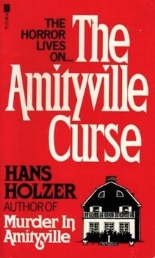
But at least it’s competently written compared to the abomination of his would-be novel The Amityville Curse. You can tell how ridiculous it is just from the setup: Three couples who know of the house’s horrible history decide to buy it, move in together and don’t leave once bad shit starts to pile on, even when that includes death. Even hiring an American Indian (named Black Eagle; good one, Hans – that’s not patronizing at all) to cleanse the spirits doesn’t help.

Holzer provides one Shocking Event after another, but because he cannot build suspense, it’s all rather pedestrian. Consider this supposedly terrifying passage of supernatural phenomena:

“The flour bin moved to the edge of the shelf, its top jerked open, and the contents poured out on the stove, creating a large white cloud. … The stove was completely covered with flour, and had to be washed. Undoubtedly, their meal would have to be cold.”

Not exactly pig eyes in the window, huh? Notice how that last line bursts with unintentional humor, as does “Good. Then I must tell you that building houses on Native American burial grounds is not the greatest of ideas.” Or, after a woman’s father is impaled to death by an “Oriental dagger,” “Well, it looks like we paid that medicine man for nothing.”

The narrative is repetitious; witness a doctor’s advice of “Or rather his curse, like a guided missile, will follow you,” and then, a mere 12 pages later, “You see, Mr. White, a curse is a little like a guided missile.” But laziness is Holzer’s greatest sin, like when the character of Frank accidentally kills the spouse of Lucille. Thank goodness it was only a spouse: “Lucille had refused to leave her room or even talk to anyone. … She was not angry with Frank, and when he came to talk to her through the closed door, she forgave him.” Whew! Glad that’s settled! Now who wants dinner?

Ready for more ludicrousness? Turn to The Secret of Amityville, which serves as a prequel to explain the Native American angle. Initially set in 1717 at outfits like The Pig and Whistle, it’s a tale of lords, Scots, buccaneers and wasted ink. If he couldn’t write a modern-day story, what made him think he could do historical?

The only thing remotely scary about this anthology? I paid for it. –Rod Lott

Get them at Amazon.

*Anson’s word, not mine.

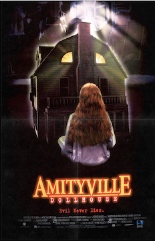
Amityville Dollhouse (1996)

Which is harder to swallow: a dollhouse being haunted or a man moving his wife into a home she’s never seen? Either would be unthinkable, yet Amityville Dollhouse gives you both, God love it. (Look, after a lamp, a clock and a mirror, a dollhouse isn’t much of a stretch, but surprising your spouse with place of residence is step one to divorce court.)
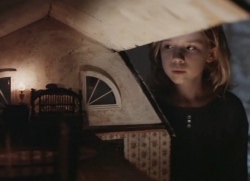
Capping off 10 months of he-man construction with his own bare hands, Bill Martin (Summer School nemesis Robin Thomas) has built a brand-new house for his new wife, Claire (Out of the Dark’s Starr Andreeff, whose name looks like the birth-certificate clerk had a stroke while typing), and their blended family of three kids. Inside the property’s original wooden shed, Bill finds a rather intricate dollhouse, which he gives to his daughter (Rachel Duncan, 1995’s Rumpelstiltskin) for her birthday. Because the toy is a to-scale replica of 112 Ocean Ave., Long Island, New York 11701, the Martin home quickly morphs into a metaphor for the dysfunctional American family, complete with a portal to hell via the den’s fireplace.

Yes, Amityville Dollhouse is a stupid title. Yes, Amityville Dollhouse has a stupid premise. No, Amityville Dollhouse is not boring.

How could it be with a giant mouse under the girl’s bed? With zombie wasps that burrow into ears? With the head of doomed That ’70s Show starlet Lisa Robin Kelly bursting into flames? With Claire’s über-nerd son (Jarrett Lennon, Servants of Twilight) being terrified of spiders, but not the reanimated, guacamole-faced corpse behind his bedroom door? With Claire possessed into having MILFy fantasies about sex with her jock stepson (Allen Cutler, The Demon Within)?

The answer: It cannot and is not. I don’t know what Joshua Michael Stern (The Contractor) was thinking when he wrote the script, but I do know I’m glad director/producer Steve White doesn’t seem to have questioned it. Playing like Poltergeist by way of The Brady Bunch, this eighth film in the Amityville Horror franchise is indeed its looniest. —Rod Lott

Get it at Amazon.

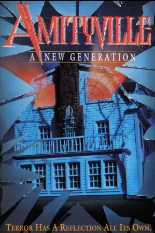
Amityville: A New Generation (1993)

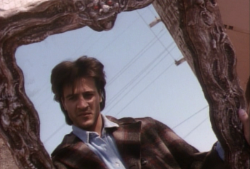
Amityville: A New Generation, the seventh in the Amityville Horror series, takes the original film’s tagline of “For God’s sake, get out!” to heart, transferring the devilish deeds from the suburbs to the streets — to be specific, the seediest Los Angeles has to offer. There, an ornately (and garishly) framed mirror has found its way from a certain possessed house in Long Island, New York, to the cardboard abode of a hobo (Jack Orend, Aaah! Zombies!!), who gives it to Keyes (Ross Partridge, Kuffs), a struggling photographer living in the sparsely rented lofts across the street.

Much to the dislike of his ad-exec girlfriend (Lala Sloatman, Watchers), Keyes lugs the demonic mirror into the building, where it causes all sorts of problems for his landlord (David Naughton, An American Werewolf in London), his starving-artist neighbor (Julia Nickson, Ready Player One), her boyfriend (Robert Rusler, Weird Science) and so on. Dead bodies pile up as Keyes experiences startling visions that change his behavior — not unlike James Brolin’s character in 1979’s OG Amityville Horror.

That idea of the sins of the father bubbles to prominence, revealing A New Generation to have more on its mind than mining quick-buck rental dollars. While lesser filmmakers would treat the material as trash, director John Murlowski (Santa with Muscles) and his DP, eventual Oscar winner Wally Pfister (Inception), bring some class to it, pulling off some ingenious shots and in-camera effects as creative as the story’s protagonists. Returning as screenwriters from the previous year’s Amityville 1992: It’s About Time, Christopher DeFaria and Antonio Toro actually make viewers care about Keyes, as does the Dermot Mulroney-esque Partridge, of course, by committing to a performance instead of just cashing a paycheck.

Partridge’s goodwill extends to others around him, including Terry O’Quinn (1987’s The Stepfather) as the investigating detective, Lin Shaye (Insidious) as a nurse and Richard Roundtree (Shaft himself) as a fellow tenant. That a sixth sequel would boast such relative star power is as surprising as the quality of the film itself. —Rod Lott

Get it at Amazon.

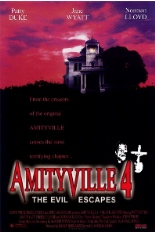
Amityville: The Evil Escapes (1989)

After Amityville 3-D bombed big at the 1983 box office, the Amityville Horror franchise retreated to network television for the fourth entry, Amityville: The Evil Escapes. Ironically, this first nontheatrical foray at least had the foresight to bring back original screenwriter Sandor Stern, who also stepped into the bound-to-be-thankless job of directing it.

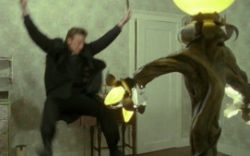
Recently widowed, Nancy Evans (Patty Duke, Valley of the Dolls) has no choice but to pack up her three kids and go live with her uptight biddy of a mother, Alice (Jane Wyatt, Star Trek IV: The Voyage Home), in California. Waiting for Nancy at the stately home is a birthday present shipped from her sister, Helen (Peggy McKay, UFOria): one fugly lamp purchased for $100 at a Long Island yard sale as a gag gift. The gag backfires on Helen, who cuts her finger on this gaudy piece of furniture — imagine Sesame Street’s iconic lamppost as constructed by The Wicker Man’s villagers — and gets tetanus and dies, failing to realize she thrifted among the cursed contents at the cursed Amityville house.

At Alice’s home, the lamp throws everything into disarray. At first, the disturbances are nothing a tube of Neosporin couldn’t solve, then they leap into the sinister with the discovery of Alice’s parrot in the toaster oven (which is probably the title of a Jimmy Buffett song). Other incidents include an out-of-control chainsaw, a sink disposal hand-mauling and strangulation by supernatural extension cord, all culminating in the possession of Nancy’s youngest child (Brandy Gold, Wildcats) and an attic-set showdown pitting a priest (Fredric Lehne, Terror Tract) against, well, the lamp of the damned.

For the virtually bloodless telefilm, Stern brings back several of his 1979 screenplay’s greatest hits: the flies, the red eyes, the sludge, the priest unable to communicate by telephone. Unfortunately, earnest attempts at scares are doomed by mood-killing bright colors, presumably dictated by NBC for prime-time readiness, as Evil Escapes is shot like any of the webs’ disease-of-the-week pics of that era. If made for theaters and aptly cast, with all else being equal, this material could have clicked.

After this, the Amityville sequels were straight to video. Incidentally, the estate sale in the prologue sets up three of them, each following a different object: a clock (Amityville 1992: It’s About Time), a mirror (Amityville: A New Generation) and a dollhouse (uh, Amityville Dollhouse). Producers never got around to all the other items glimpsed, but I’d like to think that an abandoned treatment for The Amityville Thermos sits in a desk somewhere. —Rod Lott

Get it at Amazon.

Reading Material: Short Ends 10/26/19

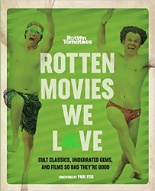
Let’s get something straight: The Rotten Tomatoes website is a tool of evil. And yet, its editors sure have put together one helluva fun book in Rotten Movies We Love: Cult Classics, Underrated Gems, and Films So Bad They’re Good. Its cover is a good place to start this discussion, too, because what’s wrong with Step Brothers? Not one damn thing, and that’s entirely the point. See, for the most part, this Running Press release is not a nose-thumbing, Medved-style coal-raker, but an affection-overflowing celebration of movies the public embraced, even if critics failed to. Therefore, across all genres, prep for spirited defenses of members of the maligned, such as Dr. Giggles, MacGruber, Event Horizon, San Andreas and Bela Lugosi Meets a Brooklyn Gorilla, the latter from guest scribe Leonard Maltin. An absolute pleasure to read, it’s a keeper worth revisiting. More ’maters, please.

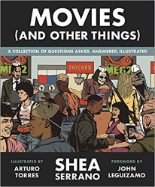
After penning a bestselling book about basketball (and other things), Shea Serrano follows it up with the similarly structured Movies (and Other Things). Published by Twelve, the colorful hardback finds Serrano posing 30 geekily theoretical questions (“Who gets it the worst in Kill Bill?”), each of which he answers in a sly, intelligent, knows-his-shit way, supplemented by charts, graphs and/or Arturo Torres illustrations. I only wished I were more willing to take part in the conversation. It’s not unlike Ryan Britt’s Luke Skywalker Can’t Read, but each essay tends to wear out its welcome before Serrano reaches his conclusion. With discussions of Denzel Washington, Booksmart, Kevin Costner, Selena, movie dogs, the Marvel Cinematic Universe and so much more, this book is destined to be beloved; I fully admit knowing my lukewarm response resides in the minority.

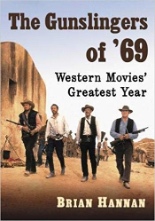
While 1939 and 1999 are often bandied about as the best years for movies, Brian Hannan makes the case for 1969 marking cowboy cinema’s sweet spot, in The Gunslingers of ’69: Western Movies’ Greatest Year. It’s hard to argue against that when you consider the staggering amount of masterpieces made, including The Wild Bunch, Butch Cassidy and the Sundance Kid and Once Upon a Time in the West. And there are 40 more Westerns where those came from (even the X-rated), with Hannan offering an inviting and well-balanced mix of history and criticism as he covers each film in a broad overview of what was perhaps the genre’s most transformative time: when revisionism hopped in the saddle. If you enjoy classic Westerns, this comes recommended, as does Hannan’s The Making of The Magnificent Seven (also published by McFarland & Company) from a few years ago.

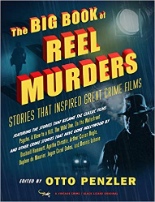
Following similar genre-celebratory collections on vampires, zombies, ghosts, adventurers and pulp heroes (all from Vintage Crime’s Black Lizard line), anthologist extraordinaire Otto Penzler rounds up more than 60 pieces of short fiction for The Big Book of Reel Murders: Stories That Inspired Great Crime Films. Simply put, this hefty trade paperback is just that, with Ian Fleming’s “A View to a Kill,” Agatha Christie’s “The Witness for the Prosecution,” Richard Connell’s “The Most Dangerous Game,” Daphne du Maurier’s “Don’t Look Now,” Edgar Allan Poe’s “The Murders in the Rue Morgue.” Straddling the genres of mystery, thrillers, horror and more, Reel Murders also showcases Arthur Conan Doyle, Dashiell Hammett, Dennis Lehane, Edgar Wallace, Jack Finney, Joyce Carol Oates, Robert Louis Stevenson — not a single one to sneeze at. Whether you like to read source material of films you’ve seen or crime fiction in general, this bang-for-your-buck collection should be right up your shadow-strewn alley. —Rod Lott

Get them at Amazon.