If you’re like me, you poor bastard, the title of this flick alone will land it in your Netflix queue. Then there’s the poster, depicting a pair of sexy, blood-spattered nurses. To hell with the queue — this one’s for instant streaming.
Sick Nurses is a horror film from Thailand and if the action took place in the real world, it would make very little sense. We’re in a hospital that seems to house no patients — just a half-dozen hot young nurses and one doctor who make a living harvesting and selling body parts. When one of the nurses who thinks the doctor is hers exclusively finds out that he is going to marry her pregnant sister, she cracks up and threatens to reveal their illegal operation. The other nurses kill her and, on the seventh day after her death, she returns to enact her revenge on everyone.
At this point, this goofy little film gets a bit more serious as directors Piraphan Laoyont and Thodsapol Siriwiwat go all surreal with the visuals. The hospital’s empty halls stop looking like ways to keep the budget down and start looking like corridors of the mind where bad things, and only bad things, ooze out of the walls or float along the ceiling.
But the quasi-artsy imagery never completely overcomes the over-the-top quality. What began as a camp comedy becomes a camp black comedy with lots of gore, long streaming hair and garter belts. —Doug Bentin
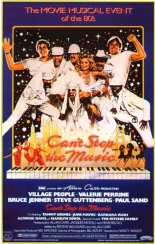
For all of its cultural infamy, Allan Carr’s disco fiasco Can’t Stop the Music reminds us of one important thing: Valerie Perrine really hated to wear clothes. I say this because even though the film was rated PG and she spends most of her onscreen time surrounded by gay dudes, she still manages to somehow flash her moneymakers in front of the camera.
For many heterosexual male viewers, this probably amounts to the film’s lone highlight, but count me amongst the minority who are willing to defend Carr’s folly. For all of its faults (supreme tackiness, nonsensical scripting, Bruce Jenner in cut-offs and a half-shirt, the fact that none of the gay dudes are actually portrayed as being gay dudes, Steve Guttenberg), the film has a cheerful innocence and lack of cynicism that harks back to the old “Let’s put on a show in the barn!” musicals of the ’30s and ’40s.
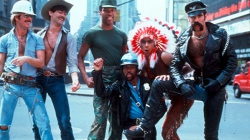
A fictional look at the creation of The Village People, the film features Perrine as a retired supermodel who decides to use her industry connections to propel her composer roommate, Guttenberg, to the top of the charts. The two of them decide to throw together a group of colorful locals — a collection of “village people,” if you will — and happily discover that they combine to make sweet, if bland, danceable pop.
And somehow the future stepfather of those Kardashian babes gets involved. I’m still not sure why, but it probably has something to do with those cut-offs. —Allan Mott
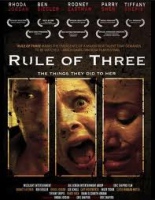
Eric Shapiro is an excellent fantasist who churns out one great short story after another. In making the jump to storytelling for the big screen, he proves he can wring suspense visually, too. He directs Rule of Three from a script by his wife, Rhoda Jordan, although the idea generated with him.
And it’s a terrific idea, taking place almost entirely within one hotel room, but in three points of time involving three sets of characters. First, there’s Jon (Ben Siegler), a father distraught over his missing daughter, Lo (Jordan). Frustrated that the detectives are dragging their feet, he goes to the desert hotel where she was last seen and finds a vaguely threatening note promising him closure at 3 p.m.
Second are Lo and her boyfriend (Cary Woodworth), attempting to coerce one of their friends into a threesome, and finally finding a willing partner (Tiffany Shepis). Finally, there’s a sad-sack loner (Lee Schall) attempting to buy roofies for a girl he likes, so he calls a delivering drug dealer (Rodney Eastman, I Spit on Your Grave) who says, “The truth is a lot like pussy: It’s always a little uglier when you shine some light on it.” The link between the first groups of people is obvious, but the second? Your initial thoughts are incorrect.
Shapiro’s too smart for that. Although at times too slowly paced, this quiet thriller lulls you into a false sense of complacency, generating a rhythm that suggests the night is going to pass uneventfully. It’s not, and this is a good thing; it’s called unpredictability. Shapiro and Jordan have a last-minute ending in store that you’re not likely to see coming; as they pull those strings tight into a double knot, you’ll be shocked, yet you’ll smile at being cleverly duped. —Rod Lott
Best known for starring in the Highlander TV series and its last two film sequels, Adrian Paul is the star of Eyeborgs, making its Syfy premiere tonight.
FLICK ATTACK: How many of your interviews start off with the interviewer saying, “Yo, Adrian”?
PAUL: Once or twice, perhaps. It’s standard.
FLICK ATTACK: Eyeborgs has kind of done the impossible for a direct-to-DVD movie these days and broken through, gaining quite a cult. What do you attribute this to?
PAUL: I think it’s the subject matter in a sense. You know, when they first came up with the idea, it was during the elections and the introductions of cameras into cities like New York and Chicago and London. To me, it’s kind of like a political statement slash thriller, with sci-fi. They did a really good job for the time they spent on it. The CGI is incredible. It wasn’t done by eight companies; most of the big work was done by one guy. It’s a slightly different slant on “We are being watched.”
FLICK ATTACK: Is there any talk of a sequel yet?
PAUL: Yeah, if it does well, there’s a possibility of a sequel. They’re talking about “is it possible to make it into a series?” I don’t know what the answer to that is, but there has been some sort of rumor about it.
FLICK ATTACK: And now it’s making its Syfy debut. How’s it gonna play alongside the lofty standards established by Mansquito and Blood Monkey and Mega Python vs. Gatoroid?
PAUL: I don’t know. Syfy comes out with some good product and other product they do for not a lot of money, and it’s pure entertainment, pure fantasy. I think they’re never going to go away. They’re just going to get bigger. They’ll do different types of film, but this one has a sci-fi element and there is an audience for it.
FLICK ATTACK: My 5-year-old wants one of those two-legged Eyeborgs for his birthday. Can you pull some strings for me?
PAUL: Well, if it does well, you can know for certain they’ll do merchandising on it, so I’ll let you know.
FLICK ATTACK: Is it more difficult acting against a spider robot that’s not really there or Christopher Lambert?
PAUL: Ohhh. That’s a harsh comment, actually.
FLICK ATTACK: No, it’s good-natured. All in fun.
PAUL: You have to have a very good imagination. All I was told was that I was given a rundown as to what these things might look like and what their capabilities were, in a sense. I actually choreographed the fight and sat down with the robot designer and the director, and came up with what could be done, how it would move. I was just fighting air, pretending there’s this eight-legged thing kicking my ass.
FLICK ATTACK: Speaking of Highlander, answer honestly: How long would it really take you to cut off someone’s head?
PAUL: How long would it take?
FLICK ATTACK: Yeah.
PAUL: Well, it would take you literally one slice. It depends on what you’re using. —Rod Lott
One of the most satisfying zombie movies I’ve ever seen isn’t a movie at all, but the British TV series Dead Set, a five-episode wonder. You know how everyone talked about how awesome AMC’s The Walking Dead show was upon its debut in Halloween 2010? Well, Dead Set did the undead far better two years earlier, and makes our Yank efforts look like Sesame Street by comparison.
Don’t get me wrong: I liked The Walking Dead. But I didn’t love it, because every episode seemed to stretch half an hour’s worth of story into twice the time. There’s no such problem with Dead Set. With the exception of the extended first ep, each one is just a hair above 20 minutes; all are packed with survivor interaction and zombie action.
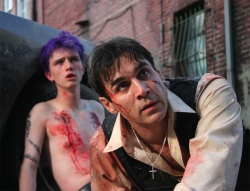
What sets it apart immediately is its concept, in that the housemates of UK’s Big Brother reality show are blissfully unaware of the zombie uprising outside their studio, until said uprising extends indoors. Suddenly, that week’s eviction ceremony is the least of the contestants’ worries.
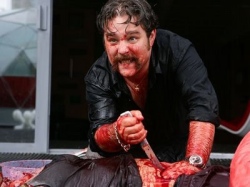
Dead Set gets away with a lot that the U.S. tube wouldn’t allow. Remember Walking Dead‘s buzzed-about scene in which a couple of characters bathed themselves in zombie blood and entrails to go undercover? That’s tame compared to the Big Brother producer (Andy Nyman) personally stripping an expired player of skin and meat, right down to the bone.
Watch all five back-to-back for a bloody good 141-minute feature experience. —Rod Lott


 If you’re like me, you poor bastard, the title of this flick alone will land it in your Netflix queue. Then there’s the poster, depicting a pair of sexy, blood-spattered nurses. To hell with the queue — this one’s for instant streaming.
 At this point, this goofy little film gets a bit more serious as directors Piraphan Laoyont and Thodsapol Siriwiwat go all surreal with the visuals. The hospital’s empty halls stop looking like ways to keep the budget down and start looking like corridors of the mind where bad things, and only bad things, ooze out of the walls or float along the ceiling.
 Eric Shapiro is an excellent fantasist who churns out one great short story after another. In making the jump to storytelling for the big screen, he proves he can wring suspense visually, too. He directs
  Second are Lo and her boyfriend (Cary Woodworth), attempting to coerce one of their friends into a threesome, and finally finding a willing partner (Tiffany Shepis). Finally, there’s a sad-sack loner (Lee Schall) attempting to buy roofies for a girl he likes, so he calls a delivering drug dealer (Rodney Eastman,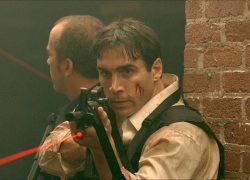
 Best known for starring in the
 FLICK ATTACK: And now it’s making its Syfy debut. How’s it gonna play alongside the lofty standards established by

 What sets it apart immediately is its concept, in that the housemates of UK’s Big Brother reality show are blissfully unaware of the zombie uprising outside their studio, until said uprising extends indoors. Suddenly, that week’s eviction ceremony is the least of the contestants’ worries.