Can you guess what movie or TV show we’re watching? We’ve turned on subtitles (when available) not to give you a clue, but to enhance that WTF effect! Leave your best guess in the comments to prove your true Flick Attackosity!

Can you guess what movie or TV show we’re watching? We’ve turned on subtitles (when available) not to give you a clue, but to enhance that WTF effect! Leave your best guess in the comments to prove your true Flick Attackosity!
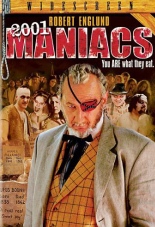
 Writer/director Tim Sullivan knows exactly what he’s doing with 2001 Maniacs: You need only wait maybe two minutes past the opening credits to get nudity, then 10 more for the plot to be fully established. A remake of H.G. Lewis’ infamous, influential Two Thousand Maniacs! of 1964, it unexpectedly plants you on the side opposite of the “heroes.” In other words, you can’t wait to see these assholes get killed.
Said assholes are frat boys on spring break; they’re the kind of guys who see and refer to women only as “pussy.” On their way to Daytona Beach, they and a few other students stupidly follow a homemade detour sign and end up at the ironically named Pleasant Valley, a small town ready to kick off its annual Guts N’ Glory Jubilee. Mayor Buckman (Robert Englund), he of the Confederate-flag eyepatch, insists they stay as the guests of honor.
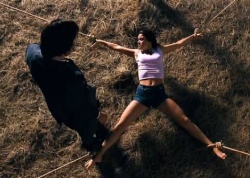 That’s because, of course, they’re to be the main course of the barbecue for this cannibal clan. Via Buckman’s bevy of busty beauties, the boys succumb to their comely charms, only to end up on the business end of machines of torture. This allows Sullivan to go whole-hog in updating Lewis’ brand of Southern-fried splatter for the gorno generation.
But it’s not without a strong sense of humor, mostly effective, in the same vein as Eli Roth’s Cabin Fever (Roth serves as producer and provides a cameo), and some of it even qualifying as sharp satire on racial and regional stereotypes. If you have an open mind and don’t mind the mess, you’re apt to find 2001 Maniacs mighty tasty — perhaps even finger-lickin’ good. —Rod Lott

 It’s possible to be a movie lover and not like Greta Garbo or John Wayne or Humphrey Bogart, and still retain some credibility — but turn your nose up at Bugs Bunny and hell hath no depth too deep for you, you humorless poseur.
Too harsh? Not harsh enough, doc.
Director Larry Jackson celebrated all things wascally with the documentary Bugs Bunny: Superstar. It contains live-action footage of the cartoonists and their staffs acting out stories before the animation began — Tex Avery was a hoot — but it’s mostly long on cartoons (a good thing) by including nine full-length examples from the 1940s, only six of which star Bugs. It’s short on documentary factoids about the history of the character and the gang who created and developed him in a creaky building called Termite Terrace on the Warner Bros. lot.
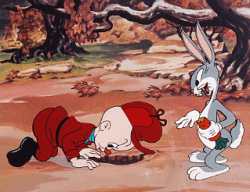 It’s this material, most of which is spoken by one of Bugs’ papas, Bob Clampett, that generated some hurt feelings when this film was released. Co-creators Avery and Friz Freleng are also interviewed, and while Clampett had complimentary things to say about Chuck Jones, Jones — who could nurse a grudge like Silas Marner could nurse a nickel — accused Clampett of being a credit hog. The thing is, when this picture was made, almost everyone from the days of classic animation was looking for credit for the work he’d done for hire in the 1930s-1950s, so a lot of exaggeration was going around.
But you can ignore this backstory and enjoy the film for the comedy it contains. Especially fun are the undeniable classics The Wild Hare (1940), A Corny Concerto (1943), My Favorite Duck (1942) and Hair-Raising Hare (1946). The movie is narrated by an obviously-in-on-the-joke Orson Welles. —Doug Bentin

 The one thing you have to know about the misunderstood masterpiece that is Bitch Slap is that you shouldn’t go into it expecting to see a whole lotta nipples. You will see at least two (by my count), but since they don’t belong to any of the three scorchingly hot protagonists, many confused genre enthusiasts have chosen to denounce the film as a failure.
They are morons. Do not listen to them. Instead, do what I did and listen only to the rock-hard, throbbing critic in your pants. Seriously, if you can make it through Bitch Slap without having to adjust yourself in order to accommodate a prolonged and painful tightness, you’re either a eunuch, a girl, a homosexual or so incredibly and specifically jaded in your perversions, the only chance of finding what you need can be found at www.balloonpoppingplushymilfsquirters.com. It’s the purest form of cinematic Viagra I’ve ever seen, and the fact that it achieves this distinction without overdosing on nips and pubes should be praised, not derided.
 A joyous pastiche of all that is great about genre cinema, Bitch Slap essentially plays like a greatest-hits collection of all your favorite movies from Memento and The Usual Suspects to Kill Bill and Sin City, ad infinitum. But most of all, the film is a celebration of the badass femme fatales best epitomized by Russ Meyer’s Faster, Pussycat! Kill! Kill!
The plot is essentially unimportant — a slender thread upon which to hang its vast collection of references and homages — but the cast is key to the flick’s success. As its trio of dangerous vixens, Julia Voth, Erin Cummings and America Olivo will sear themselves permanently into your consciousness, each one representing a different kind of archetypal hotness. Voth plays the doe-eyed innocent, trapped in the body of the world’s sexiest stripper; Cummings is the calm, voluptuous professional, dressed to kill in a pencil skirt and fishnets; and Olivo is the psychotic hothead in the tight leather pants with the killer abs. Whatever your personal kink, one of them is guaranteed to linger in your dreams.
Unless you only get off on blondes. In which case, you can go fuck yourself. —Allan Mott

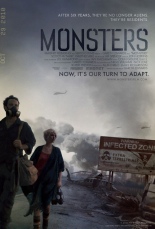 Have we become such a navel-gazing, irritatingly self-introspective, youth-fellating culture that we can’t even make a decent giant monster movie anymore? It started with Cloverfield, where, instead of a gargantuan beast destroying New York, we got a group of slick hipster jerks dodging debris, searching for a superficial “love” interest while talking about how much they loved Fraggle Rock while a gargantuan beast destroyed New York. Maybe. It’s kinda hard to tell because the thing was filmed on the modern-day equivalent of a handheld Fisher-Price PixelVision camera. It’s like a Nick Zedd movie with self-esteem.
Monsters director Gareth Edwards, luckily, invested in a tripod so we can at least see what is going on. Too bad what is going on are two insipid spring breakers stuck in Central America, trying to get home to Regular America, while gargantuan monsters are destroying the lush Mexican countryside. Maybe.
 This is a great idea — the chance for an Americanized District 9 — but every time leads Scoot McNairy and Whitney Able open their mouths, it’s like listening to every single drunken conversation you’ve ever overheard around closing time at Señor Frog’s. Mumblecore for the frat crowd, finally! And the monsters? They’re barely seen extraterrestrials who crash-landed in Mexico a few years back — oversized, Old Gods-esque creatures that crush and destroy whole villages and, best of all, inspire heavy-handed allegories about illegal immigration.
It’s commendable that Edwards made Monsters for $800,000 and, because of it, he’s got the upcoming Godzilla remake gig, which is awesome. If there’s one way to top the 1998 Roland Emmerich atrocity, it’s making an ultra-talky redux of a legendary kaiju film. Were the Duplass brothers all booked up? Either way, I look forward to the inevitable Taco Bell tie-ins. I won at least 10 free bean burritos last time! —Louis Fowler