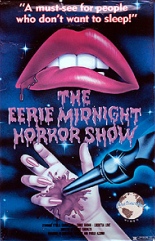
 Rip-offs of The Exorcist are a fascinating subgenre all their own. So many were made in that blockbuster’s wake, it’s difficult to keep them apart. It doesn’t help that so many of the foreign imports played in the States under a litany of titles. Originally L’ossessa, Italy’s Enter the Devil can be found as The Tormented, The Devil Obsession, The Obsessed and, best of all, the rather misleading The Sexorcist. But it’s the moniker of The Eerie Midnight Horror Show under which this mess is mostly widely available — a sheer marketing ploy of association with Rocky Horror, with which it shares nothing but color.
According to the opening credits, this one’s “based on a true story.” Because no doubt, every art student like Danila (Stella Carnacina) has been raped by an arched-eyebrow Satan (Ivan Rassimov, star of Umberto Lenzi’s Eaten Alive!), who inhabits a 15th-century, wooden crucifixion sculpture and makes it come to life to show her wood of a different kind. From there, her face goes flush and she begins exhibiting strange behavior.
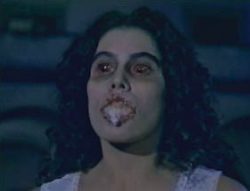 You know the drill: gaping stigmata, thrashing bed, scab-ridden lips, emission of more orgasmic cries than there are minutes in the movie. Her parents catch her masturbating, but wait for an uncomfortably long time before doing anything about it. (That could be because her mom is a bit of perv herself, a cheating whore who likes to be whipped, played by The Arena’s Lucretia Love, a name that sounds like a Sucrets fetish.)
Before long, it’s “Get thee to a nunnery!,” where the nonsensical script kicks into narrative overdrive and crackles with compelling dialogue, like this exchange:
“Good morning, Father Xeno.”
“Good morning, gentlemen.”
“Good morning.”
“Good morning, Father Xeno.”
“Morning.”
The last 15 minutes find said Father Xeno (Luigi Pistilli of For a Few Dollars More) in the inevitable good-vs.-evil showdown. The possessed Danila wants to give him a beej, then foams at the mouth and vomits great, green gobs of greasy, grimy gopher guts or something of that sort. Don’t pretend like you don’t want to see that. —Rod Lott
 A few years ago, my former employer decided to produce a series of videos for the smartphone market and tasked me with writing them. I threw together 25 scripts centered on the concept of the “sport” of curling (their idea, not mine), handed them in and heard nothing about the project for four months.
 If
If  The reveal of the killer proves to be anticlimactic, but then the film makes up for it by throwing a huge, steel-plated monkey wrench into the plot that really shakes things up – something I would never expect. The last act isn’t as good as the setup since the focus shifts from suspenseful to spiritual, but Chen Kuo Fu’s film as a whole is extremely well-crafted and anchored by two solid leads. —Rod Lott