
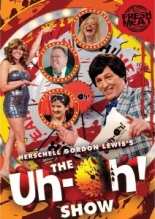
 Herschell Gordon Lewis, aka the Godfather of Gore, has still got it! By “it,” of course, I mean goofy jokes, amateurish acting, not-much-better direction, loads of gross-out shots and generally dirt-cheap production values, but if it all adds up to pure entertainment, who cares? The Uh-Oh! Show is the end of that equation. I kinda loved it.
Only Lewis’ second film since 1972, The Uh-Oh! Show is a schizophrenic comedy centered around a demented game show of the same name, in which correct answers garner priceless prizes for its contestants, but also in which incorrect answers take limbs away from them, courtesy of one Radial Saw Rex, a large, African-American man who uses his electric tool like a phallus. The body part to go is chosen by a spin of the Wheel of Misfortune. No anesthetic is offered.
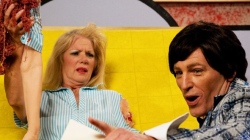 Producers want to bring the hit cable series to network prime time, but not without changes that greatly upset host Jackie (Brooke McCarter, Thrashin’). Meanwhile, a nosy reporter (Nevada Caldwell) wants to expose the show for the people-killin’ vehicle it truly is, and Uh-Oh! somehow morphs into a quasi-anthology that turns fairy tales into splatter stories.
Supplemented with boobs, boners and buckets of blood, The Uh-Oh! Show also comes packed with oodles of Lewis’ charm, evident from the start as he essentially hosts the film itself, sometimes commenting on how terrible it is. But his brand of terrible is different from other kinds of terrible, in that it translated to insanely watchable. I laughed a lot in its 88 minutes, all with it, as opposed to at it. Those with strong stomachs and an affection for his glory days of Blood Feast should do the same. —Rod Lott
 An odd bird, this
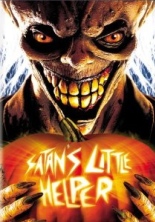
 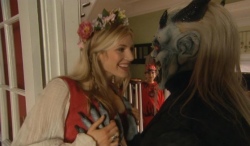 This gives way to a rollicking, stab-a-rific caper — perhaps even a love story between a lisping child and the demon to end all demons, bonding over harming innocents that include a pregnant woman, a newborn baby, a blind man, Dougie’s own father and many more. An elderly lady gets hanged to death on her porch by Satan, and Dougie, for whatever dipshit reason, thinks it’s the funniest trick he’s ever seen. Ditto for Satan squeezing Jenna’s generous breasts in her Renaissance slut costume. (“I can see your boomies!” says Dougie with a disturbing chuckle.)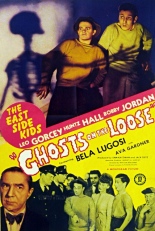
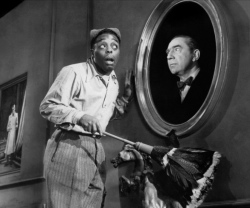 When Hall’s sister (Ava Gardner in an early role) gets married, The East Side Kids decide to fix her new house, yet they mistakenly enter the one next door that’s rumored to be haunted. It’s not — although the best scenes involve them thinking it is — but rather occupied by a group of Nazis in the cellar who print propaganda on “The New Order” (not the band) and are led by Lugosi.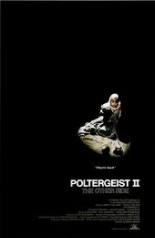
 With the aid of Sampson and pint-sized Tangina (Zelda Rubinstein), the Frelings return to the site of their old home and cross over to another dimension, resulting in a ludicrous, laughable sequence, culminating in a return from Dead Grandma as an angel. Williams cries; you’ll laugh.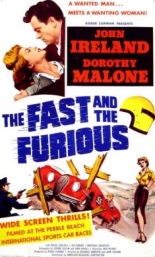
 Writer/producer Roger Corman’s original
  She’s headed for the “international” car races, so he thinks that’d be a good place to lay low until they can get across the border. Perhaps — just perhaps — captor and captive will fall in love before 75 minutes is up.