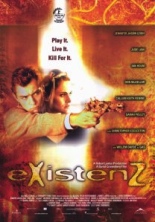

eXistenZ (1999)

In the near future, Jennifer Jason Leigh is Allegra Gellar, the world’s best game designer. The controls for her game look like pulsating handheld vaginas, and they attach directly to your spine with an umbilical cord. As the film opens, Leigh and a dozen others are test-driving her new virtual-reality game for the first time when she’s nearly assassinated by a man with a gun made of flesh that shoots teeth.

In case you couldn’t guess by now, eXistenZ was written and directed by David Cronenberg.

With various people wanting her dead, Allegra goes on the run with her company’s PR trainee, played by Jude Law. He’s never played her games before, so they get the necessary “bioport” installed in his back at a local gas station by attendant Willem Dafoe. Now Jude and Jen can play the game together to make sure it works.

The game plants Jude on the assembly line, cutting open mutated frogs for parts to make mini gamepods. This, incidentally, is where the movie starts to go south. Jen worries about her own gamepod, because it’s sick and diseased, and you wonder how the actors were able to keep a straight face.

Both Law and Leigh are fine, even if I suspect the latter is convinced she’s playing Elisabeth Shue. What’s Cronenberg trying to say in the Möbius-strip eXistenZ? Hell if I know! But for a while, I liked how he said it — gory amphibian parts, clitoral joysticks and all. —Rod Lott

Buy it at Amazon.

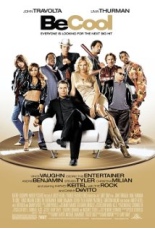
Be Cool (2005)

Somewhere in the mess of Be Cool is a story. There has to be; after all, it’s based on an Elmore Leonard novel. John Travolta reprises his role as one-time shylock Chili Palmer from 1995’s Get Shorty, also based on Leonard. While that earlier work focused on Chili’s foray into the film industry, Be Cool finds our so-cool-he’s-Popsicle protagonist drifting through the ooze of L.A.’s sleazy music biz.

In either an unfortunate accident or a meta-ironic attempt to parrot that shallow world, Be Cool serves up a passel of tired caricatures, stale gags and self-congratulatory cameos (Aerosmith’s Steven Tyler, Anna Nicole Smith, et al.). There’s a burly bodyguard who is gay and — get this — wants to be in movies! Yowzah! Oh, and a white guy who thinks he’s a black guy! Hoo-boy! There’s a Russian Mafiosi who sports a … bad toupee! Tee-hee-hee! Oh, and then there’s the gangsta rapper who’s just itching to shoot someone! Knee-slappin’ hoopa-hoopa funny!

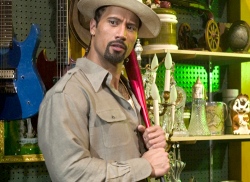
Some of these high jinks are executed by talented folks, which somewhat alleviates the sting. Andre 3000 (of hip-hop duo Outkast), Vince Vaughn, Cedric the Entertainer and especially Dwayne “The Rock” Johnson all shine in their respective roles, until the one-dimensional shtick they are saddled with starts to wear thin. It doesn’t take long.

Others in the ensemble are less lucky. Christina Milian has the thankless role of the young musical talent whom impresario Chili takes under his wing and steers toward a record contract. (Will she make it? Take a guess.) She’s relegated to several performances of synthetic R&B dross while Travolta and co-star Uma Thurman are told to sway their heads from side to side.
 
F. Gary Gray (The Italian Job remake) is a competent, if unremarkable director, and he does manage to keep the flick humming along and even intermittently entertaining. But hell, intermittently entertaining isn’t quite cool enough. Be Cool be crap. —Phil Bacharach

Buy it at Amazon.


A Force of One (1979)

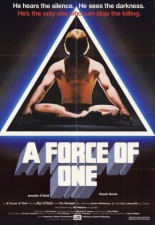
Hypothetically, say two of your fellow police officers turn up dead, both with their windpipes smashed. Would you theorize the following: “Maybe it’s one of them karate weirdos like in the movies!” The hypothetical is also a rhetorical, because that’s what happens in the Chuck Norris film A Force of One.
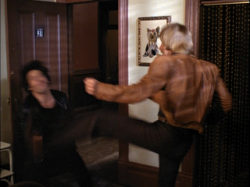
Thinking they’re up against a “karate killer,” detective Dunne (Clu Gulager, The Return of the Living Dead) brings in professional sparrer Matt Logan (Norris) to train his narcotics squad, which includes Scanners‘ Jennifer O’Neill, top-billed, yet made to look as manly as her character’s name sounds, Mandy Rust.

After the karate killer strikes again, Dunne orders, “These karate people: Check ’em out!” Even Logan begins to question it, thinking perhaps the murderer is someone he and his punching pals know closely. Without giving away the culprit’s identity, I would like to note that naturally, the final fight occurs in slow-motion and sans shirts.

Made back when Norris was considered a popular entertainer, as opposed to right-wing loon, A Force of One is a decent marriage of his considerable martial-arts skills and the constructs of the action genre. The fun supporting cast includes Super Fly himself, Ron O’Neal; Bill “Superfoot” Wallace (L.A. Streetfighters); Eric Laneuville (TV’s St. Elsewhere) as Logan’s son, so let that sink in, if you know who Laneuville is; Chuck’s brother, Aaron Norris, who co-choreographed all the kicking; Chuck’s son, Michael Norris, as “Pizza Skateboarder”; and Chu Chu Malave. I don’t really know who that is, but I sure enjoy saying his name. —Rod Lott

Buy it at Amazon.

The Da Vinci Code (2006)

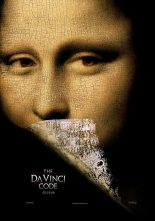
When Dan Brown’s The Da Vinci Code hit it big — and “big” really isn’t an accurate word for it — it was inevitable that Hollywood would pounce to make it into a movie. It also was inevitable that the result would mine box-office gold. What I didn’t expect is that said motion picture would be a leaden, crashing bore.

Say what you will about Brown’s book — that means you, offended Catholics and people who now pretend they never liked it when they totally once did — but there’s no denying that sucker had a pace that rivaled a toddler after downing a sippy cup full of Red Bull. By comparison, Ron Howard’s The Da Vinci Code — already overlong at 149 minutes — crawls on the floor, about as speedily as the assassinated character who opens the film, with every scene drawn out past its welcome, overstuffed with interminable speeches. There’s something to be said for brevity – a concept likely eradicated from Opie’s brain once he won the Best Director Oscar.

It makes one colossal mistake: treating the source material as if it were literature. Look, I loved reading Code, but it’s a B-level thriller. Screenwriter Akiva Goldsman treats it as if it were a work of serious art, where every sentence had been constructed with precious care, like a Jenga tower, with designs on a Pulitzer Prize. In doing so, the fun is sucked clean out of it, leaving us with one history lesson (and quasi-history lesson) after another, all of which numb our attention. Although it hews closely to the original story, there’s nothing here that sheds light on why the novel sold 2 bazillion copies and counting.
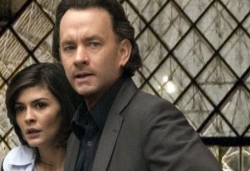
Things distract us: Tom Hanks’ ill-advised academic mullet, Audrey Tautou’s neck mole, Ian McKellen’s shameless honey-baked ham of a performance. The listless tempo carries with it an unintended side effect: highlighting how entirely preposterous Brown’s puzzle-upon-puzzle plot is. Never mind how an old man with mere minutes to live could plant hidden clue upon hidden clue by the razor-thin chance that the people he intended to follow it would indeed — one wonders why the treasure hunt be so elongated when, honestly, it needs no steps beyond the first one. That’s something easily forgiven in the reading experience (if thought is even given to it at all), but maddeningly apparent in the movies. —Rod Lott

Buy it at Amazon.

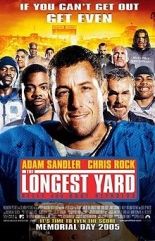
The Longest Yard (2005)

The original The Longest Yard was a landmark of ’70s-era, anti-establishment sentiment. It was violent, savagely funny, mean and an unapologetic spit in the face of authority. As directed by the gifted Robert Aldrich, The Longest Yard of 1974 was about as cutting-edge as mainstream comedy got at the time.

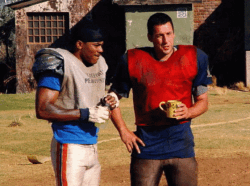
Fade in to 2005 and an ill-conceived remake, with Adam Sandler in the Burt Reynolds role of Paul Crewe, a fallen NFL quarterback rotting in a Texas prison when he is tapped to organize a football team of convicts to play the guards. What is deemed cutting-edge a generation later? Hollywood doesn’t have the cojones to focus too much on the sociopathic tendencies of convicts. 

Nope, nowadays cutting-edge means anti-gay. And The Longest Yard of 2005 is chock full o’ backwards, redneck, stereotype-embracing, queer-is-ha-ha-funny gay-bashing:
• We’ve got a prissy fella who develops an instant crush on Sandler because our hero is boorish and has crashed his girlfriend’s Bentley after going on a drunken joyride. (Gay people love brutes, don’cha know).
• We have a gaggle of flamer convicts who make up cheers like, “Gimme a D! Gimme an I! Gimme a C! Gimme …” (Get it? They want, well, you know …)
• We have two inmates caught making out over a surveillance camera.
• We have Rob Schneider in a cameo (reason enough to avoid the picture) as an overzealous convict all aflutter over the possibility of a group hug in the showers.
 
It appears that gay-bashing is the one remaining widely accepted form of bigotry left in America. —Phil Bacharach

Buy it at Amazon.


Random Genre & Cult Movie Reviews