
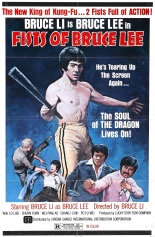
 The bad guys in Fists of Bruce Lee don’t seem all that threatening, what with their pink telephone and idling time playing bumper pool. But the woods outside their hideout are a different story, booby-trapped with sandbags, pitchforks, rope and logs!
We’re introduced to our hero — Bruceploitation star Bruce Li — via a credits sequence in which he, wearing a blindfold, spars with another guy wearing a girdle, while Average White Band’s “Pick Up the Pieces” blares. The film is produced by Woo Ka Chi, which also accurately describes how the music score sounds.
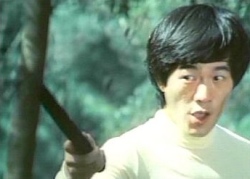 Li meets an effeminate guy with a name like Poochie Chan, who wears a white suit and continuously dabs at his face with a handkerchief. Li also falls for a woman who has a doll in her room that shoots metal darts out its head. How all these characters come into play with the story is a moot point, because there is no story. They simply amble amount and speak in generic terms and, every few minutes, a fight breaks out.
One colorful brawl takes place at night at an amusement park; another on a playground, predating a similar scene in Jackie Chan’s Police Story 2, except Jackie’s scene didn’t steal John Barry’s 007 musical cues, nor did it have a preceding foot chase scored to Paul McCartney’s “Live and Let Die.” One guy gets shot with an arrow by a dude who looks like either the construction worker or the motorcycle rider from the Village People. Some random minion gets a pitchfork deep in his ass. Story schmory, slightly snory. —Rod Lott
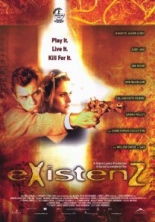
 In the near future, Jennifer Jason Leigh is Allegra Gellar, the world’s best game designer. The controls for her game look like pulsating handheld vaginas, and they attach directly to your spine with an umbilical cord. As the film opens, Leigh and a dozen others are test-driving her new virtual-reality game for the first time when she’s nearly assassinated by a man with a gun made of flesh that shoots teeth.
 Somewhere in the mess of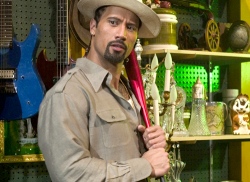
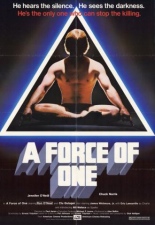
 Hypothetically, say two of your fellow police officers turn up dead, both with their windpipes smashed. Would you theorize the following: “Maybe it’s one of them karate weirdos like in the movies!” The hypothetical is also a rhetorical, because that’s what happens in the Chuck Norris film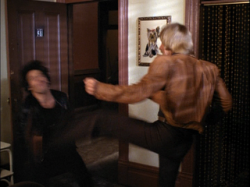
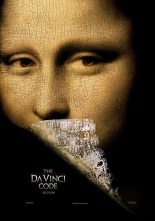
 When Dan Brown’s
 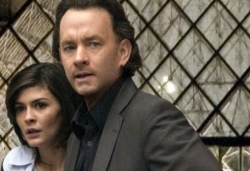 It makes one colossal mistake: treating the source material as if it were literature. Look, I loved reading Code, but it’s a B-level thriller. Screenwriter Akiva Goldsman treats it as if it were a work of serious art, where every sentence had been constructed with precious care, like a Jenga tower, with designs on a Pulitzer Prize. In doing so, the fun is sucked clean out of it, leaving us with one history lesson (and quasi-history lesson) after another, all of which numb our attention. Although it hews closely to the original story, there’s nothing here that sheds light on why the novel sold 2 bazillion copies and counting.