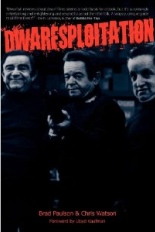
Dwarfsploitation

Immediately upon learning that Dwarfsploitation was, indeed, truly a book all about movies featuring midgets — pardon me, I mean “little people” — I thought that it had better discuss the seminal scene of Billy Barty cutting off Carrie Fisher’s dress with a sword in Under the Rainbow, or the guide wouldn’t be worth a pint of anything.

As they said in those spaghetti sauce commercials of the ’80s, it’s in there. Co-authors Brad Paulson and Chris Watson, both regular-sized humans, have compiled reviews on quite a wide selection of films. I didn’t count how many, but there are 320 pages’ worth, from The Adventures of Baron Munchausen to The Wonderful World of the Brothers Grimm, with more Weng Weng titles than I’ve been able to locate in between.

2010’s excellent Destroy All Movies!!! book rounded up every appearance of punks on film its writers could find — no matter the size of the role — and critiqued the flicks, hilariously. Paulson and Watson do the same here, but subbing dwarfs for punks, and not matching the wit of Destroy editors Zack Carlson and Bryan Connolly.

The passion for their subject is equal, however. In fact, Paulson and Watson even have created a handful of terms they use throughout, such as calling anyone who’s not a little person a “tallie.” That particular one is used the most, and kind of annoying after its first use.

Also, speaking of passion, either Paulson or Watson really, really wants to bang a female dwarf. The reviews are not credited, so I’m unsure exactly who has the hots for the little ones — maybe both. This assumption is drawn from the entries on the likes of Total Recall and I Hope They Serve Beer in Hell. It could be all an act, yet it’s not written like one.
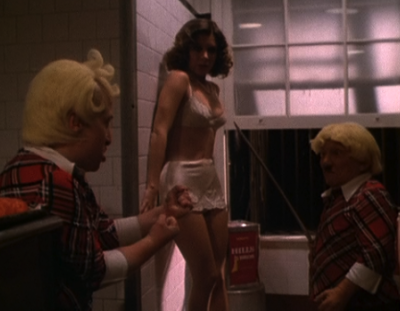
You’re not going to get deep insight into the films featured. That’s not the point. The point is celebrating the little guy, in an easygoing manner that’s both affectionate and amusing. For example, take this sentence from their look at Ghoulies 2: “The great dwarf actor Phil Fondacaro … looks like John Oates from the band Hall and Oates and wears suspenders.”

Without a doubt, unless you are stick-up-the-ass politically correct, Dwarfsploitation makes for a fun read. It is not without its, er, shortcomings — namely, it’s in desperate need of an editor. Whether repeatedly misspelling the name of someone as iconic as Diane Arbus or writing that Gremlins hit theaters in 2004, Paulson and Watson have turned in not the cleanest of copy. That loose nature may be appropriate for a project that sounds like it could’ve originated from a frat chat, but the errors number so many that I could not ignore them; I would be doing a disservice to potential readers if I chose not to bring it up.

Most people may gloss over that, instead to grow apoplectic that movies they expected to be covered are not. Now, Dwarfsploitation never claims to be complete, but for including as many obscure flicks as they have, notable omissions abound.

For example, where is Don’t Look Now? Scrooged? The Garbage Pail Kids Movie? Mulholland Dr.? On the Right Track? Jimmy the Kid? Burial Ground: Nights of Terror? The Sinful Dwarf? The Jackass franchise?

Actually, I’ll tell you where The Sinful Dwarf is: misfiled in the Ts. Again, a professional sweep-through could have elevated this book from recommended with reservations to highly recommended. —Rod Lott
Buy it at Amazon.

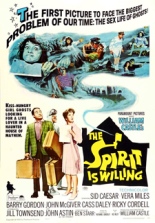
The Spirit Is Willing (1967)

Leave it to William Castle to turn a triple homicide into the basis for a comedy. The result is The Spirit Is Willing, a dispiriting effort from the usually reliable director. In fact, of all his films since Castle became a name brand with 1958’s Macabre, this is the only one I’ve seen that wasn’t at least mildly fun to watch. Even taking his minor works into account, from Zots! to Shanks, I didn’t think such an un-feat were possible.
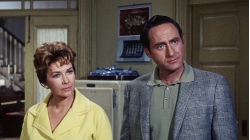
At the same time, I wish it no ill will, because it’s entirely harmless and full of the good-naturedness that made Castle a matinee hero. Its focus is on a lovely, coastal, 19th-century home haunted by the ghosts of Ebenezer, Felicity and Jenny — a love triangle between a greedy man, his ugly wife and their attractive maid, all of whom kill one another in the jaunty, played-for-laughs prologue.

The trio of mute spirits has scared away residents for ages — depicted in a crudely drawn credit sequence — and the latest arrival is the Powell family, on an extended vacation: worrisome magazine editor Ben (Sid Caesar); his subservient wife, Kate (Vera Miles, Psycho); and their temperamental teenage son, Steve (Barry Gordon, The Girl Can’t Help It). As soon as the Powells move in, the ghosts get to work wreaking havoc, and Steve angrily shoulders the blame for all the damaged antiques and even sinking his uncle’s yacht.

With guest turns from John Astin, Harvey Lembeck and Doodles Weaver, Spirit offers nothing that merits more than the rare, occasional smile. In fact, from today’s perspective, Steve’s outbursts are so violent, they provoked stress and discomfort in this viewer. For ghosts swirling around the heads of befuddled characters, Castle offered 13 of ’em in a far superior spookshow. This one’s just a rare misfire for the man. —Rod Lott

Buy it at Amazon.

New Year’s Evil (1980)

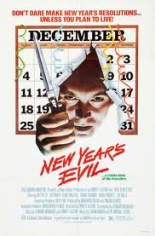
Given all that bank made by Halloween and Friday the 13th, the immortal Cannon Films wanted to get in on some of that calendar-slasher action, making its stake on the holiday of hollow resolutions with the punny but cannily titled New Year’s Evil.

It’s Dec. 31 in Los Angeles, and the big show is the New Wave New Year’s countdown, Hollywood Hotline, staged at a hotel and hosted by Blaze, a supposed punk-rock diva played by a blah Roz Kelly (aka Pinky Tuscadero of TV’s Happy Days). The live show gets off to a grand start when a caller identifying himself as “Evil” says he’s going to kill someone when the clock strikes midnight at each of the contiguous United States’ four time zones, culminating in Blaze’s death.

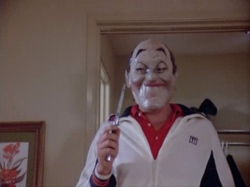
What makes New Year’s Evil different from many slashers is that after the prologue, director Emmett Alston (9 Deaths of the Ninja) makes no effort to hide the identity of the killer. Evil’s played by Kip Niven (Magnum Force), he of the feathered hair, Fila track suit, occasional Bob Hope-esque mask and mobile tape recorder, which he calls a “miracle of modern technology.” Using a variety of disguises and pick-up lines (“There’s a big party up at Erik Estrada’s place”), he finds a woman or two to slay every hour, on the hour. “Auld Lang Syne,” bitches!

Among Evil’s victims are a nurse (Taafee O’Connell, Galaxy of Terror), a bar-hopping dumb blonde who discusses diarrhea (Louisa Moritz, The Last American Virgin) and a young Teri Copley (Brain Donors), whom he catches mid-makeout at the drive-in. The film’s “twist” is startlingly obvious to anyone who pays attention the overacting of Blaze’s sad-sack son (Grant Cramer, Hardbodies) in the early scenes, and Alston has one scare scene up his sleeve that I bet worked wonders in theaters. Regardless, Niven’s multifaceted performance is such a mad gas, it makes the movie well worth watching. —Rod Lott

Buy it at Amazon.

Sixpack Annie (1975)

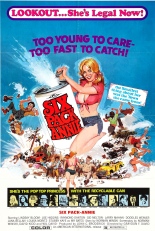
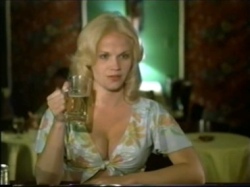
Looking like Reese Witherspoon with actual breasts, Lindsay Bloom (TV’s The New Mike Hammer) fronts the sexy, saucy and supremely silly hick pic Sixpack Annie. The young filly drives a beat-up Ford pickup truck whose seat she often shares with pull-tab cans of Miller nestled snugly in a dirty Styrofoam cooler. And she’s so hot, I’ll forgive the title’s error of not self-hyphenating.

The AIP cornpone comedy focuses on Annie’s attempts to save her aunt’s diner, where Annie waitresses in short shorts, from bank foreclosure. Her solution is simple: Just find a “sugar daddy.” In the small town of — ahem — Titwillow where she lives, works, drinks, trespasses, skinny-dips and speeds, the pickings are as slim as her waist, although everyone wants to bed her. That includes the guy they call Long John, whose license plate reads “9 INCHES.”

So Annie and her BFF Mary Lou (Jana Bellan, American Graffiti) head to Miami Beach to land a rich man, and take tips from Annie’s sister (Louisa Moritz, Death Race 2000), who works there as a flatulent, busty hooker. The jokes wrung out of every situation are goofy, sometimes stooping to the level of literally banana-peel humor. But damned if Bloom doesn’t go at it whole-hog, injecting the white-trash shenanigans with as much bubbly effervescence as the periodic bottle of Dr Pepper. The soda giant must’ve paid for the product placement, because it’s practically a supporting character.

Plus, Sixpack Annie boasts the best ending in motion-picture history, when the Titwillow sheriff (Joe Higgins, Flipper) puts on his hat and doesn’t realize Mary Lou has filled it with milk! And then he walks into a midget (Billy Barty) carrying a tray of cream pies, causing the desserts to smash in the little guy’s face! And then the angry dwarf gets revenge by smashing a pie into the sheriff’s face! And the sheriff is so mad that steam practically shoots out his ears! (Should I have added “spoiler alert” before all that?)

Also, there’s a song called “Them Red Hot Nuts.” —Rod Lott

Buy it at Amazon.

Random Genre & Cult Movie Reviews