
The Redeemer: Son of Satan (1978)

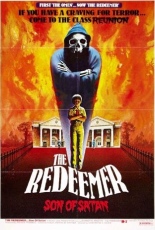
redeemerIt seems appropriate that what ultimately saves this obscure late-’70s proto-slasher is a memorably theatrical performance by T.G. Finkbinder as the title character. That’s right: The Redeemer redeems The Redeemer, but it’s a close call, because one-time director Constantine S. Gochis commits more than his fair share of cinematic sin before the end credits roll.

In a plot that predates the similar Slaughter High by eight years, six assholes are tricked into attending their 10-year high school reunion, only to discover that they have actually been gathered to be fatally punished for their supposed sins against humanity: specifically, their avarice, vanity, gluttony, haughtiness, licentiousness and perversion.

redeemer1Unfortunately, as written, the victims are all so clearly guilty of their “sins,” it’s hard not to assume the filmmakers are on the killer’s side, which is especially disturbing when you consider that the “pervert” The Redeemer punishes is simply a woman in a normal (albeit clandestine) lesbian relationship.

But what confuses the potentially ugly moral stance is the revelation that the killer is actually a priest working as the personal hand of the subtitular Son of Satan. What are we supposed to make of this? Is organized religion really a front for the devil? Is the idea that the victims’ supposed “sins” are so minor and commonplace that any one of us could find ourselves at the mercy of The Redeemer? And why is the adolescent Antichrist busy punishing earthly sinners, instead of encouraging them like a more typical Antichrist would?

Thinking about it all makes my head hurt, but — as mentioned above — the movie’s confused themes are made bearable by the presence of its antagonist, who manages to walk that fine line between campy fun and genuine creepiness. Both ahead of its time and unfortunately retrograde, The Redeemer is a highly flawed, but interesting film that deserves a place in the slasher canon its obscurity heretofore has denied it. —Allan Mott

Buy it at Amazon.

Kung Pow! Enter the Fist (2002)

kungpow‘Tis with a fiery passion that I detest comedy writer Steve Oedekerk’s many thumb-based parody shorts, which include Thumbtanic, Bat Thumb and Thumb Wars: The Phantom Cuticle. They’re simply fucking stupid. I dislike them so much that I half-wish he would lose those two digits in an accident, in a bizarre twist of irony.

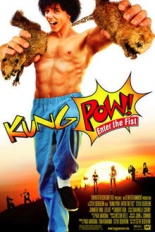
So I fully expected to despise his chopsocky parody, Kung Pow! Enter the Fist, with a passion. But other than an instantly dated Matrix bit, a lame gopher gag and the inane talking-tongue business (thus replacing the thumb), I really, really, really enjoyed it.

kungpow1And to this day, I’m pretty embarrassed to admit it.
For the movie, Oedekerk removed the soundtrack from Hong Kong’s 1976 Jimmy Wang Yu vehicle Tiger and Crane Fist, and dubbed most all the voices himself. Using blue-screen technology, he also stars in the movie as the Chosen One, a martial-arts master seeking revenge for the murder of his parents at the hands of evil guy Master Pain, who now calls himself Betty.

All the conventions of the kung fu film are sent up with a mix of mindless Airplane!-style humor and good-natured Farrelly brothers raunch. But it most resembles a solid episode of TV’s Mystery Science Theater 3000, minus the silhouettes. Repeat value is strong with this one. —Rod Lott

Buy it at Amazon.

Queen of the Damned (2002)

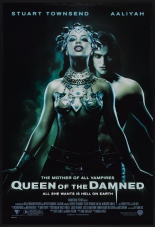
queendamnedA belated sequel to 1994’s hit Interview with the Vampire, the flop follow-up Queen of the Damned is, to me, the more enjoyable work, because it doesn’t try to be an important, arty film like Neil Jordan’s laborious adaptation. Recognizing the source novels of Anne Rice as purely B-level material — Jane Austen she ain’t — Queen sets out to be nothing more than a B movie.

Stuart Townsend (The League of Extraordinary Gentlemen‘s Dorian Gray) takes over for Tom Cruise in the role of Lestat, the ancient vampire who has now become a rock star, singing terrible death-metal songs (penned by Jonathan Davis, the guy behind the terrible nu-metal band Korn). By informing his fans of his bloodsucking status, Lestat has raised the ire of the vampire nation, which seeks to silence him permanently. In making his evil music, he’s also raised the titular queen (R&B singer Aaliyah, who eerily perished in a plane crash before the film’s release) from the dead, and she wants to extinguish the human race.

queendamned1Queen is more campy than anything, especially with the majority of vampire action given silly ghost-trail effects that cheapen the film. The direction by Michael Rymer (In Too Deep) is flashy and showy, befitting of the piffling material, which grows confusing as it heads toward Act 3. But with bloody bosoms and combustible corpses, who’s expecting Shakespeare?

The end seems to be a direct setup for another sequel, unlikely to surface given this chapter’s tepid reception. —Rod Lott

Buy it at Amazon.

Reptilian (1999)

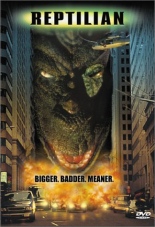
reptilianReptilian is South Korea’s needless attempt at creating a Godzilla-esque franchise like Japan, with a little all-American Independence Day thrown in for foul measure.

The derivative monster in question begins the movie as a mere dinosaur fossil, before he’s awakened by an electromagnetic force from an alien spaceship. Then he’s a living, fire-breathing killing machine, and dubbed something that sounds like “Young Gary” by the pesky humans. (It’s really Yonggarry, the original, overseas title.)

reptilian1The aliens are some of the cheapest-looking the decade produced (they speak English, yet their mouths never move), and Young Gary isn’t any better. Since he’s entirely a CGI creation, he’s entirely phony-looking the duration of the movie. Because director Hyung-rae Shim (Dragon Wars: D-War) and his fellow crew members were bankrupt in the idea department, a second Young Gary emerges from the ground at the end, only so the two can battle each other.

The terribly bad acting — with terribly bad dialogue to match — keeps Reptilian from being a total snoozer. At one point, someone exclaims, “Compared to this guy, Godzilla is a pussy!” That’s untrue. —Rod Lott

Buy it at Amazon.

The Cinema of Cruelty: From Buñuel to Hitchcock

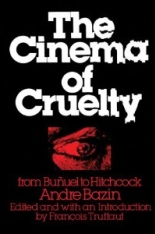
cinemacrueltyMy introduction to vaulted film critic André Bazin, co-founder of the influential and revolutionary Cahiers du Cinéma, arrived as yours should: via The Cinema of Cruelty, Arcade Publishing’s trade-paperback reprint of the 1975 text collected and edited by François Truffaut, who knew something about the medium himself.

Both Frenchmen, the director and his subject were unofficial members of a mutual appreciation society, but Cruelty finds Bazin, who died in 1958 at the age of 40, discussing six other legendary filmmakers: Erich von Stroheim, Carl Dreyer, Preston Sturges, Luis Buñuel, Akira Kurosawa and Alfred Hitchcock.

The latter makes up the bulk of the material, which is great for two reasons:
1. Hitchcock is my favorite director.
2. Hitchcock is not Bazin’s favorite director. In fact, the film theorist wasn’t exactly into him at all, at least not at first. Because Truffaut presented select essays and reviews Bazin penned on the master of suspense chronologically, we have the pleasure of witnessing Bazin’s slow progression from disdain to being won over.

Seriously, this is to the degree Bazin’s dislike began (italics added for emphasis): “Since 1941, Hitchcock has contributed nothing essential to cinematic directing. Mentioning his name along with that of Orson Welles or William Wyler (which I have also been guilty of doing) as one of the principal champions of Hollywood’s avant-garde, stems from an illusion, a misunderstanding, or a breach of trust. … But just between us, we’ve been had.”

When Bazin finally came around, it was to praise 1953’s I Confess, oddly enough, which most of the world considers minor Hitch at best.

However, I’d argue that such unpopular opinions — call them “quirks,” if you wish — help made Bazin unique and cement his global reputation. The man clearly harbored undying love for the art form, then still in somewhat of an infancy, and his passion is reflected in lines like, “If Buñuel made films exactly as he wished, the screen would undoubtedly burst into flames at the first screening!”

While I dislike the occasional style of “Now I will address this …” guideposts, there’s no denying his status as a giant in the field. He was an important voice silenced too soon, and The Cinema of Cruelty was and remains an important book that I hope wins him new fans — beyond myself, mind you. —Rod Lott

Buy it at Amazon.

Random Genre & Cult Movie Reviews