
Pacific Rim (2013)

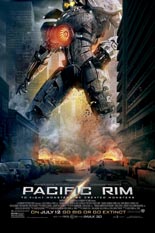
245941id1b_PacRim_1sided_120x180_2p_400.inddFor all the bad press Michael Bay gets for Transformers — incomprehensibly edited, poorly acted, overly long, transparently cynical — there is one remarkable thing: Somehow, despite all odds, Bay made giant robot battles a thing of pure boredom. Pacific Rim saves the concept by making giant robots, well, fun again. Maybe it comes down to a subtle difference: Transformers is made by people who think people will pay money to see giant robots fight; Pacific Rim is made by people who genuinely find giant robots to be the coolest thing ever.

There’s no point pretending that Pacific Rim isn’t a $200 million mega-monolith of special effects. Nor should we pretend it reinvents the wheel. Director Guillermo del Toro (Hellboy) crafts his spectacle of monsters battling humanity from classic archetypes of character and situation. There is really nothing here you haven’t seen in Star Wars or Independence Day, or Homer’s The Iliad, for that matter.

But gawddammit, it’s tons of fun. Whereas Bay soaks his movies in scorn for the theme, del Toro brings childlike enthusiasm and monster-centric glee. For good reason is his tale of hideous leviathan kaiju versus iron giants dedicated to stop-motion creature master Ray Harryhausen and Godzilla maestro Ishiro Honda: Del Toro simply loves what he does.

pacificrim1Nicely breaking tradition from the usual “all-American” route, del Toro goes international in casting, tossing Brit Charlie Hunnam (TV’s Sons of Anarchy) in as the token heroic American who pilots a robot, teaming him with spunky Rinko Kikuchi (Babel) and allowing the towering Idris Elba (Prometheus) the rare privilege of keeping his British accent. Throw in a comedic pair of bickering scientists (Charlie Day and Burn Gorman, both very funny in the C-3P0 and R2-D2 roles) and a slimy opportunist played with aplomb by genre veteran Ron Perlman (again, Hellboy), and you’ve got broad, yet effective characters played at perfect pitch by all.

And as for the real reason most people will watch Pacific Rim? The monsters are enormous, the robots huge, the effects freaking incredible, and the battles directed with clarity and verve. These things have weight to them. The punch-ups are epic, and show Bay how it’s done. Not once was I ever confused as to what was punching what.

So yeah, I loved it, if for no other reason than this: At the reveal of the first kaiju, 30 seconds in, I was grinning from ear to ear, and I never stopped. Except when, no kidding, I honestly choked up when the Aussie father/son pilot combo said their goodbyes to each other. Huge lump in my throat. —Corey Redekop

Buy it at Amazon.

Do You Like Hitchcock? (2005)

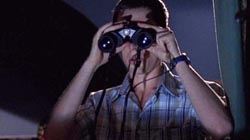
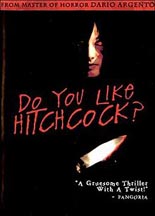
doyoulikehitchDo You Like Hitchcock? We know Dario Argento sure does. The director’s made-for-Italian-cable pic plays primarily as a pastiche of Rear Window and Strangers on a Train, with a litany of references to Hitch’s other works. Sharp eyes will catch nods to those of Brian De Palma, who, like Argento, built a career by paying homage to cinema’s all-time suspense master.

Elio Germano (Nine) is the giallo’s erstwhile Jimmy Stewart as Giulio, a college student writing his film thesis on Alfred Hitchcock German Expressionism. From his upper-floor apartment, he has a splendid view of the sexy Sasha (Elisabetta Rocchetti, The Last House in the Woods), whom he often sees at the video store and romping about town with the equally enticing Arianna (Cristina Brondo, Penumbra).

doyoulikehitch1When Sasha’s mother is brutally murdered, Giulio pieces 1 and 1 together to arrive at 2: that Arianna might be the culprit, as part of a Strangers on a Train scenario; all he lacks is proof! Like all stupid protagonists in thrillers do, he puts his life on the line to investigate.

Had Do You Like Hitchcock? carried the name of an unknown director, its reputation would be sturdier, perhaps as something of a minor gem. With Argento at the helm, however, expectations unfairly raise the bar. While there is no way this one can compete on the level of his early works — the so-called “animal trilogy,” in particular — it is a satisfying thriller exuding real love for the movies and the voyeurism they inspire. Don’t be put off by its TV status, either, as the initial murder is as to-the-pulp as anything Argento has shot, and contains more nudity than his classics.

Do I love Do You Like Hitchcock? No, but I like it just fine. —Rod Lott

Buy it at Amazon.

Turistas (2006)

turistasTry as he might, actor-turned-director John Stockwell (John Carpenter’s Christine) can’t get away from the ocean blue — Blue Crush, Into the Blue, Dark Tide, Turistas — but perhaps he should try harder, especially after that last one. If offering the continuous sight of Olivia Wilde in a bikini can’t raise moviegoers’ pulses, you’re screwed.
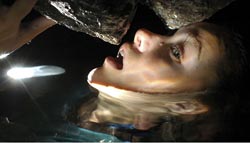
Made at a time where “torture porn” was briefly all the rage, Turistas follows a handful of American backpackers to Brazil, including siblings Bea and Alex, played by Wilde (TRON: Legacy) and Josh Duhamel (the Transformers franchise). When a bus wreck leaves the gringos stranded, they join forces with a fellow traveler (Melissa George, 30 Days of Night), despite her butt-ugly hair braids. Because she can speak the native tongue of Portuguese, she can help them get out of trouble.

turistas1But first: parrrrr-TAY! Livin’ it up one night on the beach, our white folks are drugged and robbed of all their possessions. Seems they’ve stumbled into a conspiracy where vital organs are harvested without consent from stupid Americans. Ironically, your interest will have waned long before this point is reached, provided you had any left after the first scene.

To the surprise of no one who’s seen Stockwell’s work before, Turistas boasts beautiful scenery and expert underwater photography — all wasted on one of the weakest horror films shat out by a major studio in the new millennium’s first decade. Looking pretty means nothing when your words bore others to tears. To borrow the movie’s own tagline, “Go home.” —Rod Lott

Buy it at Amazon.

You Won’t Believe Your Eyes!: A Front Row Look at the Sci-Fi/Horror Films of the 1950s

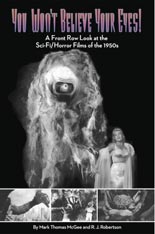
YouWontBelieveThis isn’t stated anywhere in You Won’t Believe Your Eyes!, but co-author Mark Thomas McGee holds such a deep and abiding love for the monster movies of the dawn of the Cold War era that he eventually created one of his own, in 1970’s Equinox. The only reason I bring it up is to assure readers they’re in good hands with this fond look back at so many of those science-fiction and horror matinees.

For the BearManor Media paperback, McGee’s co-writer is lifelong friend R.J. Robertson, who — we learn in the introduction — died two decades ago. That means much of the contents are older than that (McGee even mentions forgetting they wrote this until it was found in the garage), yet you wouldn’t know it, because invasions of saucer men, atomic submarines, incredible shrinking men and beasts of Hollow Mountain are timeless.

In 11 loosely themed chapters, the two review what has to be more than 100 B movies of interchangeable titles and painfully low budgets, bearing names of men like Roger Corman, Herman Cohen and Bert I. Gordon. The best entries arrive when the authors supplement their opinions — honest, it should be noted, as they’re unafraid to call crap “crap” — with the positions and perspectives of members from the cast and crew. In doing so, we learn a little more about what it took to get the American Godzilla to screen, not to mention Hammer Films co-founder James Carreras’ quote that at his studio, “we make the movies where the monsters bite the women’s titties.”

One knock on the book is such third-party inclusions are the exception rather than the rule. Fortunately, rarer are the times when McGee and Robertson have so little to say, you may wonder why the entry wasn’t excised entirely.

Most of the time, they have plenty worth sharing, including a playful fit. For example, of Patricia Laffan’s performance in Devil Girl from Mars, they write, “She looks like she hasn’t had a bowel movement for twenty years.” Such remarks make me willing to overlook the occasional movie that doesn’t seem to fit with the rest (the comedy Bell, Book and Candle?), in much the same way that the generous helping of photographs mitigates the sometimes-crowded layout. —Rod Lott

Buy it at Amazon or BearManor Media.

The Signal (2007)

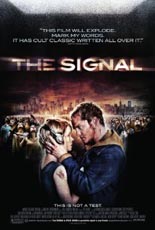
signalTold via three “transmissions,” The Signal stands as a unique interpretation of the end-of-the-world scenario that informs so many works of speculative fiction. The quasi-anthology of interlocking stories depicts the effects of a synapse-disrupting broadcast that travels through all modes of electronic communication — from television sets to telephones — resulting in mass psychosis.

Stephen King’s 2006 novel Cell explored eerily similar territory, but whereas his book ultimately left me thinking, “Why did I bother reading this?,” The Signal had me asking, “Why didn’t I see this sooner?”

signal1Not so much separate stories as shifts in perspective, the tales of co-writer/directors David Bruckner, Dan Bush and Jacob Gentry largely follow an unfaithful young woman (Anessa Ramsey, Rites of Spring) whose blue-collar hubby (AJ Bowen, The House of the Devil) succumbs; the cuckolding boyfriend (Justin Welborn, The Crazies) who tries to save her; her paranoid neighbor (Sahr Ngaujah, Stomp the Yard) who cobbles together some improvised weaponry; and attendees of the bleakest of New Year’s Eve parties. People haven’t taken this many shots to the head since … well, insert the gang-bang joke of your choice here.

For a good half, the proceedings exhibit a freewheeling style where anything can happen; somewhere around that mark, however, it gets caught in a vortex of repetition. The film crawls out of it for the third and final bit, but it pales in comparison to the strongest segment: the first. So while the scrappy triptych amounts to one of diminishing returns, the exercise is arresting just enough to emerge on the side of positive. —Rod Lott

Buy it at Amazon.

Random Genre & Cult Movie Reviews