
The Gallows (2015)

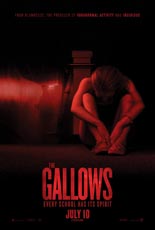
gallowsMuch curiosity surrounding The Gallows is to see if Cassidy Gifford, the 22-year-old daughter of NFL legend Frank and longtime Regis Philbin sidekick Kathie Lee, can emote. The answer: She can, but only poorly, so move along to a better movie, i.e. virtually any other movie. The only thing worse than a horror film that doesn’t raise the pulse is the one that puts you to sleep, and The Gallows is a strong contender as this millennium’s dullest of offerings yet, found-footage or otherwise.

In 1983, students of a small-town high school in Nebraska mounted a production of the titular play, during which the leading man was accidentally, fatally hanged. Twenty years later, the school tries again — too soon! — this time with a jock (Reese Mishler) assuming the lead. Despite his crush for his leading lady (Pfeifer Brown), he develops serious butterflies as opening night approaches, so his best bro (annoying Ryan Shoos) proposes a late-night sabotage of the set, entering through a door that everyone knows is broken.

REESE MISHLERSo break in they do, with Gifford’s bitchy Cassidy in tow. (Why do so many found-footage films name their characters after the actual actors, your editor asks rhetorically.) However, clad in a hangman’s mask that is glimpsed too little to elicit shivers, the spirit of the dead performer appears to haunt the stage, not to mention the rest of the school grounds. In general, the kids are portrayed (purposely and, Gifford excepted, by unknowns) as self-absorbed brats, leaving the viewer to feel the quicker they are choked to death, the better.

With no true hero, there are no real stakes; therefore, barely any structure exists on which to hang a feature film, yet Travis Cluff and Chris Lofing have done it anyway. The directing duo’s script, wafer-thin, is all buildup to a conclusion that qualifies as foregone before frame one hits your eyes. If you’ve ever wanted to watch a few asshole teens yell at one another as they run around the darkened halls of school for an hour, The Gallows is your movie. Godspeed, and be warned: It’s as dramatic as watching someone open a locker … which we see happen, by the way. —Rod Lott

Get it at Amazon.

Poltergeist (2015)

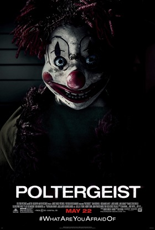
poltergeist15To enjoy the remake of Poltergeist — and yes, it can be done — you have to distance yourself from feelings over the 1982 original, a classic of contemporary horror cinema. Granted, that’s difficult to do when the new version keeps calling back to the original version, such as when the families discuss the neighborhood being built over a former cemetery: “At least it isn’t an Indian burial ground!”

And at least director Gil Kenan — moving fluidly from an animated Monster House to a live-action one — tries to do enough things differently while still bearing resemblance to a beloved film. Whereas the Freelings were pot-smoking Reaganites, the Bowens (Moon’s Sam Rockwell and The Watch’s Rosemarie DeWitt) are jobless, overextended victims of the housing collapse and Great Recession. They’ve barely settled with their kids in a new-to-them home in the suburbs when their youngest, Madison (Kennedi Clements, Jingle All the Way 2), starts talking to the bedroom closet. The “TV people” have become “lost people,” and not only do these spirits fill the basement ankle-deep in Amityville-brand sewage and fuck with the WiFi signal (every child’s worst nightmare), but also abscond with Madison (every parent’s worst nightmare), sucking her into a ghostly netherworld.

poltergeist151Standing in for — and nearly 2 feet taller than — Zelda Rubinstein is Jared Harris (Sherlock Holmes: A Game of Shadows) as the paranormal professional called in to assist the desperate family; updated for these times, he’s the reality-TV star of a series called Haunted House Cleaners, for which his sign-off of “This house is clean!” has become such a catchphrase, it has earned its own hashtag. He also uses a drone for this assignment. Such concessions for the Internet age are inevitable and goofy, but forgivable if the movie delivered jolts. It does — not in the style of cul-de-sac camaraderie established by director Tobe Hooper and screenwriter/producer Steven Spielberg in ’82 — but in the carnival-spookshow manner associated with Sam Raimi’s Ghost House Pictures banner, under which this Poltergeist was unleashed, promising a good time vs. great art. I actually found myself tensing up during the trip through the other dimension, and a bit with a drill is the kind of mischievous menace Raimi himself is keen on employing in his own scare films.

None of the three Bowen children makes an impression beyond middling, but Rockwell and particularly DeWitt (whose ponytail I could watch flop for days) are ideal and believable as the shell-shocked and overstressed marrieds just doing the best that they can. That includes enduring the questions of their middle child (Kyle Catlett, TV’s The Following): “Why would why somebody have a box of clowns?” Clearly the kid never saw the first one! —Rod Lott

Get it at Amazon.

We Are Still Here (2015)

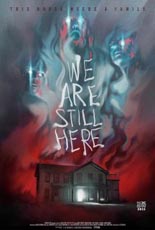
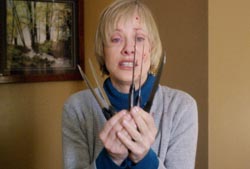
wearestillhereTwo months after a car crash kills their son, Anne (Barbara Crampton, You’re Next) and Paul (Andrew Sensenig, Don’t Look in the Basement 2) move from the city — but not their grief — and into an old house in a snowy, sleepy New England town. Almost immediately, strange stuff happens, leading an emotionally fragile Anne to believe his ghost is haunting them.

He’s not, but something definitely is at work, because that’s what happens when you move into an ornate structure that operated as a funeral home in the late 19th century — especially one that sold off its inventory, and I don’t mean coffins. Also cluing Anne in: a note covertly pressed into her palm upon meeting a neighbor, reading, “THE HOUSE NEEDS A FAMILY — GET OUT!” Why, it’s enough to invite their kooky hippie friends with supposed psychic abilities (Mars Attacks’ Lisa Marie and Late Phases’ Larry Fessenden) up for a visit and séance, and enough to send viewers to a state of utter impatience.

wearestillhere1For all its arthouse-horror trappings, We Are Still Here is as predictable and cliché-ridden as any mainstream fright film. For just one example, our foursome of friends enters a local bar and grill, only to have its drinkers and diners immediately fall into a frown-filled hush of suspicious disapproval — a conceit that dates back to ye olde Universal Monsters. Writer and debuting director Ted Geoghegan also can’t keep his own mythology straight; whereas in one scene a character explains with utmost authority that the house contains a darkness that rises “every 30 years like clockwork,” he later settles for “every 30 years or so.”

At least that “darkness” is well-depicted by beings of glowing ash and milky eyes. At least Crampton has reached an age where she is allowed to act instead of just disrobe. And at least the movie carries an aura like its sinister abode — unfortunately, it’s one rather cold to the touch. —Rod Lott

Get it at Amazon.

Guest List: Stephen Jones’ Top 5 Horror Stories That Also Have Been Adapted for the Screen

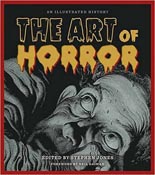
artofhorrorFew know horror quite like Stephen Jones. Therefore, he’s a natural to compile The Art of Horror: An Illustrated History for Applause Theatre & Cinema Books, just in time for Halloween! Also just in time for Halloween: this list of five screen-adapted terror tales, which we’ve whittled down from the renowned anthologist’s full list of 10 favorite spooky short stories of all time on our sister site, Bookgasm.

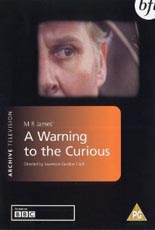
warningcurious1. “A Warning to the Curious” by M.R. James
adapted as A Warning to the Curious (1972)

No horror anthology would be complete without a contribution by M. (Montague) R. (Rhodes) James (1862-1936), that English master of supernatural fiction. The Cambridge Provost invented the modern ghost story as we know it, replacing the Gothic horrors of the previous century with more contemporary settings and subtle terrors. Although his tales have been much imitated, they have never been surpassed, and amongst the very best is “A Warning to the Curious,” which, with its cursed object and doomed protagonist, perfectly exemplifies everything that is memorable about the author’s fiction. I was proud to compile Curious Warnings: The Great Ghost Stories of M.R. James, a definitive collection of James’ fiction beautifully illustrated by Les Edwards, for Jo Fletcher Books a couple of years ago.
 
Continue reading Guest List: Stephen Jones’ Top 5 Horror Stories That Also Have Been Adapted for the Screen →

Cop Car (2015)

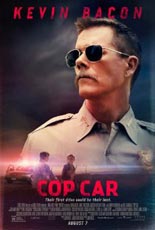
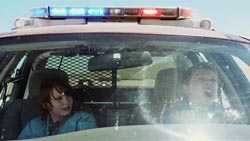
copcarOn pretweens’ pie-in-the-sky wish lists, somewhere between “have a candy tree” and “travel back in time to assassinate the guy who created school,” is “drive around in a police vehicle.” In Cop Car, two troubled 10-year-olds (natural newcomers Hays Wellford and James Freedson-Jackson) get the chance to do the latter when they come upon a Quinlan County Sheriff’s cruiser in the middle of a field. While a beer bottle sits on its hood, no cop is to be found inside — but his keys and weapons are.

The reason it’s abandoned is because small-town Sheriff Kretzer (Kevin Bacon, Black Mass) is off a little ways, busy burying a dead body under nobody’s nose but his own. Returning to find his car missing, our corrupt cop panics, assuming (wrongly) that whoever stole it also stole a glimpse at his criminal misdeeds. Kretzer gives chase, once he’s able to put two and two together, thanks to communications with dispatch (Bacon’s wife, The Possession’s Kyra Sedgwick, unrecognizable in a voice-only cameo).

copcar1Although arguably a supporting player in the film that bears his name above the title, Bacon rules in one of his best roles yet. Long underappreciated, perhaps due to an unshakable Footloose teen-idol factor, he’s a rock-solid actor who continues to get even better with age. His Kretzer — a bogeyman in beige, above the law and beyond reproach — lets Bacon play several shades, most of them black and bleak. As confident as he is in his menace when warning and threatening the boys over the radio, he’s fallible to the point of cracking when glimpsed alone and then both cocky and Chicken Little in the film’s well-orchestrated climax, in which surprises await each participant.

As directed by Jon Watts (who co-wrote with Clown compatriot Christopher D. Ford), the movie makes excellent spatial use of the Colorado landscape, giving him a canvas across which his scant few characters maneuver like chess pieces toward an inevitable endgame. Starting as escapist fantasy before a cruel reality sets in, Cop Car is a ball of fun until it’s suddenly (but bravely and appropriately) not. Be careful what you wish for, kids. —Rod Lott

Get it at Amazon.

Random Genre & Cult Movie Reviews