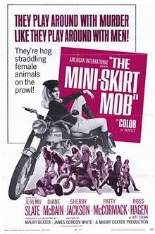

The Mini-Skirt Mob (1968)

Traveling rodeo star Jeff Logan (Ross Hagen, Avenging Angel) has just lassoed a different kind of filly: a purty new wife! Her name is Connie (Sherry Jackson, Gunn), and the couple is still in the RV-rockin’ honeymoon phase when a lithesome figure from Jeff’s past pops up.

It’s his ex-girlfriend, Shayne, for whom he was not crying to come back. With perfectly coiffed blonde hair unbecoming of a Honda hellcat, not to mention belies a nail-tough demeanor, Shayne (Diane McBain, Wicked, Wicked) is the leader of the she-devils on wheels who call themselves The Mini-Skirt Mob.
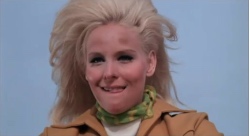
Still harboring quite the lady boner for an nonreciprocal Jeff, who left any bad-boy longings in the dust, Shayne won’t let the two lovebirds alone. In fact, with an assist from Lon (Jeremy Slate, The Centerfold Girls), she’s rarin’ to split them asunder. Why, if she can’t have him, no one will — except the Grim Reaper!

I can’t speak for you, reader, but having two beautiful women fight over you? To the death? I can relate.

Shot in the arid Arizona desert by House of the Damned’s Maury Dexter, The Mini-Skirt Mob is one of the more toothless biker pics to emerge from the era when they actually were in vogue. Despite a significant plot point’s commonality with Lee Frost’s comparatively ballsy Chrome and Hot Leather (they also share space on the official DVD), the AIP offering feels like adults playing pretend — not that there’s really anything wrong with that when you’re revisiting the bones of a long-expired genre. McBain’s villain is presented more as someone to be jeered, rather than feared, as if a catfight is bound to break out at some point. And it does.

The most interesting element to The Mini-Skirt Mob is in its casting of two supporting characters, giving The Bad Seed child star Patty McCormack a grown-girl part as Shayne’s sassy sister, and future Repo Man Harry Dean Stanton an early film role as bad boy Spook, perpetual drunk and dangler of bikini tops. —Rod Lott

Get it at Amazon.

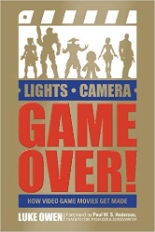
Lights, Camera, Game Over!: How Video Game Movies Get Made

As revenue generated from video games rivaled — and eventually eclipsed — that of motion pictures, Hollywood executives have been eager to reclaim some of those plunked quarters by adapting arcade and console favorites into movies. It wasn’t always the more-regular occurrence it is today, and the results have been messier more often than not, and both those points make Luke Owen’s book on the subject a fairly fascinating chronicle of coin-op/cinematic synergy.

In Schiffer Publishing’s Lights, Camera, Game Over!: How Video Game Movies Get Made, the British-based Owen offers detailed production histories of 11 key adaptations — well, okay, 10 adaptations, plus Adam Sandler’s two-bit flop on 8-bit nostalgia, 2015’s Pixels.

Whether covering the utter debacle of Super Mario Bros. or the C-cup success of Lara Croft: Tomb Raider, each chapter zeroes in on each step of the often tortured conception, development, shooting, release and (with luck) legacy of these movies, drawing upon deep-dive research and Owen’s original interviews with principal players (most notably Mortal Kombat and Resident Evil director Paul W.S. Anderson, who contributes the book’s foreword), which yields an astounding, refreshing amount of candor — such as Jean-Claude Van Damme’s drug and dong use on the set of Street Fighter.

Not every game-based flick is included (sorry, Uwe Boll fans), but Owen does not neglect to include some of the more obscure films, such as the kung-fu jiggle-fest DOA: Dead or Alive and the misbegotten Tekken, originally slated to star Jackie Chan and Jet Li. More intriguing are shorter, interstitial chapters on movies that didn’t get made, including Halo and Pac-Man — and the proposed plot for that last one (courtesy of Poltergeist rebooter Gil Kenan) is one you won’t believe!

As strong as Owen is in gaming knowledge, he is not so much in spelling. Names are botched throughout the book — not just once, in a forgivable typo, but multiple times, like “Steven Segal” every time Steven Seagal is mentioned. Legendary Paramount Pictures exec Sherry Lansing becomes “Lancy”; The Shield creator Shawn Ryan, “Rowe”; splatter director Lucio Fulci, “Fulchi”; Resident Evil franchise players James Purefoy and Iain Glen, “Purefory” and “Glenn.”

Red flags fly high even concerning the veracity of simple information, when Owen refers to “Agatha Christie’s Strangers on a Train” when surely he meant Murder on the Orient Express, or calls the Brandon Lee vehicle Rapid Fire a made-for-TV movie, or continually confuses a work visa (lowercase) with the credit card giant Visa (uppercase). He uses “cannon” for “canon,” and “coo” for “coup.” Although not as cut-and-dry, the most eyebrow-raising stumble of all is his description of 1990 Tom Hanks as an “upcoming actor,” despite being the first or second lead in no fewer than a dozen major motion pictures by then, including such hits as Splash, Bachelor Party, Dragnet and Big, the latter earning him an Academy Award nomination for Best Actor — hardly the “relative unknown” he is painted to be.

So, yes, Lights, Camera, Game Over! is in need of a reset button on the proofreading and copyediting levels, yet I’m too much of a sucker for a well-told tale of behind-the-scenes machinations to let those factual lapses sour the overall experience. In fact, I devoured all of its 315-plus pages over the course of two nights — and I don’t even like video games! I’m up for another round, because if he won’t preserve the history of Double Dragon and Doom, Lord, who will? —Rod Lott

Get it at Amazon.

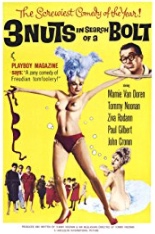
3 Nuts in Search of a Bolt (1964)

Nebbish comedian Tommy Noonan (Gentlemen Prefer Blondes) stretches to play a nebbish actor named Tommy Noonan. He’s unemployed, too, until he’s hired by high-class stripper Saxie Symbol (Mamie Van Doren, Sex Kittens Go to College) for an unusual weekly gig: to go to the psychiatrist for her and her two platonic roomies, narcissistic model Bruce (John Cronin, Twist Around the Clock) and car salesman Joe (Paul Gilbert, Women of the Prehistoric Planet).

See, shrink appointments are cost-prohibitive, and Saxie, Bruce and Joe reason that if they relay their neuroses to Tommy, he can attend for all of them. (Why they need to hire him at $60 a week when one of them could do the same would be a gaping plot hole, but that requires plot.) Tommy agrees and plops upon the couch of psychiatrist Dr. Myra Von (Ziva Rodann, Pharaoh’s Curse) to spend 20 minutes on the problems of each of his employers. However, being an actor, Tommy does so while imitating their voices and mannerisms, thus leading Dr. Von to see him as a special kind of schizophrenic: one worth studying. Don’t ask, but an incident involving a nudie magazine and spilled coffee causes their closed-circuit session to hit boob tubes nationwide, instantly vaulting Tommy to national celebrity status.

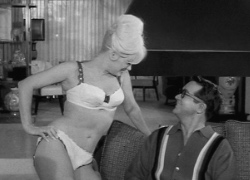
Are you laughing yet? You won’t. Directed and co-written by Noonan as a follow-up to Promises! Promises!, his 1963 hit with Jayne Mansfield, 3 Nuts in Search of a Bolt is a sex comedy that has aged so poorly, no discernible laughs remain — and that’s assuming it had any with which to begin. Given the lack of permissiveness of the times, it also has no sex. Sure, MVD is sexy AF, and Noonan’s camera offers peekaboo glimpses of her famous bosom, including a scene that finds the starlet literally bathing in beer. As with her striptease numbers, this sequence is lovingly rendered in color, whereas the bulk of the picture was shot in much cheaper black-and-white stock.

Playing less like a movie and more like a wish-fulfillment fantasy for its creator, 3 Nuts is not the sharpest tool in the sex-comedy shed. While harmless, it also is utterly charmless. Arguably, the most interesting about it is that its production design is credited to one Carroll Ballard, future director of the G-rated future-glue movie The Black Stallion! —Rod Lott

Get it at Amazon.

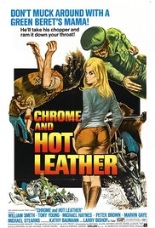
Chrome and Hot Leather (1971)

Hotheaded biker gang member Casey (Michael Haynes, The Dunwich Horror) breaks away from the pack of his fellow Wizards to terrorize two female motorists, and ultimately sends them over a cliff and to their deaths. One of the young ladies (future Charlie’s Angel Cheryl Ladd, in her motion-picture debut) was the fiancée of U.S. Army Sgt. Mitchell (Tony Young, Policewomen), who doesn’t take the news well.

In fact, when he returns from a stint in ’Nam, Mitch enlists three Army buddies (including singer Marvin Gaye, in his lone film role) to help him track down the Wizards, led by human muscle T.J. (William Smith, Terror in Beverly Hills). To do this, they go undercover as bikers as best as they can, starting with the purchase of four matching red Kawasaki dirt bikes, and traverse L.A.’s Bronson Canyon on their would-be hogs, inquiring about the Wizards’ whereabouts. (Actually, everyone throughout the film refers to T.J.’s gang as “The Devils,” despite its members’ sleeveless denim jackets clearly emblazoned with the word “Wizards” on the back.)

Released by AIP as demand for the biker pic began to wane, Chrome and Hot Leather tackles the disillusionment of the Vietnam vet under the unassuming guise of the two-wheeled subgenre, giving Mitch and his Green Berets the victory and respect our real American soldiers were denied. Now, how much of this was intended by director Lee Frost — the prolific exploitation filmmaker behind The Defilers, House on Bare Mountain, The Black Gestapo, Zero in and Scream, Love Camp 7, et al. — is up for debate.

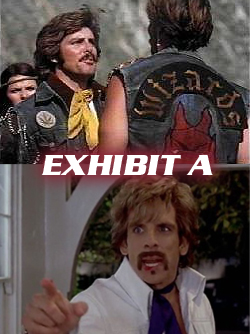
But why bother debating? It’s easier just to enjoy Chrome and Hot Leather as is and at face value. (Speaking of faces, is it possible Casey served as the visual inspiration for Ben Stiller’s White Goodman character in Dodgeball? See Exhibit A.) Although somewhat relegated to supporting status in the third act, Smith is a hoot as head Wizard, particularly with the line, “Gabriel, can’t you see we’re menacing someone?” Keep your eyes peeled for Dan Haggerty, Erik Estrada and “Monster Mash” singer Bobby “Boris” Pickett, as well as enough smoke and grime to make those peepers of yours water. —Rod Lott

Get it at Amazon.

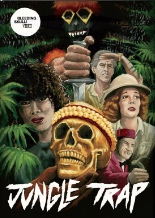
Jungle Trap (2016)

Whether working together (The Executioner Part II) or separately (Don’t Go in the Woods), actress Renee Harmon and director James Bryan never disappoint me in disappointing me. The last of their seven collaborations, Jungle Trap is the only one to have been considered lost, which is where it could inflict the least amount of harm. The duo wrote the script — yes, there is one — and commenced camcorder shooting in 1990, yet the movie remained unfinished until more than a quarter-century later, when the Bleeding Skull powers that be provided a meaningful assist.

Anthropologist Chris Carpenter (Harmon, Frozen Scream) prepares for a return expedition deep into the Amazon rainforest, although she’s hardly over the experience of losing two people on the previous trek. This mission takes her to the supposedly luxurious Palace Hotel, built over sacred burial ground of the indigenous tribe, whose members were slaughtered to make way for this “millionaire’s playground.” For some reason, Chris and her fellow white explorers fail to recognize any potential negative ramifications that might present.

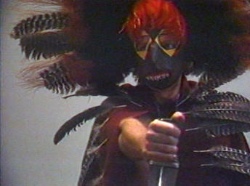
Located in the middle of the jungle, the hotel — which looks like a semi-decorated, summer-seasonal corner of your local Pier 1 Imports — is haunted. A snake slithers up someone’s bed (pay no attention to the crew member’s hand giving the serpent a good shove at the upper-right edge of the frame). Shrunken heads and full-sized spectres appear willy-nilly. Members of the Carpenter party get decapitated. Feather-laden ghosts of the tribesmen attack, as does stock footage that would not match even if Bryan tried — not least because said clips were shot on film, whereas Jungle Trap could afford only VHS, as if you’d want it any other way.

I would not, because I fear that might jeopardize the movie’s most surreal touches, like the elderly bellhop who appears in the brush as if it’s the most natural thing in the world. Or that the production values might rise in turn, denying us such sights as cast members cramped together in what appears to be a box crudely pinched into a shape approximating the interior of the elderly bush pilot’s airplane. Or that Harmon would be costumed for the evening “horror con” party in something other than her pointy Kleenex dress. At least we know that no matter how many nickels Bryan put into this thing, Harmon still would be rocking her inscrutable, in-need-of-decoding German accent. —Rod Lott

Random Genre & Cult Movie Reviews