Dixie Dynamite (1976)

In the Deep South, because where else, Tom Eldridge (Mark Miller, Blonde in Bondage) runs a moonshine business on his 7.5-acre property … until the town sheriff (Christopher George, Mortuary) shows up to throw a wrench in the works. As Tom panics and tries to flee Johnny Law, he’s shot dead by a lummox of a deputy (Wes Bishop, who wrote and produced the film).

Daddy’s death is the first domino in a string of troubles in motion for Tom’s two daughters, Dixie (Jane Anne Johnstone) and Patsy (Kathy McHaley). They face eviction from their home, thanks to the local greedy banker (R.G. Armstrong, Evilspeak), and can’t find a job — cue the montage of the ladies walking past multiple “NO HELP WANTED” signs. When close family pal Mack (Warren Oates, Stripes) fails to win the $1,000 grand prize at The Moto-Cross Big Race — seriously, that’s what it’s called — the Eldridge girls decide to resort to the ol’ standby. No, not prostitution: revenge.

A knee-jerk reaction would be amazement that Dixie Dynamite works as well as it does. But Bishop and frequent director Lee Frost made B-movie magic almost every time at bat in their long and fruitful partnership, which included horrors that shocked (Race with the Devil), schlocked (The Thing with Two Heads) and stripped (House on Bare Mountain). This proto-Dukes of Hazzard entry into the hicksploitation contender is no different. In fact, it’s one of the better ones, comfortably forming a wheel-centric companion to Chrome and Hot Leather, Frost/Bishop’s 1971 biker pic.

Plus, with Oates as something of a third-lead ringer, Frost/Bishop were able to anchor the film with more talent than the duo’s lesser efforts. If Dixie Dynamite holds any sort of surprise, well, it actually has two. The first is that one of the racing cyclists is Hollywood legend Steve McQueen; don’t bother looking for him, because he’s hiding uncredited underneath a helmet. The other, larger surprise is not that Johnstone and McHaley had zero movie credits before this, but that they had zero afterward, as both women are radiant. The screen clearly adores them, making their vanishing act from it all the more criminal. And speaking of, the final reel’s heist sequence cleverly pulls a Quick Change/Inside Man trick years before either had the chance. —Rod Lott

Get it at Amazon.

The Real McCoy (1993)

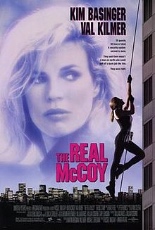
One of the great good films to come out of the 1990s action boom, this Russell Mulcahy caper stars Kim Basinger as Karen McCoy, quite possibly the hottest felon ever to walk out of a woman’s prison, complete with makeup and hair did. After a multiyear rap for a botched burglary of an Atlanta bank — complete with high-tech gear that must’ve cost more than she would’ve made from the heist – she’s now looking to reconnect with her son and walk the straight and narrow.

But, of course, because Kim Basinger is so hot, every man she comes across wants to wrap their slimy tentacles around her, especially her grimy parole officer, who I’m pretty sure was in plenty of Ernest P. Worrell flicks. Add in the equally slimy Terence Stamp, as a crime lord clad mostly in a terrible Southern accent, who kidnaps her kid, leaving her with no other option but to return to the robbing life. Along the way, she meets affable J.T. (an affable Val Kilmer), a bumbling driver who seems out of place in this movie, but oh, well, it was the ’90s and we threw caution to the wind and hired Val Kilmer whenever we could.

Watching The Real McCoy for the first time in 20 or so years, it’s a bit strange now to watch these Joel Silver, Andrew Vajna, Don Simpson or, in this case, Martin Bregman-produced flicks in the era of #MeToo, because throughout most of the movie, Basinger takes beating after beating from various men and never once fights back — until the very end, of course, when she all of a sudden unleashes kung-fu kicks left and right.

A lot of this probably wouldn’t fly today and you’d have to wonder if Basinger, whose star has waned a bit, would do it all differently today. And while it would be easy to call for a remake, this was quite the bomb at the box office, earning about $6 million in receipts. Maybe it didn’t fly so well back then, either? —Louis Fowler

Get it at Amazon.

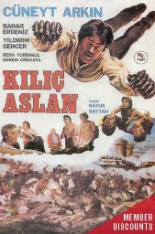
The Sword and the Claw (1975)

Cüneyt Arkın, one of the proud futuristic freedom fighters from Dünyayı Kurtaran Adam — also known in the States, rather dumbed-down if you ask me, as Turkish Star Wars — is back on the small screen in a rather good-looking print of 1975’s Kiliç Aslan or, for the sake of argument here, The Sword and the Claw.
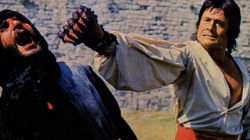
In this bargain-basement flick, a king with a birthmark of a lion on his back is killed by his sleazy mustachioed rival. When his concubine, pregnant and on the run, has his baby in the woods, said child is kidnapped and raised by lions, mostly done through a quick vignette of a small child feeding an equally immature lion some raw meat, which couldn’t have been safe, but the kid and the lion look like they’re having fun.

As the child grows up into strapping vine-swinging man Arkin, he immediately runs afoul of the same corrupt leader and, for his troubles, has his hands burnt black, Cajun-style. Thankfully, an old man forges a pair of new unwieldy metal hands — lion’s claws, if you will — and, in the last 10 minutes of film, rips out the throats of the supreme leader’s army and, of course, the big boss. Roll credits.

That seems simple enough, right?

A prime example of the popular Turkish costume dramas of the time, The Sword and the Claw has choppy editing, uneven music and the worst dubbing in history, but damned if it isn’t an entertaining flick, with Arkin jumping off the screen, somersaulting into every fight scene, with particular abandon being given to the bloody finale and his angry lion-face.

If memory serves me, I vaguely remember the VHS box for this movie when it was called Lionman, always overlooked and gathering dust. Still, the American Genre Film Archive’s Blu-ray — from the only 35mm print in existence, natch — is the nicest I’ve even seen of a Turkish film of this ilk, a genre usually reserved for 10th-generation burns.

As a bonus feature, the AGFA disc includes the kung-fu foible Brawl Busters starring Black Jack Chan, produced by the “Official Chinese Black Belt Society.” Yep, that sounds totally legit. —Louis Fowler

Get it at Amazon.

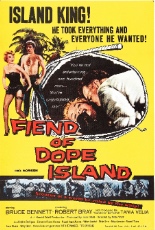
The Fiend of Dope Island (1961)

WTFSomewhere in the Caribbean, psychotic pot farmer and arms dealer Charlie Davis (Bruce Bennett, The Alligator People) is The Fiend of Dope Island, who physically abuses the native slaves he calls his employees. (Comparisons to Michael Fassbender’s Oscar-nominated role in 12 Years a Slave are not out of line.) Meanwhile, right-hand man David (Robert Bray, My Gun Is Quick) tries to right his boss’ wrongs. Besides being the only white guy on the payroll, David stands out for wearing a yacht captain’s hat as if he’s the top half missing from an “& Tennille” marquee.
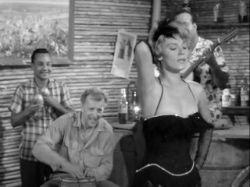
One day at the isle’s bamboo-walled cantina (and the movie’s primary set), in sashays Glory La Verne (Queen of Outer Space’s Tania Velia, billed here as “the Yugoslavian bombshell”), a shapely firecracker Charlie has hired to perform hoochie-coochie dances for his viewing pleasure to the point of literal exhaustion for her — a weakened state making it all the easier for him to attempt rape.

Although directorial duties fell to oater specialist Nate Watt (Hopalong Cassidy Returns, et al.), the script was co-written by Bennett, who sure gave himself a meaty part as the antagonist. Seeing him bark orders — each punctuated with the crack of his trusty whip — is one thing, but Bennett is at his ham-hock best during the dance numbers, maniacally laughing and feverishly bongoing his way into an orgiastic frenzy as Glory shakes her groove thang. Dope Island may be nothing more than a melodrama, but his Reefer Madness-styled overdelivery infuses the picture with a nutty flavor, kicking it over into the stuff of many a men’s adventure magazine cover. —Rod Lott

Get it at Amazon.

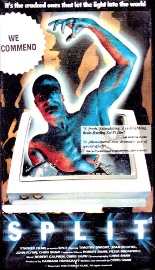
Split (1989)

Not to be confused with the recent M. Night Shyamalan film — but how I hope it is — the Split from 1989 is very much a prototypically bizarre YouTube clip stretched out into interminable movie length, so I guess that’s something to be technologically proud of.

Within minutes of pressing play, the screen is soon filled with bad teeth, bad accents and bad dialogue — including the classic line “We came for breakfast, not for AIDS!” — with the immediate start-stop bent going between this homeless man’s world and some sort of technologically unsound underworld, giving the movie an infinitely more intriguing first half-hour than many other futuristic-repressed films of the time.

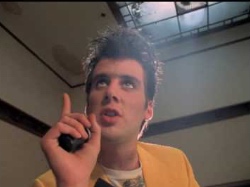
The homeless man, actually, is a sort of quick-change artist, slipping in and out of one bad comedic persona after another; he’s also on the run from this nameless group of American computer-hacker types who are desperately trying to track down the man, whose real name we learn is the unlikely Starker (Timothy Dwight).

Apparently living off the grid, especially in a time when it was easier to, strange computer graphics come to life, pixelating and swirling, proving somehow that Big Brother really is watching Starker and, of course, brainwashing all of us. By the way: Everyone is living in some form of a dystopian future, but I only learned that from reading the back of the Blu-ray case — it still looks and feels like generic 1989 Los Angeles to me.

While writer/director Chris Shaw’s film drags as we follow Starker around from one supposed comedy bit after another, where he goes to art shows as an Austrian psychoanalyst and hangs out at a Terry Gilliam-esque woman’s house, for example, keep with it; if you persevere and give it a few minutes, Split eventually becomes an absolute cheesy mind-melt as it barrels down toward a typically dark and depressing ending that I’m not sure I really get yet, but I appreciated nonetheless.

Apparently one of the first films to use CGI — and it shows — Split was a very low-budget outing with a message bigger than it could possibly contain: Conformity is a soul-destroying beast and the only thing that can save us all is a fat urinal cake to be dropped in the water supply cleaning our clouded visions — something I’ve written about in clandestine pamphlets for years. —Louis Fowler

Get it at Amazon.

Random Genre & Cult Movie Reviews