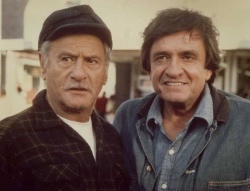
Obsession (1976)

As a kid, I gained an incredible amount of film history — not to mention history, period — through back issues of Mad magazine. My favorite features were the movie parodies, which I often read years, if not decades, before actually seeing the films they spoofed. Only once has this practice soured my enjoyment: Mad #191’s “Sobsession” all but ruined Brian De Palma’s Obsession for me. Even though 35 years passed between my reading and eventual viewing, knowing the twist excised nearly all the suspense — and, therefore, the fun.

The cozy, coddled life of real estate magnate Michael Courtland (a drab Cliff Roberston, Spider-Man’s Uncle Ben) turns to crap when his wife, Elizabeth (Genevieve Bujold, Earthquake), and their young daughter (Wanda Blackman) are kidnapped from their own home and held for a sizable ransom. Due to a hiccup in the negotiated drop-off, tragedy strikes, leaving Michael to bury and grieve his loved ones.

Sixteen years later (which pass in one bravura 360˚ shot on De Palma’s part), the widower still hasn’t moved on. When work takes him to Italy, where he met Elizabeth, he meets her spitting image in Sandra (also played by Bujold). Whether they fall in love for happily ever after is a moot point; this is De Palma, not Nicholas Sparks.

Something else it’s not: great De Palma. Although visually sumptuous, even with its gauzy haze, Obsession bores on the level of narrative. Co-written with Paul Schrader (the no-slouch scribe of Martin Scorsese’s Taxi Driver that same year), the film finds De Palma further exploring — and more deliberately so — the idea of the Hitchcockian double, injecting his own Sisters with airs of respectability.

As intoxicating as its setup is, the film starts to falter. Those looking to have their itch for a De Palma set piece scratched will get it … at the very end, itself abrupt and possibly a concession to the studio suits. All that sits in between indeed just sits, lulling viewers to a light nap. You may find yourself roused whenever John Lithgow (2019’s Pet Sematary) pops in as Michael’s business partner; I’m not sure what he’s doing here with full Southern Gentleman affectation, but damn is he ever doing it. —Rod Lott

Get it at Amazon.

Charlie Says (2018)

WTFI think that, if I was born a couple of decades earlier, I would have been a pretty good hippie cult leader, you know, minus all the murder; just me and a bunch of groovy runaways, kicking back on a deserted movie set and eating out of dumpsters while trying to reach universal oneness … sounds like far-out time to me.

That’s probably why I never fully understood Charles Manson or the notorious 1969 murders he was behind; sure, you can go with the de facto notion that he’s a fucking lunatic, but he probably would have had it so much better, possibly for the rest of his life, if he hadn’t ordered his followers to go out and kill due to a record producer not wanting to record his mostly lousy tunes.

It’s a line of thought that the mediocre flick Charlie Says could get behind, I’m sure. Starring Merritt Wever as Karlene Faith, a fully invested prison teacher who comes to know Manson’s so-called girls — Leslie Van Houten, Patricia Krenwinkel and Susan Atkins — and their undying devotion to Charlie, who took the classic pimp-game strategy and added a skewed version of Christianity to it to give his lost followers something to believe in.

Director Mary Harron (American Psycho) does a good job of keeping the usual histrionics of the girls to a bare minimum — something many other Manson filmmakers seem to go absolutely crazy themselves with. The real sore spot of the movie is with ol’ Charlie himself, played by the flaccid Matt Smith, complete with a laughable beard and wig, but maybe that was the point.

Sadly, while the ’60s are long over and so is my chance to be a cult leader, Charlie Says is thankfully the wishful-thinking flick that tells me I would probably screw it all up just as bad — if not worse, yikes — as Manson did. Believe me: Even the most minor of power corrupts, especially in me, absolutely. —Louis Fowler

Get it at Amazon.

Django the Bastard (1969)

In all the dusty annals of the mythical Western genre, if there was ever a true bastard to tame the Wild West, it was apparently Django or, even better, Django the Bastard, this illicit Italian rip-off of his blood-spattering name.

People are strange when you’re the Stranger, a gunslinger dressed in black (the decided un-Franco Nero Anthony Steffen) who walks into town one day carrying a convenient wooden cross; he plants it dead in the middle of the town square and quickly doles out his six-shooter justice, the only way a black-hearted demon from hell — as we’re told he might be — can.

Meanwhile, the just-as-terrible townsfolk are placing wagers on a game where two poor boys toss a stick of dynamite back and forth, betting dollars on who is going to get a hand blown off first. Welcome to Desert City, population … well, I guess it doesn’t matter, because Django’s got a handmade wooden cross for all of them, which he hands out one by one.

Turns out that this low-rent incarnation of Django isn’t an avenging angel, but rather a former soldier who is seeking revenge on the perpetrators of a brutal Confederate massacre, one that apparently he can’t seem to get over; he crafted this death-bringer persona as way to not only strike fear in the hearts of fellow evildoers, but also to help him through the apparent post-traumatic stress that he is surely going through.

Whatever works, I suppose.

Filmed at a tumultuous time in spaghetti cinema when the men looked like glam-rock refugees and the women like young Melania Trumps, Django the Bastard was originally released under the more family-friendly title of The Strangers Gundown — and it’s gundowns a-plenty that Django delivers in this mostly watchable tale of brutal revenge and copyright infringement. —Louis Fowler

Get it at Amazon.

Weird Science (1985)

Of all the movies from the 1980s loosely based on an Oingo Boingo tune, Weird Science still remains the breast — uh, I mean best – of the lot.

Coming off his back-to-back directorial triumphs of Sixteen Candles and The Breakfast Club, even John Hughes was seemingly tired of all the laid-thick teen pathos; for his next film, he opted for a raunchy teen sex comedy where, instead of having what I feel would have been a full weekend of absolutely incredible lovemaking with Kelly LeBrock, the youngsters learn about themselves and each other. Good for them, I guess.

Gary and Wyatt (Anthony Michael Hall and Ilan Mitchell-Smith, respectively) are two teen-movie approved geeks repeatedly picked on by their horrible mulleted classmates. Instead of making a Terminator-like killing machine to wreak cold-blooded revenge on them, using their highly advanced (even for 1985) computer, they break into the Pentagon’s data files and invariably create The Woman in Red, seemingly just to stare at from afar.

Lisa (LeBrock) is not only a gorgeous mature sexpot, but also has cyber-enhanced powers, warping time and space to fit whatever mood she’s in; great for us (but sadly for the impoverished children of the world), those powers mostly go into throwing the wildest party this side of the ’80s, complete with nuclear missiles, a piano getting sucked through the chimney and an appearance by The Road Warrior’s Vernon Wells as a post-apocalyptic biker.

LeBrock was perfectly cast in an icon-making role, but that’s not to say Hall or Mitchell-Smith are by any means shabby in their archetypical nerd roles that defined a generation of dorks for HBO-obsessed youths; that being said, a special lifetime achievement award of some sort should have gone to Bill Paxton for the role of the meathead older bro Chet, mostly for introducing the phrase “You’re stewed, buttwad!” to the lexicon.

The gorgeous Arrow Video release of Weird Science not only delivers a 4K restoration, but both the theatrical and television versions of the flick are present, the latter of which is twice as funny for its barely legible curse-word redubs, which is especially great for the story where the girl of Gary’s dreams kicks him in the “guts” and calls him a “braggart” in front of everyone. —Louis Fowler

Get it at Amazon.

[Censored] (2018)

They say one man’s trash is another man’s treasure. Make that other man a woman — specifically, Down Under filmmaker Sari Braithwaite — and the treasure is [Censored], a documentary constructed solely of film footage once banned by the Australian Censorship Board and now culled from the Australian National Archives. Over the course of 63 minutes, excitement over her find not only fades, but flips, as she narrates each step of a crisis of conscience.

Making up the tarnished treasure are those excised portions from 1,991 movies between 1958 and 1971, organized from A to Z — er, Zed. The clips run the gamut of genre and budget, from melodrama to mondo, from cowboys to aliens. In this, her first feature — an outgrowth of her 2015 short, Smut Hounds — Braithwaite considers being confronted this “state-sanctioned spank bank” and wonders, “How do I tell a story with all these scraps?”

She more than makes do. The displaced frames find a home as she initially sets out to examine and decry her homeland’s history of censorship, grouping the cuts thematically and presenting them with a modicum of context. We get a montage of screen kisses — chaste to erotic, consensual to forced, hetero- to homosexual — and think little of it. Young men then brandish knives, and their serrated machismo strikes the viewer of silly, if nothing else.

Then come the slaps — hard, as men backhand wives, girlfriends, mistresses, whores, whomever. Not any one slap bothers on its own, but the cumulative effect of violence is jarring and uncomfortable. As a result, Braithwaite’s thesis comes into focus — and grows sharper with subsequent sequences concerning Peeping Toms, acts of striptease and the act of rape. (Incidentally, the most nerve-wracking scene of all isn’t among these: an extended and unflinchingly graphic childbirth, with more liquid-expelling orifices onscreen at once than your pick of David Cronenberg pictures.)

To acknowledge her point does not mean the audience is required to co-sign. Even those who disagree with her ultimate view can appreciate her journey for its inherent historical value; the documentary is inadvertently star-studded, featuring legends Kirk Douglas, Clint Eastwood, Dean Martin, Steve McQueen and Bob Dylan, who argues over broken glass. The directors represented are no slouch, either, as they include Agnes Varda, Ingmar Bergman and Jean-Luc Godard.

And yet, [Censored] ultimately works not because of them, but because of Braithwaite and her creative collaborators. Primary among them are two who work in tandem here: post-rock outfit The End, whose potent instrumental score helps fuel the considerable tension crafted by editor James Arneman. —Rod Lott

Random Genre & Cult Movie Reviews