The Banana Splits Movie (2019)

Nostalgia-amped superfans of Sid and Marty Krofft’s The Banana Splits Adventure Hour from the late 1960s and early ’70s — back when the phrase “Saturday morning” meant something — may be horrified to see what awaits under the innocuous title of The Banana Splits Movie: a honest-to-God slasher movie (and to complain about that is no better than the fanboys whining about girls being Ghostbusters). But in this ready-to-market age of IP revivals, reboots and reheats, it’s nice to see one that doesn’t just thumb its nose at the source material, but urinates on it, too.

In the direct-to-disc flick, the Krofft show exists (albeit under the name of Taft) in the real world of present. Speaking of present, it’s the birthday of young Harley (newcomer Finlay Wojtak-Hissong), a friendless boy who likes to wear butterfly wings while dancing along with his favorite show on TV, much to the dismay of his macho-asshole father (Steve Lund, TV’s Bitten). However, Mom (Dani Kind, TV’s Wynonna Earp) is so supportive that she’s scored the fam tickets to a live taping.

No one in the audience knows the episode being taped will be the last, as The Banana Splits has been axed — fresh news taken not so well by the animatronic foursome, thanks to a pre-curtain programming upgrade. Behind the scenes and at the post-show meet-and-greet, the Splits (Fleegle, Bingo, Drooper and Snorkel) take the frustration of unemployment out on everyone who deserves it, as dictated by slasher-movie rules, which director Danishka Esterhazy (Level 16) clearly delights in depicting — after all, it’s not every day you get to shoot a giant robot lion and dog respectively flambé a pushy parent’s face or saw an Instagram “influencer” in half.

But maybe it should be. Whatever possessed Warner Bros. to turn a beloved, kiddie-courting property into R-rated Grand Guignol … well, I’m for it. I’m guessing the runaway popularity of the Five Nights at Freddy’s video-game franchise among grade schoolers — now in high school with more rebellious taste — proved an unofficial factor. Yet from the start of the Krofft empire, the line between their creations and childrens’ therapy appointments has been drawn with the sharpest of washable markers, so it takes only one turn of the screw to reimagine the cute and cuddly as vile and violent. Essentially a two-location picture, The Banana Splits Movie looks flat and cheap, but self-parodic subversiveness and perversity work in its favor. —Rod Lott

Get it at Amazon.

Night Killer (1990)

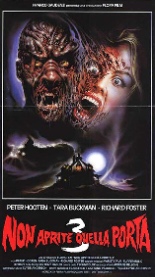
Ladies of Virginia Beach are all atwitter over an unnamed serial rapist/killer terrorizing the community. (Let’s call him Night Killer, since the movie is named just that.) Luckily, he’s easy to spot: He’s the guy in the Toxic Avenger-esque rubber mask with matching rubber hand spouting spiky yellow fingernails long enough to vie for a Guinness World Record. Only if he stood under a neon arrow flashing “GET MURDERED HERE” could he be more identifiable.

His signature move? Punching clean through women’s torsos. Melanie Beck (Tara Buckman, Silent Night, Deadly Night) somehow makes it through a terrifying home-invasion encounter with him, emerging with scraps, bruises and amnesia, but nary an extra hole. After being discharged from the hospital, life for Melanie continues to be a living nightmare, thanks to Night Killer still at large, as well as being stalked — and then abducted and sexually assaulted — by a creepy guy named Axel (Peter Hooten, who donned the cape as 1978’s Dr. Strange).

As a director, Claudio Fragasso (aka Clyde Anderson) is remarkably consistent. However, as other Fragasso films like Beyond Darkness, Monster Dog, Troll 2, et al. raise their right hands and testify, that consistency is a remarkable disdain for reality and rationale — and Night Killer might be his most imbecilic. Nothing happens as it should or would, even when allowing for a moviegoers’ suspension of disbelief. For example — and this is minor, mind you — Melanie reacts to a threatening phone call by looking in the mirror and yanking out her breasts. In fact, it’s just the first of several instances that call for Buckman to bare at least one of them, which accounts for her wardrobe choice of saggy sweaters for easy access; exposure happens so often — perhaps only a single instance merited — that I felt embarrassed for her.

Elsewhere, Melanie lays out a picnic of pills on the shore. In a public bathroom, Axel is forced at gunpoint to strip to the blue banana hammock that passes for his underwear. Seemingly from another movie emerges Blind Vision’s Lee Lively as an apparent stand-in for Donald Pleasence’s signature Halloween role of Dr. Loomis. I’m more than happy to discuss the bonkers twist, but don’t get me started on the choreographer. —Rod Lott

Get it at Amazon.

The Great Texas Dynamite Chase (1976)

Only in the 1970s — or at least the New World Pictures version of the 1970s — could you make absolute heroes out of a pair of cop-shooting, hostage-banging, dynamite-toting bank robbers the way that the drive-in favorite The Great Texas Dynamite Chase did, starring the breast-baring duo of Claudia Jennings and Jocelyn Jones.

Doing a good job of capturing small town Texas — or at least the California stand-in of it — complete with tumbleweeds blowing down the railroad tracks, bored Texan Ellie Jo (Jones, Tourist Trap) works in a bank that has a Confederate flag on the wall; when prison escapee Candy (Jennings, Sisters of Death) comes in, sticks of lit dynamite in hand, the two team up and head out on the road looking for money and men, not in that order.

And it’s a pretty good plan, too, taking them all across Texas’ various backroads, saloons and hotels. Eventually, they hook up with small-time thief Slim (Johnny Crawford); if you’ve ever wanted to see the co-star of The Rifleman making drunken love while a song called “Love Is Good to Me” plays over the quadraphonic stereo — and I know that fetish is out there — here’s your flick.

In a particularly downbeat ending, even though the gals make it to Mexico on horseback, just about everyone else receives massive shotgun blasts to the chest; to be honest, I was kind of hoping for some dynamite-handling gone wrong — nothing big, just a few blown off fingers here and there — but on an impossibly tight budget, I guess director Michael Pressman (Doctor Detroit) did the best he could.

However, with Jennings and Jones frequently nude — and both with a sexy look that reminds me of the white-trash moms I grew up around in Texas — it’s really not that difficult for The Great Texas Dynamite Chase to instead manifest a couple of explosions in your blue jeans. —Louis Fowler

Get it at Amazon.

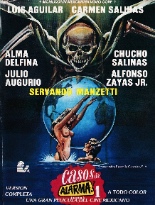
Casos de ¡Alarma! 1: SIDA (1986)

WTFThe sensational Mexican newsmagazine ¡Alarma! is legendary for the graphic violence and tremendous sex contained within in its bestselling pages, with images of severed heads and mutilated corpses right on the cover, usually in blazing full color. I’ve got a couple of old copies if you really want to take a look at one.

In 1986, the fotonovela titled Casos de ¡Alarma! made it to the big (well, big in Mexico) screen in a film subtitled SIDA or, as it’s more popularly known in America, AIDS. Of course, it’s a highly melodramatic and deeply pungent story that, even for the time, is hilariously uninformed about the disease. But, I guess if you’re watching a film from the makers of ¡Alarma!, you’re really not looking for integridad periodística.

A moody young man named Rodolfo (Servando Manzetti) comes to a small rural town, with uncomfortable flashbacks to an apparent murder as he looks out the window wistfully on the bus. Seems he’s confused about his sexualidad ever since a kid (who resembled a young John Candy) molested him at boarding school, leading to a life of being taken advantage of by old men and, for the most part, he didn’t really hate it.

However, when he meets atractiva clothes-washer Carolina (Alma Delfina), it energizes the fuerza de vida machista pura inside him, but, consequently, he gives her SIDA. Then, despite the romantic ranchera musical numbers by the mayor’s son, Ausencio (Julio Aldama), to her, he vengefully sexually assaults Carolina and that gives him SIDA, too, which apparently has a gestation period of three months before you die a horrible death on a tractor.

At two hours, the thing is surprisingly filled with dumb comedy, tired gay stereotypes and plenty of punishing filler. Regardless, it’s still very much like the death-obsessed magazine, from a bordello of breast-heaving prostitutas to the bloody gundown of Carolina from an angry padre; this first volume of Casos de ¡Alarma! is remarkably trashy and fully exploitative of the absolute temor surrounding SIDA at the time. —Louis Fowler

Get it at Amazon.

The New Gladiators (1984)

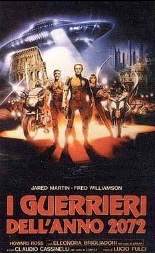
In 2072, the TV networks’ biggest shows are reality competitions like Killbike and The Danger Game, both as nihilistic as they sound. (Isn’t that crazy? I don’t mean those shows, but the idea that TV networks will exist in 2072. Oh, that Lucio Fulci — such a kidder!) The webs’ ante gets upped when the floating station WBS makes plans for The Battle of the Damned!
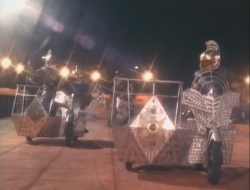
To be played in Rome’s Colosseum, where the bread-and-circus gladiators once sparred, this surefire ratings grabber forces death-row inmates to participate in games of mortal combat that update Ben-Hur-style chariot races with motorcycles. Among the first round of The New Gladiators (to borrow the film’s title) are Drake (Jared Martin, Fulci’s Aenigma), in the clink for killing the three guys who killed his wife, and Abdul (Italian post-apocalyptic flick staple Fred Williamson, Warriors of the Wasteland), who practices kung fu under disorienting strobe lights.

It’s a terrific idea, not fully realized until the release of the Arnold Schwarzenegger vehicle The Running Man three years later. The New Gladiators gets too caught up in prepping for the games, as Drake and friends — including Doctor Butcher M.D. himself, Donald O’Brien, as a severely burned ol’ pal with fiber-optic eyes — plot to destroy the show and WBS from within.

Known alternately as Warriors of the Year 2072, the movie certainly bears appeal, yet has more ambition than director and co-writer Fulci (The New York Ripper) has means. This is evident from frame one, when a pan across the cityscape at night aims to evoke the “wow” factor of Blade Runner — unachievable when said cityscape clearly is a model in miniature, akin to a backdrop from your cousin’s Lionel tabletop train set. Fulci gets in one good effect, when a woman’s face melts like a candle. —Rod Lott

Get it at Amazon.

Random Genre & Cult Movie Reviews