Centigrade (2020)

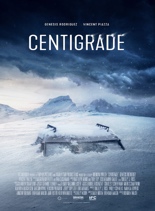
Centigrade comes from the long line of confined-space thrillers, in which most — if not all — of the movie takes place in one cramped spot (e.g., Buried, Phone Booth, Devil, Cube and ATM). The difference with Centigrade is being inspired by true events — no supernatural elements here, folks!

Set in 2002, the film opens with very pregnant author Naomi (Genesis Rodriguez, Tusk) and her husband, Matt (Vincent Piazza, Rocket Science), waking up inside their car, only to find it snowed under. See, touring through Norway, they chose to pull over due to freezing rain while waiting for the storm to pass. Oh, it passed, all right, leaving impenetrable precipitation behind.

Frustration boils as panic almost immediately sets in; complains Matt, who isn’t helping matters, “Can you not be so defeatist?” (Also not a calm influence? The score’s simple tinkling of a lone piano key.)

Given the demands of Centigrade’s story and setting, if you’re going to be trapped with two people for weeks — even if compressed into 89 minutes — you’d damn well better like them. In his first feature, director Brendan Walsh (TV’s Nurse Jackie) seems to make a rookie mistake by not exactly ingratiating the couple with viewers right off the bat, but this proves to be wise; with both being so flawed and fraught with alarm, the tension between them starts at a level higher than normal. While it may wane from there, one part remains constant: wondering what you would do. —Rod Lott

Get it at Amazon.

Sukiyaki Western Django (2007)

Takashi Miike (Audition) has always been an extremely divisive filmmaker, so it makes sense this ramen Western’s opening scene features Quentin Tarantino — America’s own cinematically disruptive director — gutting a raw egg fresh out of the belly of a snake before gunning down a few overacting varmints.

And even though this whole introduction does little for the rest of the film, it does provide a red-stained and sin-staged sense of Japanese theatrical weirdness that anyone with the drawn-out wherewithal will experience over the next 98 or so minutes, Gatling gun and all.

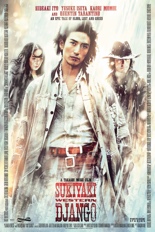
A cynical homage to Sergio Corbucci’s Django — and the many nameless spaghetti flicks that came before it, as well as their Japanese originals — Sukiyaki Western Django stars Hideaki Ito as the nameless gunman who wanders into a small Nevada town ruled by two gangs: the white-clad Genji and the red-emblazoned Heike, both obsessed with the area’s gold and the power it brings.

Both sides want the expert marksman for their own purposes, but he’s playing them for his own vengeful needs and purposes, with Miike borrowing from the best of Western flicks and samurai films to tell his head wound of a tale. As you could guess, it all explodes in an extended final battle that practically tears the town to bloody shreds, save for a little boy who becomes … Django.

The only thing about this film is you have to have a bit of cooled patience to get to that bombastic ending. At times, Sukiyaki can drag itself down under the pitch-black weight of its own gory self-importance, but for me at least, that’s somewhat typical of many — and I do mean many — of Miike’s films. But here, it really seems more deserved than others. —Louis Fowler

Get it at Amazon.

Demonia (1990)

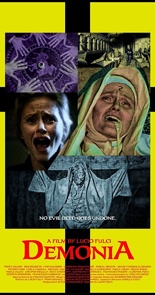
Rumored to participate in murderous orgies — and, thus, under suspicion of satanic possession — five nuns are literally crucified by God-fearing town residents in 15th-century Sicily. Meanwhile, in Toronto — oh, and 500 years later — archaeology student Liza (Meg Register, Boxing Helena) makes contact with their souls during a séance, conveniently before she’s about to travel to Sicily with her professor (Brett Halsey, Return of the Fly) to excavate some ruins.

Once there, Liza expresses her desire to check out what remains of the nunnery, to which the prof replies, “We’re archaeologists, not morticians!” (With Demonia being a Lucio Fulci film, however, characters might have to be both.) The locals are not of the Welcome Wagon variety. And neither are the nuns’ vengeful spirits, as one poor fellow (Fulci regular Al Cliver, The House of Clocks) finds out aboard a boat named the SS Perversion (seriously) when he’s harpooned by a headless, topless ghost.

Other unfortunate demises hot off the menu in Demonia include a woman killed by her own cats, who tug at her eyeballs like they were orbs of yarn; a man attacked by a slab of meat, which repeatedly slams him against a wall like a rolling pin to Play-Doh; another man tied to trees that rip him in half, from crotch to crown, as his son watches in terror; and one flame-broiled baby.

These are the wicked, wicked ways of the Italian gore godfather in his contribution to the world of nunsploitation; this being his lone work in that subgenre, he sure as hell leans in — sometimes even literally, pushing the camera forward with each swing of a sledgehammer or assault by beef. Part of the fun of watching a movie by Fulci is seeing how far he’ll go; only in the depiction of the infant’s death does Fulci show any restraint, focusing on the tot’s teeny-weeny hand as the casually discarded bundle of joy burns like trash on a farm. By contrast, the guy pulled apart like human Laffy Taffy is shown in daylight, out in the open, in a wide shot; at no point does it look real, but that’s hardly the point.

Demonia offers the Fulci faithful more than enough gore to have them foam at the mouths, preferably not as colorfully as the yellow bile oozing from the ghost nuns’ collective cakeholes in the abrupt final scene of utter WTF-ery. —Rod Lott

Get it at Amazon.

Unhinged (2020)

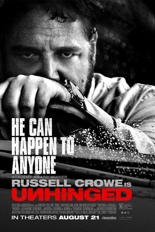
After everything from 1992’s Romper Stomper to 2005’s errant hotel phone, if you still haven’t learned Russell Crowe is not to be fucked with, let Unhinged serve as your zero-ambiguity lesson.

His newly divorced Tom is, after all, a guy who hammers in the skulls of his ex-wife and her new man in the film’s opening scene, and then burns down her house. (Take that, queen of the harpies!) With depression-level girth, a hair-trigger temper and a Ford truck to compensate, Tom is not in the mood to be honked at mere hours later by Rachel (Caren Pistorius, Mortal Engines), a freshly single suburban mom just trying to get her teenage son (Gabriel Bateman, Lights Out) to school on time.

So, when at a stoplight, she impatiently blares her horn and doubles down on her refusal to apologize, Tom takes road rage to a vengeful extreme, not only upending all traffic laws in the process, but playing serial killer with her friends and family in between rounds of their cat-and-mouse pursuits. His methods of dispatch — such as tying a man to a roller chair and setting it aflame before shoving it toward a cop — lean into the slasher territory of Jason Voorhees at his most practical (and unintentionally comical).

Directed with too loose of a grip on the part of Derrick Borte (H8RZ) to offer true escapism — his attention to spatial awareness is kneecapped and even the foreshadowing has foreshadowing — Unhinged arrives in the tradition of such white-knuckle, forward-momentum classics as Duel and Speed. Note the operative word is “tradition,” because Unhinged isn’t in their league; it belongs further down, even underneath your The Call and Premium Rush, but maybe pulling alongside the most recent direct-to-video sequel for Joy Ride if it knows how to parallel park.
Remove the A-list luster of Crowe — who’s coasting, anyway — and its below-averageness as vehicular entertainment becomes all the more apparent. That’s disappointing because when they work, simple films of a breathless chase tend to be real crowd-pleasers.

Here’s your courtesy tap: Move along. —Rod Lott

American Rickshaw (1989)

In the early 1930s, Hollywood tapped Olympic gold medalists Johnny Weissmuller and Buster Crabbe to play Tarzan. Half a century later, when high-concept action became big box office, studios wanting to shepherd the next Stallone or Schwarzenegger again looked to the middle of the medal podium; within 13 months of one another, moviegoers could see Kurt Thomas in Gymkata, Bart Conner in Rad and Mitch Gaylord in American Anthem.

Had those flicks clicked, who knows? We might have Michael Phelps defending God’s pool as Aquaman or Simone Biles crushing it as Katniss in The Hunger Games franchise. Although I have no evidence, I’d like to think Gaylord’s sophomore slump, American Rickshaw, served as the final nail in this miscasting coffin.

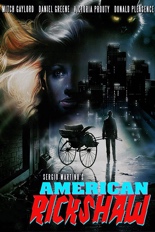
Gaylord’s Scott is a struggling full-time college student who works as a part-time rickshaw driver in Florida. One night, slinky redheaded stripper Joanna (one-and-doner Victoria Prouty) offers intercourse as a tip, which he accepts … until he realizes their shower romp is being videotaped by a thumbless perv (Gregg Todd Davis, Nightmare Beach) who happens to be the son of televangelist Rev. Mortom (Donald Pleasence, The Great Escape). The young Mortom is killed by a towering hulk (Daniel Greene, Hands of Steel) who frames Scott as the culprit, then sets out to kill him, too. Scott need only not get murdered, but clear his name and find that sex tape!

Conspiracy, secrets, homicide, a femme fatale, unlabeled VHS cassettes, AIDS needles — all pretty standard stuff for a thriller of that era, but Sergio Martino is no standard director. Known more for his stellar work in the giallo (The Strange Vice of Mrs. Wardh, et al.), he introduces one weird, wild supernatural element to keep things from being too generic: an immortal Asian witch (Michi Kobi, 12 to the Moon) who helps protect Scott by teleporting a cobra and turning Rev. Mortom into a satanic warthog on live TV — but not at the same time, mind you, because that would be stupid. At least the script offers an ironclad reason for the witch’s kindness: because Scott helped her onto his rickshaw on a rainy afternoon.

Seeing as how American Rickshaw (aka American Tiger) contains nary a pommel horse, the logic in hiring Gaylord is negligible. Then just shy of 30, he looks like a preening preteen, yet is a real wet blanket on screen. His line readings are so wooden, he could have found them near the contractor’s entrance at Home Depot. He can’t convincingly act an sexual encounter in the shower, which he’s certainly had in real life; by contrast, as the antagonist, Greene sells the hell out of a magic key burning straight through his hand like Alien acid, as if he’s lived it a hundred times before, just as Pleasence commits to uncontrollable oinking — ever the professional, no matter how embarrassing. And this one is that, to all involved, to our eternal enjoyment. —Rod Lott

Get it at Amazon.

Random Genre & Cult Movie Reviews