
Ingagi (1930)

WTFOne has to admire the guts and gusto of the gang behind Ingagi — or would admire if director William Campbell’s very idea and execution weren’t so, well, racist. It’s a historical curio nonetheless.

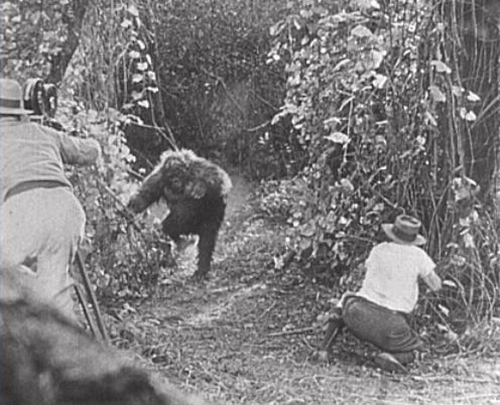
A color-tinted stew of ethnography and chicanery, the film purports to be a documentary of a 1926 African expedition by one Sir Hubert Winstead. In actuality, Ingagi not only was faked, but much of its safari footage stolen from another movie, which explains why those scenes are of much lesser resolution.

As the opening crawl of exposition informs audiences, Winstead has heard wild stories of a remote village in Africa whose tribesmen adhere to a most unusual yearly ritual: sacrificing a woman to a sex-mad gorilla, simply because they believe the gods demand it. The gods must be crazy! So Winstead and his fellow British explorers head to Africa to take some time to do the things they never had.
Upon arrival, they watch a beggar perform cigarette tricks and play three-card monte with eggs — all a mere prelude to the zoo-as-menu shenanigans on which the bulk of Ingagi is built, from warthogs to wildebeest. Animals encountered and/or hunted include crocodiles, zebras, elephants, leopards, deer, giraffes, ostriches, vultures, rhinos, armadillos, hyenas and fairly tame impala. Many, if not most, of these creatures are killed, with retrieval of the bodies left to Winstead’s native “boys.” Maybe it’s my chronic back pain, but dragging a dead hippo looks like quite the chore.

We also witness a python denied a lunch of lemur, as well as Winstead’s crew setting traps for little monkeys; when one is caught, narrator Louis Nizor chuckles with a tinge of cruelty, “What a duffer!” (Nizor, who fulfilled similar duties a year later for Campbell’s follow-up, Nu-Ma-Pu – Cannibalism, is highly opinionated throughout, remarking on “grotesque baboons” and outright declaring, “Rhinos are stupid beasts.”) For good measure, they “discover” a new animal they dub the “tortadillo,” which is a tortoise affixed with phony wings and tail, looking not unlike a Pokémon precursor.

Infamously, Ingagi’s climax depicts Winstead’s cameramen catching footage of that fabled gorilla nabbing a topless native woman for some interspecies hanky-panky. The big ape is played by none other than Charles Gemora, who donned such a suit in more than 50 movies, including The Gorilla and Island of Lost Souls. After more than an hour of buildup, the sequence is deflating to expectations — fitting for what amounts to a no-taste National Geographic special and forebearer of the mondo mockumentary. —Rod Lott

Get it at Amazon.

Trucks (1997)

My favorite Stephen King film is probably Maximum Overdrive, with its Emilio Estevez “performance,” AC/DC soundtrack and Green Goblin truck mowing down everything in sight. That being said, Trucks, based on the same material, definitely isn’t.

I’m not sure who or what gave director Chris Thomsan and writer Brian Taggert the wherewithal to make their own version of King’s short story — I’m guessing the USA Network — but none of Overdrive’s very minimal star power, grinding soundtrack or Marvel Comics-inspired vehicular damage is present; instead, everything is replaced with Timothy Busfield and some people outrunning two or three trucks.

A sullen Busfield is Ray, a grease monkey with a not-so-sullen son, both mourning the death of their wife/mother. They run the local garage/diner and, I think, the town’s premier UFO tour with the incredibly bland Hope (Brenda Bakke). As she brings tourists to town, they run amok of the titular automobiles on the roadway, which eventually trap them in the small diner.

While Overdrive was literally filled with bloody gags — both the funny and the cruel kind — Trucks is more sputtering along a road of bloodless gugs, as each large vehicle saunters around the gas station, barely providing any true fear for the trapped veteran actors or hysterical newbies.

You’d think that remaking what many consider to be the worst King flick — again, not me — it would be nothing but up for all involved, but with Trucks, it’s somehow nothing but down — all the way down. —Louis Fowler

Get it at Amazon.

Mortuary Academy (1988)

Police Academy’s success was so huge, it predictably led to a glut of slob-comedy imitators that could be pitched — and likely were — with the sentence “It’s Police Academy, but [insert training scenario here].” The best of these was arguably the screenwriters’ own Moving Violations (“at a traffic school”); the worst is a distinction among many contenders, including the leaden Mortuary Academy, appropriately late to the game.

Brothers Max and Sam Grimm are due to inherit their deceased uncle’s Grimm Mortuary & Academy (“You kill ’em, we chill ’em”) on one only-in-the-movies condition: They first must graduate from it. Having no motivation, Sam (Jocks’ Perry Lang) has nothing to lose, but Max (The Blue Lagoon’s Christopher Atkins) dreams of becoming a doctor, not an embalmer. However, once he’s rejected in short order by med schools and his pretty-but-petty girlfriend (Megan Blake, Eyeborgs), Max suddenly has no other prospects. After all, a premise is a premise!

The hallowed institution is, per the film’s not-aged-well poster, “where the dearly departed meet the clearly retarded.” Per the demands of the subgenre, it’s chock full of misfits! They include Tracey Walter (Repo Man), who “revives” dead dogs with robot technology; Stoney Jackson (Angel 4: Undercover) as the token black character — rapping, no less; and Lynn Danielson (from director Michael Schroeder’s other 1988 movie, Out of the Dark) as a good-girl love interest for Max and superfan of Radio Werewolf, a band I didn’t realize was genuine until afterward. The group’s inclusion is tied to the movie’s “Special Appearance by Wolfman Jack” — the adjective is up for debate.

In charge of the academy are Eating Raoul power couple Mary Woronov and Paul Bartel as, respectively, the nymphomaniac professor and the necrophiliac owner with eyes on keeping the brothers Grimm from taking over. Bartel also co-wrote the script with William Kelman (Beach Babes from Beyond), but the satirically dark touch Bartel is known for (baby caskets, anyone?) isn’t employed nearly enough, drowned out by the easy-lay, low-hanging fruit of sophomoric and scatological jokes. The dialogue can be so clunky, it sounds like the work of an ESL student who hasn’t stuck to the lesson plan: “Your head’s swollen with baby vomit! You listen to me, you toxic vagina!”

At least Bartel presumably penned himself into Mortuary Academy’s one good bit, in which he falls hard for — and gets “engaged” to — a deceased cheerleader (Cheryl Starbuck, Pathology). After taking her corpse to a drive-in restaurant, they have a romantic encounter on the beach à la From Here to Eternity … if Deborah Kerr were dragged out to sea while Burt Lancaster zonked out in a post-coital snooze. —Rod Lott

Get it at Amazon.

The Batwoman (1968)

Na-na-na-na-na-na-Bat … woman?

On the not-so-sullen streets of Acapulco, a lone vigilante of the daylight stalks her chubby prey using a sporty convertible, a few police pals and, best of all, a lucha libre alter ego with the exact same name: the Batwoman.

When fellow wrestlers are found dead on the beach, she’s called in to help solve these crafty crimes in her very sleek and hyper-sexy costume, which is basically a black bikini with a Batman cowl; if I saw her in real life, my knees would shake, too, but probably not out of fear.

The murderers are (somewhat) evil scientists and their middle-aged henchmen, lounging in lab coats on a luxury yacht near the beach. So powerful is their supposed reign of terror, that at one point the Batwoman shows up on a much smaller speedboat, only to be told to go home … and it works!

In between chasing down leads, of course the Batwoman tears up the mat, practicing wrestling moves and lucha throws, oddly enough in an even bulkier Bat-costume — think her superhero outfit, but as a sweatsuit instead. Still, the various bouts are a great way to stretch out this already thin superhero soup.

Maura Monti, as the Batwoman, is a defiantly sensual presence who does a good job of talking down baddies and clothespinning opponents alike. It’s a strong message The Batwoman should have really gone out on, but instead, it ends with her utterly afraid of a mouse while her police pals laugh at her expense. —Louis Fowler

Get it at Amazon.

Spidora (2014)

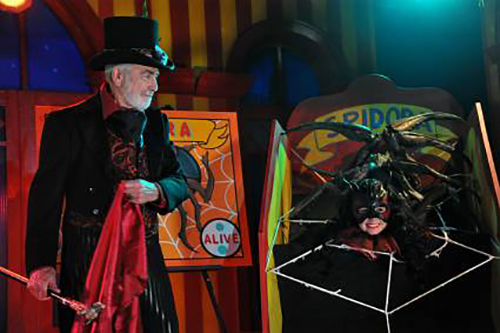
WTFMultiple reasons may exist for a carnival sideshow’s use of garish paintings and a curtain to curtail peeks from the ticketless, but I’m only interested in the most obvious: Because you don’t get what you pay for.

Legendary B-movie director Fred Olen Ray (Hollywood Chainsaw Hookers) knows this; in fact, he literally wrote the book on it. Amplified by the barker’s ballyhoo, the sideshow posters outside the tent promised one thing and delivered another on the other side of the admission booth: something always lesser, often phony. For example, what was depicted as a giant spider with a human woman’s head actually would be — zut alors! — an illusion achieved by the lady sticking her head through a prop atop of a web of rope, with everything below her neck concealed.

Which brings us to Ray’s carnival-set Spidora. Its key art and tagline — hell, its very title — prime the viewer for a fanciful, “eight-legged love story” of this so-called spider woman. This is not that.

As much of a con as the shows it emulates, this is about Princess Marina, the Lobster Girl (the Amy Adams-esque Megan Sheehan), she of the claws for hands. Now, she does don a mask to moonlight as Spidora, which we get in one all-too-brief scene. But the rest? The rest is Marina and the smitten, Shakespeare-quoting suitor (Bobby Quinn Rice from Ray’s Super Shark) who’s a regular to the Museum of the Weird, Strange and the Unexpected. (Try fitting that on a ticket.)

Ray’s affection for the state-fair “freak show” is evident and reverent, given the sheer amount of coverage allotted to Marina’s act, the introductions of the top-hatted host (Jerry Lacey, TV’s Dark Shadows), the coat hanger swallower (Grindsploitation’s Krystal Pohaku) and the fire dancer (Crystal Marie) who twirls nary a tassel, but lighted wicks dangling from her pasties.

Less-exotic-sounding subject switcheroo notwithstanding, more to interested parties’ detriment is Spidora’s running time, misleadingly labeled at “Approx 90 Minutes.” That number is accurate if you include — and the Retromedia Entertainment DVD does — 1952’s notorious Chained for Life among the bonus features. Separated from that vehicle for conjoined sisters Daisy and Violet Hilton, Spidora runs a pat 15 minutes, which is not enough time to achieve anything but a start. Ray may not have had the funding to expand the short into a full film, but he definitely had the story, however unexplored. —Rod Lott

Get it at Amazon.

Random Genre & Cult Movie Reviews