Come Play With Me (1977)

Though their teeth stereotypically may not be in all that great of condition, the sturdy women of the British sex comedy Come Play With Me are people who deserve our respect and admiration, mostly due to the fact they very rarely, if ever, wear clothes. I really admire that, guv’nor!

Although these ladies don’t show up until about 30 minutes in — a charming Mary Millington among them — as soon as they appear on-screen (and their clothes, of course, disappear!), it quickly becomes the sex comedy we’ve paid good money for, as they dance and sing in the nude while two old perverts dressed like Laurel and Hardy try to hide their blood-infused members.

At legendary 10 Downing Street, the prime minister (played by Benny Hill cast member Henry McGee!) and his cohorts argue about some stolen money. Across town, in a burlesque house, some guy argues about women while one dancing spreads fluffernutter on her nether regions. And then, down at a café, two guys argue about the price of coffee and pies.
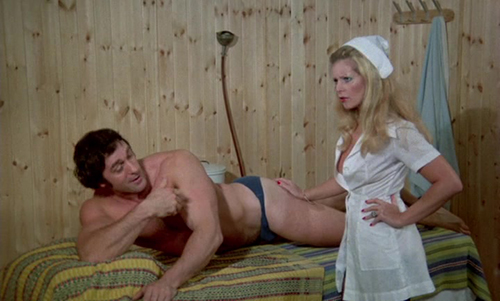
None of that really matters, because when a rock ’n’ roll band stops at a local hotel, the horny women turn the place into a health club that seems to run, primarily, on juice and nudity; honestly, though, it’s a business I can get behind — and in front of — and would like a pamphlet, and not just for the fact Millington gives a horny gentleman a wholly painful yet fully erotic colonic.

Double-breasted with cameos from performers from the best British sex comedies of the era — movies and television shows, mind you — Come Play With Me is, honestly, mostly dumb, but filled with so many titillating moments of Her Majesty’s softcore sexuality that it’s easy to see why it played in London theaters to forlorn perverts for four royally arousing years. —Louis Fowler


Get it at Amazon.

Russian Raid (2020)

Among the events crammed into the needlessly distended Guy Ritchie’s The Gentlemen is a fun moment in which Charlie Hunnam’s drug-trade enforcer runs afoul of — and trades blows with — a group of street thugs. Russian Raid feels like an extension of that scene into nearly two hours of its own, turning a standout bit into mere status quo. Do you want to settle for that? Nyet.

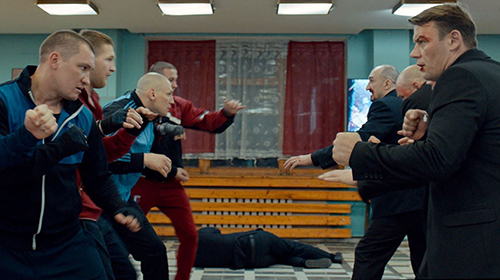
This Russian actioner’s story is somewhat less thin than its setting’s doors, which look to be made of packing material: Former military sniper Nikita (Ivan Kotik, Chinese Zodiac) takes a freelancing assignment to rob a missile factory of its riches. Reluctantly assisting him on this nighttime heist is a rowdy, ragtag pack of tracksuited hooligans with authority issues. While they target a massive safe — and even attempt its penetration via medieval battle ax — Nikita has personal reasons for retribution as well.

Justifying the assumed titular nod to Gareth Evans’ The Raid, but hardly as vertical, reaching the well-fortified bounty requires moving from room to room and level to level through the factory. Wearing a blue-striped tank top that registers as ridiculous to this side of the world, Nikita and his hired charges go to hand-to-hand combat in one skirmish after another.

While I have no doubt of the guys’ real-life fighting abilities, the choreography isn’t as supportive; in fact, it’s pretty clunky. In his first feature, writer/director/producer Denis Kryuchkov not only errs by hitting “play” on a distractingly obnoxious soundtrack when shit hits the fan, but speeds up the footage to a telling degree. Worse, he gives the camera a slight bump to punctuate the points he wants viewers to react to with a sympathetic “Oof!”

It’s so obvious, it’s Pavlovian. The overall effect is punishing, as the sequences near-instantly wear out their welcome, with a respite of flat humor or preening villainy before returning to more of the same song, different room. In a fight film, the fights are everything. And sometimes, as in Russian Raid, nothing. —Rod Lott

Get it at Amazon.

Shogun’s Joy of Torture (1968)

I’ve never been a shogun and, sadly, probably never will. Mostly because while I may enjoy tacos and dogs and movies, if this flick truly leads me to believe one thing, it’s that shoguns only really enjoy the cruelest of tortures, primarily through inflicting it on other people’s bare bodies. There goes another dream!

One of director Teruo Ishii’s infamous flicks of sex, violence and torture, often at the same time, this Toei production is a supposed anthology of the heinous practices documented on scrolls during the height of Tokugawa shogun. It features a catalog of barbarism that deftly mixes penile titillation with painful humiliation, seemingly a specialty of Ishii.

Focusing on three stories, Shogun’s Joy of Torture begins with a young woman and an illicit romance with her recently hurt brother and the scummy lawmen who jealously take their sexual issues out on her, with, of course, violent retribution.

The same goes for the second story, featuring the unbridled passions and unheralded smacks at a Buddhist nunnery. And the final story, which honestly wouldn’t seem out of place in an otherworldly Amicus production, depicts a tattoo artist who wants to get as close to death as utterly possible and achieves it with the help of a sadistic shogun.

Each tale is, as you’d probably imagine, beautifully — but brutally! — told, with excesses of ropes, whips, chains and other instruments of haughty pain throughout, used primarily on women hanging from the ceiling. While I’m sure a trigger warning is necessary for most viewers — I know I could’ve used two or three — this depiction of sex and sadism is a well-made movie that, I’m sure, will make someone’s penis suitably hard. —Louis Fowler

Get it at Amazon.

One Way Passage (1932)

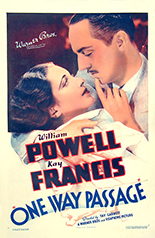
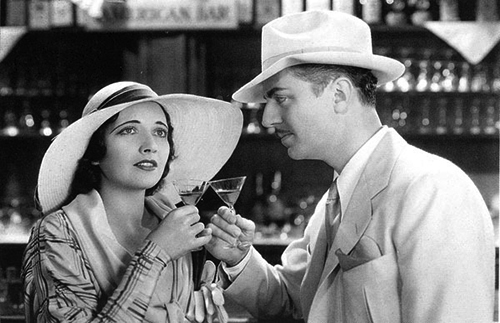
One Way Passage’s Dan Hardesty and Joan Ames take the concept of star-crossed lovers up a few notches. These moribund lovebirds could have met on a dating site run by the Grim Reaper. But being that this gem is from Warner Bros. in 1932, there is no dating site, but rather a Singapore bar for the couple’s meet-cute.

Played by William Powell and Kay Francis (their fifth on-screen pairing), Dan and Joan fall for one another almost instantly. As fate would have it, they soon find themselves aboard the same ocean liner steaming from Hong Kong to San Francisco. The operative word here is “fate.” Dan is in the custody of a tenacious but dimwitted cop (Warren Hymer) and on his way to the San Quentin penitentiary to be hanged for murder – a perfectly justifiable homicide, mind you, but the law is the law, even in pre-Code Hollywood.

Joan is facing her own mortality issues. She suffers from one of those nebulous movie maladies where, as her doctor helpfully explains, just a shock to the system could kill the poor girl. On the high seas, however, Dan and Joan are determined to hide the tragic truth from one another, choosing instead to dance, drink cocktails and pitch woo.

Can love forestall fate? The inordinately dapper prisoner-to-be (it’s William Powell, after all) manages to elude his escort with the help of two longtime pals who are also making the trans-Pacific trip. That pair prove to be the comic ace up the movie’s proverbial sleeve. Alice MacMahan shines as a streetwise con woman masquerading as a countess, while Frank McHugh crushes his every scene as a drunken pickpocket.

To borrow a colloquialism from its era, One Way Passage is a honey of a picture. Director Tay Garnett would go on to have a more auspicious career shooting for TV in the 1950s, but his work here is altogether respectable. The camerawork is surprisingly fluid for its time, with nifty tracking and dolly shots. The pace is brisk, the laughs are genuine, and the script, by Wilson Mizner and Joseph Jackson, even serves up an emotionally resonant ending, all within a 67-minute running time. That’s always a trip worth taking. —Phil Bacharach

Get it at Amazon.

Running Time (1997)

I remember reading a story about Running Time in the pages of Film Threat sometime in the late 1990s and was pretty pumped to see it, especially with Bruce Campbell in the lead role. But, like many things written about in the long-gone and lamented magazine, it never came out. Sadly, I then completely forgot about it, as one is wont to do.

I was surprised to recently receive it and even more floored to finally watch the one-shot heist film. While it understandably never received a wide theatrical release, it does kind of irk me I never saw it at least once on video back then, considering all the video stores where I worked.

Campbell is Carl, a smart aleck fresh out of prison and ready to rob its scheming laundry take. Teaming up with a trio of typical cinematic losers, everything goes wrong as you might expect, from the smack-addicted getaway driver not showing up to the scummy partner’s quick-trigger finger blowing away a security guard. But it’s the shock ending after the heist from hell that truly surprised me.

At the time it was (barely) released, I admit, I was caught up in the wave of Pulp Fiction and its assorted criminal rip-offs, so I probably wouldn’t have liked Running Time all that much, save for Campbell, of course. But looking at the film now some 20-plus years later, I feel genuine appreciation for what director Josh Becker set out to accomplish, at times even being a bit amazed by it.

Inspired by Alfred Hitchcock’s Rope, Becker creates a flowing single-take film that manages to subvert just about every heist stockpile out there. I’m surprised this structure has barely been attempted since. Of course, I say that and think about another Becker flick, Thou Shalt Not Kill … Except, and realized that’s been largely forgotten about as well.

They never steal from the good ones, do they? —Louis Fowler

Get it at Amazon.

Random Genre & Cult Movie Reviews