
Die My Love (2025)

Within minutes of Die My Love, Jennifer Lawrence is clutching a butcher knife as she crawls through the grass, stopping only to give in to an urge to masturbate under the golden sun. So if you didn’t believe it before, let’s make it really, really official: Those Hunger Games have ended for good.

Strike that — they’ve ended for the great, because this film is a vehicle for Lawrence’s finest performance to date, besting even her Winter’s Bone breakthrough. She’s fantastic. Her role as Grace, a young mother in the throes of postpartum depression, frees her as an actress; she isn’t afraid to be unlikable, to shed her inhibitions, to cry without knowing why, to take extremely dangerous actions, and more.

As the mother (Sissy Spacek, 1976’s Carrie) of her baby daddy (Robert Pattinson, The Batman) tells her, “Everybody goes a little loopy the first year.” But in the hands of director and co-writer Lynne Ramsay (We Need to Talk About Kevin), Grace’s loopiness is anything but small, much less something carrying a 12-month expiration date.

Just as Ramsay crafted You Were Never Really Here into an ice-cold revenger beyond what one would expect from Joaquin Phoenix hammering bad people, she’s stripped this follow-up project of any disease-of-the-week trappings any surface-level synopsis might imply. (FWIW, she’s also gutted the source novel’s comma from the title.)

Die My Love is an outlandish, unconventional psycho thriller that doesn’t just flirt with horror, but fucks it. Quite apropos for the exceedingly horny nature of its main characters, colors cast in otherworldly shades, comedy darker than the most bitter chocolate, a timeline twisted into knots, and visions of the abstract that would do David Lynch proud, perhaps most notably a drop of breast milk dissolving into the night sky. —Rod Lott

Get it at Amazon.

Under the Cherry Moon (1986)

WTF

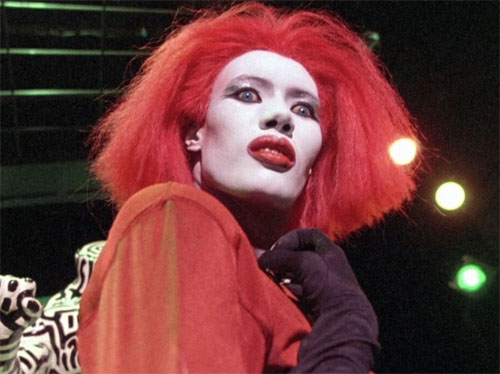
In between 1984’s utterly transcendent Purple Rain and 1990’s much-maligned Graffiti Bridge, Under the Cherry Moon is the 1986 outlier that Prince fans forgot. That being said, I’ve always thought it’s the better Prince movie. Its soundtrack is a brilliant companion piece I often play as well. Does anyone agree with me? Anyone?

In the glam retaliation of the French Riviera at an unspecified time, Christopher Tracy (Prince) is a stylish piano player at a swanky nightclub. He and his ambiguous partner/roommate, Tricky (mirror master Jerome Benton), are high-priced gigolos, methodically preying on the wealthy women of the lavish coast while homoerotically playing in their shared bathtub.

Either way, while crashing a party, they meet spoiled socialite and spicy ingenue Mary (Kristin Scott Thomas) in her birthday suit. Spasmodically, they play the drums at her coming-out party. True to form, Christopher gives her the searing eye while she does the cha-cha and kicks him out of the party but

As their relationship forms, it becomes a constant battle of wills and wiles, barbs and beauty, will they or why they shouldn’t, with him calling her a “cabbage head” in a paralyzing sneak attack of words.

They fall in tragic love that’s more chaste than expected, filled with more dirty talk than actual realized sex, giving more pomp (pump?) than penetrative circumstance. In a weird way, Cherry Moon is a truly romantic film that only become more endearing with its taut strangeness.

The soundtrack is one of my favorite albums, one where the grooves are about to be blown out from constant play. The same thing can be said for the actual movie, where Prince’s style and grace are fully encapsulated in a funky 100 minutes.

After the movie bombed, Prince made one more film (the aforementioned Graffiti Bridge), but it was too late; he was culturally dead until he was actually dead. But, in my opinion, Under the Cherry Moon is his pinnacle in a career of high points, dramatic and otherwise, and should be re-evaluated.  —Louis Fowler

Get it at Amazon.

Frankenstein (2025)

Between 2024’s Lisa Frankenstein and Maggie Gyllenhaal’s upcoming The Bride!, new iterations of the stitched-together and woefully misunderstood monster drop on a damn-near annual cycle. Lately, these takes have been far-removed from Mary Shelley’s classic novel. So much so, Guillermo del Toro’s Frankenstein — while still highly anticipated by the filmmaker’s faithful — almost seems passé and uninspired on its surface. At the same time, the director’s work is rarely skin-deep. And similar to his last adaptation, 2022’s Pinocchio (the good one, without Tom Hanks), del Toro wraps his iconic aesthetic around an emotional and accessible narrative heart.

After Capt. Anderson (Lars Mikkelsen, Netflix’s House of Cards), his crew and his ship get stuck in the North Pole, they rescue a dying Victor Frankenstein (Oscar Isaac, Ex Machina). Unfortunately, saving Victor incurs the wrath of his creature (Jacob Elordi, Saltburn), who quickly turns a third of the crew into ragdolls and human accordions. After temporarily subduing his monster, Victor recounts his history, including his tumultuous relationship with his brother’s fiancée, Elizabeth (Mia Goth, MaXXXine). Before he can wrap up his memoir, however, the creature returns with a forceful request: to tell his own story.

Frankenstein is a straighter adaptation than Pinocchio, though both necromancy-laden films feel tonally and thematically inseparable. The former notably lands on a less bleak note than its source material without significantly changing Shelley’s plot. Still, it takes some liberties to modernize with mixed results. On the plus side, Elizabeth has exponentially more agency and purpose, who’s made even more vibrant by Goth’s performance.

And despite its two-and-a-half-hour runtime, the film’s pacing is far brisker than a mostly faithful Frankenstein adaptation has any right to be. That said, the film omits a particularly famous act that — while it ultimately makes sense — is nonetheless missed given everything else del Toro includes. Finally, the forced creature fight scenes feel at odds with the film’s celebration of life, almost like they were jammed in because someone felt the film was too boring without some Marvel-esque violence.

Overtly, this may be the most del Toro of the director’s filmography. It’s not for everyone, but for those who vibe with his craft, Frankenstein feels like the film he was born to make. It has some superficial flourishes, like the flaming angel of death that sort of looks like an unused asset from a Hellboy flick, but most of his visual storytelling lands poetically. As far as the cinematography is concerned, it’s a little more muddled. For the most part, the ample closeups lend themselves to the film’s overall intimacy. Conversely, only a few shots of Victor’s castle and Anderson’s ship convey the sprawling epic that the film — at least at times — tries to be.

Frankenstein, like the monstrosity it revolves around, isn’t perfect. But deep down, it delivers a message that we desperate need: We try so hard to beat death, we unintentionally forget to champion life. In a time where catastrophic violence can seem imminent, living might be the greatest act of defiance. —Daniel Bokemper

Night of the Demons 3 (1997)

For Halloween-set horror films that aren’t Halloween, 1988’s Night of the Demons is a fun night’s rental that quickly earned cult-classic status. Annnnnd Night of the Demons 3 is a sequel.

En route to an All Hallows’ Eve costume party, two high school good girls (Patricia Rodriguez and Decoys’ Stephanie Bauder) encounter car trouble. They reluctantly accept a ride from a van full of their no-good classmates swapping “yo mama” jokes. The most juvenile delinquent of the bunch (Kris Holden-Reid, Habitat) demands a stop at Quicky Mart for smokes and ends up shotgunning a cop.

To hide from the police, they head to Hull House, the old, abandoned funeral parlor. It’s still haunted by the witchy woman Angela (a crazy-eyed Amelia Kinkade), who specializes in sexually charged pranks. Few, if any, of the teens will live to see daylight. Probably not the girl (Tara Slone) with her hand in a sock-puppet snake that Angela turns into a real reptile that slithers straight to the crotch. And definitely not the dweeb (Christian Tessier, Battlefield Earth) who asks Angela if she can “suck a golf ball through 10 feet of garden hose,” to which she responds by fellating his gun … then spitting the bullets into his palm.

Previous installments were directed by such VHS-era horror faves as Kevin S. Tenney (Witchboard) and Brian Trenchard-Smith (Dead-End Drive-In), whereas Night of the Demons 3 comes to us from one Jimmy Kaufman, who’s helmed a lot of Canadian television. He likely was eager to live a little, which could account for this entry containing the most leering nude-teen shots of the franchise — and I do mean leering, as if it were shot with a zoom lens across the street.

And that’s about the most effort we see put into this tired threequel. I enjoyed Vlasta Vrana (Brainscan) in a showy part as the magic-obsessed police lieutenant, but he’s the only one invested. Even Kinkade, whose kitchen pantry likely depended on this gig, seems to be running on fumes, which at least corresponds with the production value. Other than an ill-received 2009 remake, this was it for the series — about 85 minutes too late. —Rod Lott

Get it at Amazon.

The House of Witchcraft (1989)

Every so often, I experience a harrowing dream in which no matter the location, I face the same two-pronged conundrum:
1. My bladder is full.
2. There’s nowhere to pee.

In The House of Witchcraft, Luke (Andy J. Forest, Bridge to Hell) also is vexed by a recurring nightmare with larger stakes, I guess:
1. He enters a gorgeous country house on a spacious estate.
2. In its kitchen stands an old witch.
3. She’s boiling his disembodied head in a goddamn cauldron.

When Luke awakes, he’s hardly better off: His six-month marriage to queen of the harpies, Marta (Sonia Petrovna, Not for Publication), is on thin ice. Attempting to salvage their union, Marta’s rented a gorgeous country house on a spacious estate. No points for assuming the home is straight from his slumber, because of course it is.

Therefore, freaky things freak. Like, you know that scene in Alfred Hitchcock’s The Birds where Tippi Hedren is attacked in the attic? That happens here, but in a bedroom and with birds replaced by pillow feathers. In other sequences, writer/director Umberto Lenzi presents a sleepwalking Marta, a black cat with bloody paws, a maggot-ridden skeleton and — hey, did Luke just witness some old hag (Maria Cumani Quasimodo, Nosferatu in Venice) crowbar a priest on the grand lawn? I’ll never tell. But her face is terrifying.

In terms of how The House of Witchcraft stands against among the rest of Lenzi’s haunted house output, the man has fared worse (The House of Lost Souls) and more delirious (Ghosthouse). This made-for-TV chiller may not be “too damn sinister,” to borrow a phrase from the estate owner’s niece (Marina Giulia Cavalli, Alien from the Abyss), but for those seeking ’80s Italian horror with all the fixtures, it scratches the itch. And whatta view! —Rod Lott

Get it at Amazon.

Random Genre & Cult Movie Reviews