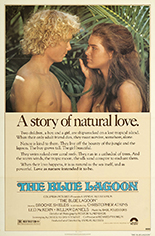
The Blue Lagoon (1980)

WTFIf you ever needed proof that watching teenagers engaging in unmarried intercourse is actually quite boring, here’s The Blue Lagoon for you and your pervert eyes.

Because I vaguely remember watching it as a small child with my parents in the early ’80s, I have occasionally flashed back to various scenes throughout my life, most notably the ingestion of deadly berries on a boat. (I don’t know why Mom and Dad were watching it so often. I hope because it was there on HBO and they were too lazy to change the channel. I hope.)

Sometime in the 1800s, on a boat bound for America, a fire breaks out. Two kids and a salty-dog seaman escape, only to land on a barren paradise filled with plenty of coconuts and bananas, with only the ominous drumming from a nearby tribe to keep them company when the old man dies of bloated drunkenness.

Thankfully, he taught the young boy — who grows up to be Christopher Atkins — how to make shelter and fish while the young girl — who grows up to be a still very young Brooke Shields — learns how to pout when things don’t go her way. Of course, as they get older, sex is discovered — taking up just as much of the film as the waterlogged swimming scenes — and a child is had, leading to most hilarious scenes of terrible parenting.

Directed by Grease’s Randal Kleiser, The Blue Lagoon was the start of what I’m terming his filmography’s “sandy vagina” trilogy, which included the worse Summer Lovers and North Shore. He eventually executive-produced the 1991 sequel, Return to the Blue Lagoon, a movie starring Milla Jovovich that I’m sure is far worse unless, of course, some zombies show up. I seriously doubt it. —Louis Fowler


Get it at Amazon.

Escape Room (2017)

Setting a horror film inside an escape-room attraction is such a good idea, multiple movies have done it, including the 2019 theatrical hit Escape Room. Generically enough, two films from 2017 are simply titled Escape Room, too.

This is one of those — the one starring former Scream king Skeet Ulrich.

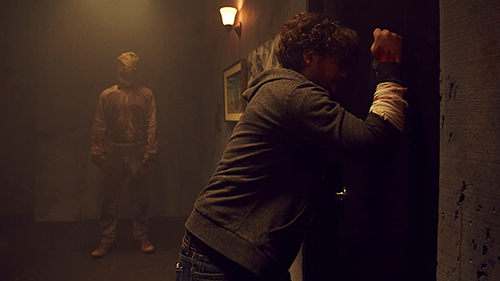
As Brice, Ulrich is the owner of the escape room Deranged, the logo of which adorns his ever-present black hoodie. With attendance having significantly cooled since the previous Halloween, Brice is desperate to get Deranged some new buzz to bring in the kids. Instead of offering free beer, booking a band, incorporating strippers or pursuing any valid idea, he goes browsing for antiques. At his first stop, he immediately gets worked up over a skull box behind the counter, but the shop owner (Sean Young, 1984’s Dune) says it’s not for sale, because it’s one of the world’s most cursed objects, what with housing a demon and all.

One stolen skull box later, Deranged welcomes new customers in Cutout Bin Brad Pitt (Randy Wayne, Hellraiser: Judgment) and Junior Varsity Danny Masterson (Matt McVay, TV’s Lovecraft Country) as a pair of total horror bros. The boys have brought their less-enthused girlfriends (Hometown Killer’s Ashley Gallegos and Animal Among Us’ Christine Donlon) who, in real life, would not only be attending Wine Wednesdays, but would be with other guys.

As they try to uncover clues to unlock the door within 60 minutes, Brice watches from the comfort of his office, pumping his fists whenever they jump in response to a chintzy scare effect, as if to say, “Crushing it, dude!” Chained to the wall of the escape room is a sack-headed employee our foursome christens with the franchise-ready name “Stitchface” (Taylor Piedmonte, Mimesis). Unbeknownst to them, Stitchface has been possessed by the demon from the skull box; this only becomes apparent when he starts stabbing them to death while they attempt to solve puzzles. As Billy Joel put it, one-two-three-four-PRESH-SHURE!

How’s that for a premise? If you answered “about two levels beyond what I’m willing to believe,” you clearly stole my notes. For his first feature, writer/director Peter Dukes demonstrates skill in keeping the disposable cast’s hourlong challenge to more or less just that. Dukes’ decision may be strategic to stretch the running time, as the ridiculously needless Middle East prologue certainly suggests. Either way, that doesn’t make the movie interesting; watching the customers think aloud in real time about shapes and colors amounts to a taxing sit. The effect is like watching someone play a video game, in that at least someone appears to be having fun — it just isn’t you. —Rod Lott

Get it at Amazon.

Lapsis (2020)

Like many indie science-fiction flicks, Lapsis has a fantastical premise, but takes a lackadaisical way to get to the rushed ending. I’m sure you know what I’m talking about and have been there before.

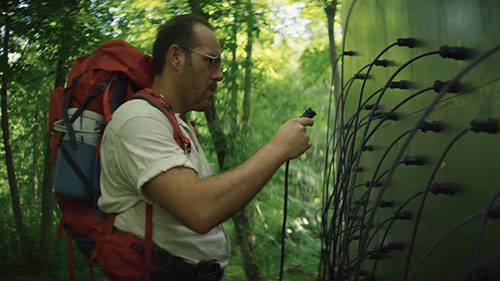
Quantum computing, I guess, is the best thing going in this alternate present, with scads of people signing up to run cable through state parks. This seems like an easy enough way for Ray (Dean Imperial) to earn a couple of bucks for his brother who has some sort of made-up fatigue syndrome; after obtaining shady papers, Ray’s in the forest, running wire and dealing with the passive-aggressive jerks he encounters.

There are also robots that look like the mechanical spiders from Runaway — I was almost hoping for Gene Simmons to show up, but that’s how I feel about most movies — that compete with the humans as they lay cable as well, with an underground group of cablers trapping and destroying the robots. I didn’t fully understand the ending, as it just kind of showed up.

With Lapsis in a broken-down sheen that many indie flicks have had for about 20 years, its idea of cabling for a new internet source is honestly remarkable, and Ray’s meeting of the many skewed characters, interesting enough. I don’t know why the spiders were introduced and, by the final third, you give up caring.

I guess what I’m trying to say is this movie really needed Gene Simmons. —Louis Fowler

Get it at Amazon.

Sharks’ Treasure (1975)

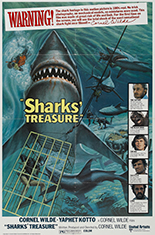
More than one shark flick swam into theaters in 1975. Released a few months later than that other one was Sharks’ Treasure, the final film of the do-it-all director Cornel Wilde (The Naked Prey). Far from delivering an iron-hot cash-in, the aging auteur approached the oceanic adventure the only way he knew how: utter earnestness. So earnest is the film, Oscar Wilde — no relation — would look at it, nod his head and say, “Important.”

William Grefé’s Mako: The Jaws of Death, this is not.

Crusty skipper Jim Carnahan (Wilde) is approached by a young man (John Neilson, Terror at Red Wolf Inn) about chartering his boat to a spot where a Spanish galleon’s gold is rumored to be sunk in the sands of the Caribbean floor. After an initial and impulsive turndown, Carnahan agrees and takes out a dangerously large loan to fund the mission. Among the hired crew is a Black Irish diver (Yaphet Kotto, Across 110th Street).

As the title has it, the waters between the boat and the loot are shark-infested. And as the title doesn’t have it, sharks aren’t the dominant threat. That honor belongs to a dinghy full of escaped convicts who, led by the appropriately named Lobo (Cliff Osmond, Sweet Sugar), hop aboard to hold our heroes hostage. Still, if you don’t think the threats won’t overlap, you’re chum.

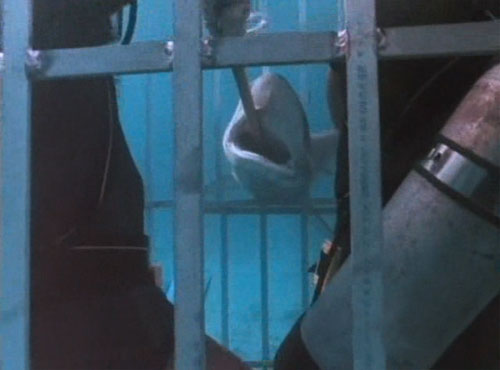
Featuring sharks and otherwise, the underwater footage is real and it’s spectacular — not a surprise when you consider the man-vs.-nature themes of Wilde’s No Blade of Grass and the aforementioned Naked Prey. While the fearsome finned fish clearly were the front-and-center selling point of Sharks’ Treasure, the movie would be compelling enough without it. With a character like Wilde on hand to scowl, bark and show off his sexagenarian physique — including a pre-Palance demo of one-handed push-ups, it would be hard not to. —Rod Lott

Get it at Amazon.

Nosferatu in Venice (1988)

I’m very much a lover of Werner Herzog’s works, having seen most of his collaborations with Klaus Kinski except, oddly enough, Nosferatu the Vampyre. Though it’s highly acclaimed and critically loved the world over, I instead watched the lackluster sexual improprieties of the pseudo-sequel, Nosferatu in Venice, where the famed monster (still played by Kinski) goes on an Italian adventure! Pass the marinara, paisans!

Or not. Employing five different directors — including Starcrash’s Luigi Cozzi and Kinski himself — instead we’re left with a mostly drab and melancholy journey through the stench-filled canals of Venice, with grandstanding actors like Christopher Plummer and Donald Pleasence taking on questionable roles in their battle to not only take on evil at its root, but apparently stave off real-life hunger in the lean ’80s.

As an obvious Van Helsing knock-off, Plummer comes to a Venetian house filled with statuesque young women, square-jawed young men, wholly off-putting crones and, of course, Pleasence as a hungry priest who seems to have been paid in craft services. Somehow, they resurrect Nosferatu (Kinski), now with a bitchin’ haircut the ladies seem to lust after.

Apparently, the only way to destroy the suave creature is for him to fall in love with a virgin, which, if I might be blunt, is pretty stupid. Still, with large holes blasted in his chest by the cowardly lot of supposed heroes as they run, the film comes to an ending I’m sure is supposed to be meaningful, but honestly seems more like a quick shot of Kinski on the way to his plane as villagers go pheasant hunting.

Final writing and directing credit was dropped in the lap of Augusto Caminito, who I guess did the best job he could with the big ball of film stock he was handed. Still, the ultimate shocker of this horror flick is the music by Vangelis that, while it don’t class up the movie, at least attempts a sheen of sorts almost comparable to Chariots of Fire. Almost. —Louis Fowler

Get it at Amazon.

Random Genre & Cult Movie Reviews