Grave Intentions (2021)

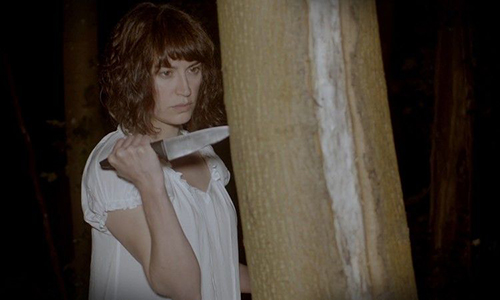
Courtesy of Death Cat Entertainment, the horror anthology Grave Intentions presents a quintet of tales hosted by voodoo retailer Magical Madam Josephine (Joy Vandervort-Cobb). Before each, she spotlights a relevant product in her shop, including charm pouches, voodoo dolls, crystals, talismans and even a candelabra prestuck with a Rainbow Coalition of candles. Josephine addresses the viewer with lines like, “Most believe bravery is a good t’ing,” “Oh, I pray this customer uses puppet magic wisely” and “Are you the hero … or the villain?”

While Jocelyn and Brian Rish’s wraparound is new, the stories Josephine introduces are not, being unrelated independent short films as old as 2014. Moreover, coming from half a world away is Matthew Richards’ The Disappearance of Willie Bingham. Easily Grave Intentions’ highlight, the Australian short is a blackly comic look at a child killer (Kevin Dee) used by the judicial system as an experiment for scared-straight schoolchildren and other would-be offenders; rather than put Willie to death for his crimes, he is gradually relieved of appendages, limbs, organs and then …

Running a not-so-close second in quality is James Snyder’s Violent Florence, whose title character (Charly Thorn, 2020’s Relic) demonstrates why it’s not wise to mess with a stray black cat. Meme immortality awaits.

I wish the rest of Grave Intentions were as appealing as this pair. Lukas Hassel’s The Son, The Father … gets close, but its tit-for-tat scenario of a boy (Lucas Oktay) whose alcoholic mom (Colleen Carey) to die on his 11th birthday is more depressing than entertaining, despite good performances.

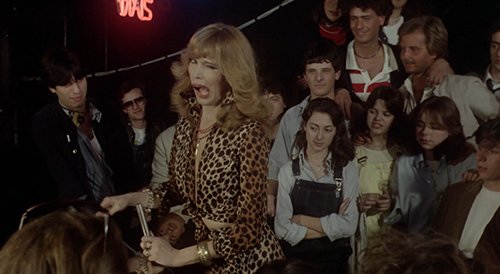
Another abused child is at the center of the final segment, Brian Patrick Lim’s Marian, which stands alongside the first, Gabriel Olson’s The Bridge Partner, as the portmanteau’s weakest links. Ironically, Olson’s film is the only one with star power, as sultry newcomer Olivia (NYPD Blue’s Sharon Lawrence, vamping up a European accent) vows murder to the Moss Harbor Bridge Group’s mousiest member, Mattie (Beth Grant, Southland Tales), unprovoked. I really expected to click with this, especially with the late, great Robert Forster (Jackie Brown) aboard as Mattie’s husband — but its ending is as flat as day-old Tab, and Forster appears only in one short scene. That minor and painless disappointment aligns with Grave Intentions being an overall mixed bag — neither hero nor villain. —Rod Lott

Get it at Amazon.

I Am Toxic (2018)

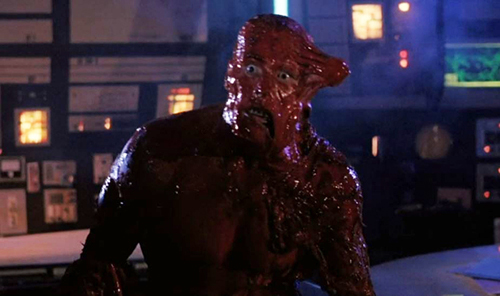
With its Americanized name change, I’ll admit I was more than ready to pass up I Am Toxic. But, still, the idea of Mad Max meeting The Walking Dead, per Hollywood News’ cover blurb, piqued my interest enough to give it, at the very least, a 10-minute viewing just to test the diseased waters.

Seconds after popping it in, however, it became evident the film’s original title was Soy Tóxico and, even better, it was from Argentina. Realizing this wasn’t the same straight-to-video dreck I’m used to, I stuck around a bit longer. And the longer I stuck in, the more I got sucked into this brutal world of disease and death, not in that order.

It’s way in the future and the southern hemisphere has become one large garbage dump. A haggard man wakes up in the middle of a pile of corpses, unable to remember who he is or what he’s doing there. As he’s attacked by sun-beaten corpses, he’s momentarily rescued by an old scavenger in a tricked-out apocalypse-mobile.

The old scavenger takes him to his walled-in dump of a living situation with his two sons and, supposedly, a daughter. Of course, the nameless man is immediately taken prisoner and always on the verge of death; with a tattoo on his wrist providing the only key to his future, he starts to remember things as he goes through changes, mostly in his face.

With a final act that ties it all together ’til it bleeds, I Am Toxic is directed by Pablo Parés. With a seemingly shoestring budget, he’s able to turn what could have been a nonsensical mess into a rather pulse-pounding zombie (if they even are zombies) flick with only a handful of characters and even fewer locations. —Louis Fowler

Get it at Amazon.

No Time to Die (2021)

In the opening moments of No Time to Die, Daniel Craig’s fifth and final time as James Bond, the iconic spy visits the grave of Vesper Lynd, the woman who died for his love. Because Eva Green’s Vesper had a hand in 2006’s Casino Royale, Craig’s 007 debut, the gesture feels like the finishing stroke of a full circle representing his 15-year run. That feeling only deepens when he faces the rock slab — and, by camera placement, the audience — and says in an earnest near-whisper, “I miss you.”

Then, just as Bond spots a business card emblazoned with the SPECTRE organization’s ominous octopus logo, Vesper’s resting place explodes into rubble. It’s the filmmakers’ way of saying, “Time to upend your expectations.” All things considered, they mostly make good on that unspoken mission statement. (On the negative side of that, Billie Eilish’s theme song is a tepid bore.)

Now retired and committed to Madeleine Swann (Léa Seydoux, returning from 2015’s Spectre), Bond is coaxed back into the field when an MI6-manufactured virus is stolen from the agency’s off-the-books lab. Dubbed “the Heracles Project,” the bioweapon is genetically engineered to impact only the DNA of its possessor’s choosing — peculiar functionality that means everything to its warped thief, Safin (Rami Malek, The Little Things), a terrorist with a taste for revenge and a burnt face. Safin initially hides behind a Japanese Noh mask — a chilling image and one of the movie’s most indelible. With stakes standing at an all-time high, 007 resorts to consulting ol’ archenemy Blofeld (Christoph Waltz, reprising his Spectre role in a Hannibal Lecter-style cameo).

While much hype surrounds No Time to Die being not only Craig’s last time in the tux, but the 25th official film in the series, I’ve seen no writing on the wall regarding its stature as the franchise’s longest entry, at an eon of 163 minutes. Truth be told, its machinations run a level or two too complex than necessary.

That said, what would I cut? Certainly not a second from the action set pièce de résistance: a chase through the cobblestone streets — and up the stairs — of Matera, Italy. Definitely not Bond’s firepower-packed pas de deux in a Cuban nightclub with cleavage-bearing CIA contact Paloma (Knives Out’s Ana de Armas, bringing a wonderfully disarming comedic presence). In both sequences (and more), director Cary Joji Fukunaga exhibits a control as comfortable as the series’ best, even if none quite approximates the blood-pumping tension of his CV’s highlight thus far: that six-minute tracking shot from True Detective season one, episode four.

I might be persuaded to cast my vote against a rather overstuffed ending that sucks all the fun out of the room … but not when we have Malek treating Safin like Shakespeare once No Time to Die says “yes” to cribbing from Dr. No by jetting to its villain’s island lair.

But I come to praise 007, not to bury him. Through more highs (Skyfall) than lows (Quantum of Solace), one thing remained consistent: Craig, cucumber-cool and captivating. Sean Connery aside, nobody did Bond better.

Already, I miss you. —Rod Lott

Bluebeard (1972)

Given how many times Richard Burton eventually married before his death (five!), more than a little irony exists in viewing Bluebeard today. From Superman producer Alexander Salkind and The Caine Mutiny director Edward Dmytryk, the film version of France’s felonious folktale casts Burton as cerulean chin-bristled World War I hero Baron Kurt Von Sepper, returning from aerial battle to only wage the war of the sexes on the ground by marrying — and killing — one beautiful woman after the other.

Bluebeard the movie’s first victim is Bluebeard the character’s sixth wife (Karin Schubert, The Panther Squad), felled by a bullet in an hunting “accident.” Before long, Bluebeard finds himself entranced by flapper girl Anne (future Happy Hooker Joey Heatherton). Despite all the red flags surrounding the guy — a one-eyed cat, a cobweb-strewn castle, a crazy old woman combing the hair of his mother’s corpse — Anne happily becomes Wife No. 7, the Jell-O to his jam.

When she finds his … let’s just call it a “scrapbook” of past wives, he confesses everything to her chronologically, doomed spouse by doomed spouse. Buckle in, viewers, because the result is an all-star panoply of acts of uxoricide, with Burton’s master of misogyny wearing more shades of purple than the Joker and Prince would find tasteful. Virna Lisi (The Statue) is seduced into a guillotine; Marilù Tolo (My Dear Killer) is drowned; and Agostina Belli (The Night of the Devils) takes a falcon to the face.

Most amusingly, Raquel Welch (The Last of Sheila) plays against type as a nun whose inventory of global dalliances angers Bluebeard into such a rage, he locks her in a coffin. Genuinely funny is how increasingly annoying he finds the gorgeous Nathalie Delon (Le Samouraï) for her endless baby talk and for naming her breasts “Jasmine” and “Sicumin.” When she hires a prostitute (Sybil Danning, Chained Heat) over to give her husband-satisfying whore lessons, Bluebeard catches them au naturel and penetrates them both … with a pointy-tusk chandelier, so get your mind outta the gutter.

If “prestige Eurosleaze” exists, Dmytryk’s Bluebeard is the default example, with Burton at his most bombastic. The Gothic gaslighter pops with color and delights with a campy tone, trashy sequences and an Ennio Morricone score that positively fucks. Bluebeard will tickle you pink, if you let it. —Rod Lott

Get it at Amazon.

Ouija Japan (2021)

Having lived in Japan only six months, the English-speaking Karen (Ariel Sekiye) is having a rough go fitting in with fellow housewives in her community volunteer work — so much so, the gaijin resists attending the group’s two-day camping retreat. (True, it doesn’t help the trip is to a village protected by a fox spirit who “will punch you and drag you to hell.”)

The night of arrival, boss Akiyo Yoshihara (Eigi Kodaka, Headcrusher) and her fellow mean girls play kokkuri-san, the Asian country’s coin-on-paper version of Hasbro’s Ouija board — hence this film’s title, Ouija Japan. Folklore has it that breaking the rules brings consequences; sure as Shinola, the ladies awake to find their group thinned by one. Karen’s idea of calling for help is to run outside half-yelling, “Somebody! Somebody!”

How could this trip get any worse? For starters, that fox deity could self-install an app on everyone’s phone: a game that pits every girl for herself in a fight to the death.

That happens. And — just like Candy Crush, I assume — the more they kill, the more features they unlock. By sword, rifle, pipe and electric-powered gadget dropped in a full bathtub, Karen and the others battle it out until 15 lives are claimed. The upper-left corner of the screen — yours, not the app’s — keeps a body count so viewers don’t have to put forth that effort.

In Ouija Japan, first-time director/writer Masaya Kato (not the actor) has a premise that, while not exactly original, is plenty perfect for this genre — or for a mix of the horror and action genres, as we have here. However, it’s not well thought-out, with early scenes merely repeating information from the previous; by design, scuffle after scuffle make up the latter half, yet each feels so endless, it’s exhausting. Perhaps Kato was checked out as well, because the final shot is not only a cliché, but a cliché so clichéd, it’s used as the sign-off for all five Scary Movie entries.

There is no nice way to say this: Taken individually or collectively, the acting is awful. Kodaka overplays the villain role to twirling a nonexistent mustache; after vowing to have the metaphorical last laugh, she physically utters one. Worse, in her first credit, Sekiye has a sleepy and lifeless presence; if she had a line that didn’t begin with some unnatural variation of “Oh, um, uh,” I missed it. —Rod Lott

Get it at Amazon.

Random Genre & Cult Movie Reviews