
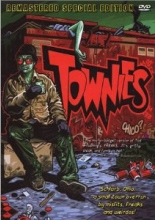
 Townies is a sleazy flick about a group of strange characters in a town called Schlarb, Ohio. (Imagine a black-and-white Hal Hartley film cast with recently discharged mental patients.) Scharb is a nice enough little town, but is suddenly being overrun by weirdos, freaks and goons. In true B-movie tradition, it is these freaks and goons that are the heroes of the piece. It’s the “normals” that you have to watch out for.
Director Wayne Alan Harold (Killer Nerd) introduces his ensemble, then moves briskly into the story, which includes necrophilia, martial arts, kidnapping and squirrel-eating. Townies definitely evokes early, rough-around-the-edges John Waters works, but retains its own sensibility.
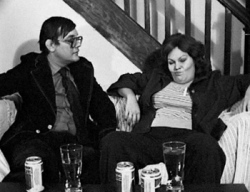 While the movie is filled with bizarre characters and disgusting situations, Harold somehow manages to inject quite a bit of actual drama and emotion into the film. Clocking in at a mere 71 minutes, it moves at a brisk pace and never has a chance to get boring.
Townies was shot on a budget of $300, and serves as a great example of overcoming all kinds of limitations, especially budgetary. It has a completely stripped-down, grainy look. But the characters are interesting, the locations look like they’ve been carefully chosen, the movie is very well directed and it’s actually funny! Most of the time, I can’t even watch low-budget DV movies. I’m never “caught up” in them, like a viewer should be. I didn’t have that problem with Townies at all. It’s gross, humorous and even a little touching at times. —Ed Donovan


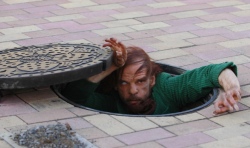 Why is it that most triptych flicks seem to place the weakest segment in the middle? Such is the case with “Merde.” From Leos Carax (
 Unable to kill herself, she is saved from imprisonment by the titular event, only to face the near-impossible choice of loving the deity who caused her so much pain or spending the rest of eternity in desolate isolation.