
Category Archives: Sci-Fi & Fantasy

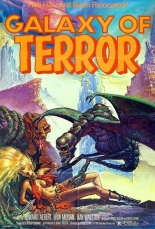
Galaxy of Terror (1981)

Look, there is no way in the universe that a movie starring Edward “Stare as Blank as Empty Space” Albert and Joanie Cunningham (er, Erin Moran) is going to be quote-unquote good. So know that going in, lower the bar on your entertainment value, and you might find the B-movie schlockfest Galaxy of Terror to be a guilty pleasure of modest proportions.

Marketed as an Alien rip-off, but thematically closer to Forbidden Planet, Galaxy is your typical Roger Corman cheapo that drops a gaggle of mismatched space personnel onto a planet where every fear is made real. If it is at all prescient, peoples of the future will be solely afraid of goopy rape-worms and giant leeches, with a modicum of psychological self-doubt thrown in. But only a modicum, as no audience pays to watch Robert Englund (Freddy Krueger of the Nightmare on Elm Street series) do battle with himself. Bring on the rape-worm!

The real pleasures here are half-inadvertent and half-inspired. Future soft-porn dynamo Zalman King (Wild Orchid) apparently understood “acting” to be “yelling.” The sexual dynamics between Albert and Mr. C’s daughter have a creepy brother/sister vibe. The rape-worm scene is disturbing for all the wrong reasons, obviously thrown in to give some unwarranted nudity to undiscerning pervs who don’t mind that the object of their fetishization is GETTING RAPED BY A GIANT WORM! As much as I’ve tried, I actually cannot make the whole of the plot make any sort of narrative sense. I’ve probably given it more thought than the screenwriter.

True pleasure comes from veteran Ray Walston (TV’s My Favorite Martian), bringing his usual twinkling charm to his scenes and providing the only watchable performance. And substantial kudos go to future powerhouse James Cameron for bringing an unexpected sense of style in his work as production designer. The landscapes are suitably dark and brooding (echoing his work just five years later in Aliens); the sets are fairly intriguing; and on the whole, the movie looks a hell of a lot better than it really deserves.

And you have to love Twin Peaks‘ Grace Zabriskie as a maverick, disaster-haunted space pilot who has my vote as the worst pilot of all time. Her ship loses power mid-flight; she hits some switches for two seconds; then slouches forlornly as she says, “Well, I’ve done all I can do.” I haven’t laughed that hard in years. It’s all in the delivery. —Corey Redekop

Buy it at Amazon.

The Invisible Boy (1957)

The Invisible Boy refers to Timmie (Richard Eyer, The 7th Voyage of Sinbad), the 10-year-old son of a cold, emotionless workaholic. (But really, aren’t we all?) The kid hangs out at his dad’s top-secret intelligence office, which houses a talking supercomputer containing the sum of all human knowledge.

Left to his own devices while his father works, the kid reassembles Robby the Robot (from Forbidden Planet), who becomes his new friend. At first, they do things together like flying kites, but after the supercomputer downloads a big batch o’ evil into Robby’s electrobosom, the robot is getting the kid to drink a potion that turns him invisible.

It’s every kid’s dream to have a robot and be undetectable to the human eye (or maybe just to have a robot; the invisibility part is ideal for teenage boys who wake up with sticky sheets), which is what makes The Invisible Boy an enjoyable, old-school science-fantasy film, particularly when the kid starts pulling pranks on his parents.

But in the final half-hour, this squeaky-clean exercise ceases to be fun when it no longer focuses on the boy, but his dad and his co-workers. Thus, what was playful and mischievous turns into something political and menacing — in other words, just like real life. —Rod Lott

Buy it at Amazon.

The Curious Dr. Humpp (1967)

Somewhere in Argentina, a doctor — a curious doctor, if you will — is up to no good. At night, he sends out his pasty-faced, failed-conceptual-art experiments to round up various lovers in different states of doing it. From a teen couple and busty ’60s lesbians to a drunken nympho and couple at a weed orgy, these monsters are the very definition of coitus interupptus, always attacking before the sex gets hot and heavy — damn you, Dr. Humpp! (In between all this, a monster walks into a bar, orders a drink and watches a burlesque show … and no one bats an eye.)

Meanwhile, the police are baffled.

We finally meet The Curious Dr. Humpp (Aldo Barbero, The Naked Beast). While I didn’t find him so much curious as I did lecherous, it seems that the reason he sends out the monsters to collect the fornicating couples is to collect the “blood forces of sex.” Why would one need these sexy forces? Why, to keep eternally young, of course. These experiments consist of forcing couples to get it on and watch them. And watch them. And watch them. And watch them. His jealous, buxom-blonde assistant (Gloria Prat, Feast of Flesh) begs Dr. Humpp to “use my body to keep you alive.” Where can I find that kind of help?

Meanwhile, the police are baffled.

While I’m sure The Curious Dr. Humpp (aka La Venganza del Sexo) was a raincoat potboiler back in its day, the Spanish work is actually pretty tame by today’s standards. Yet it still works as a testament to outré ’60s bizarro cinema. This is the kind of movie that could have only been made back then, with half-baked sci-fi, no-baked monsters and fully baked bosoms. In other words, it has everything.

Meanwhile, the police are baffled.

One question: Is Humpp his real name? Just like if a kid’s name is Gannett McCaster, he’ll be a cop; Jet Rockway, an ace pilot: If your last name is Humpp, it’s a guaranteed life in the sex trade, science or not. What medical school did he go to? How did that graduation ceremony go? Were his parents, Mr. and Mrs. Humpp, in attendance? Were they proud? Are they proud now? What was his thesis? If only the WB could commission a pilot for Humpp: The Early Years.

Meanwhile, the police are baffled. —Louis Fowler

Buy it at Amazon.

Project X (1968)

Not to be confused with the forgettable Matthew Broderick/monkey team-up of the ’80s or the insipid teenagers’ apoca-party flick, this Project X is one of William Castle’s lesser-known pictures, likely because it’s neither gimmicky nor Rosemary’s Baby. It deserves not to be so obscure; far more eyes should feast upon this imaginative mix of The Matrix and Fantastic Voyage than just me and the Wachowski siblings (formerly known as the Wachowski brothers).

Set in 2118, the film posits the difficulty of retrieving a top-secret piece of info from the brain on a felled spy (Christopher George, Pieces) four days after he’s been frozen following a near-fatal plane crash. His last message to HQ warned that their country would be destroyed in 14 days, but failed to mention the weapon at play. To do this requires imprinting a new matrix (in other words, an entirely new identity and personality) as they probe his subconscious and pray his doesn’t notice or suffer brain damage.

They decide to make him part of a post-heist gang of bank robbers hiding out in a farmhouse in the 1960s. Their manipulation efforts include a dumb, beautiful blonde (Greta Baldwin), but the lost spy (Monte Markham, Guns of the Magnificent Seven) infiltrating the grounds isn’t part of their plan.

There’s a lot of Cold War paranoia going on here, but Castle does his best to dress it up as sci-fi entertainment, lest risk scaring audiences away. Despite a cast heavy with old fogies in jumpsuits and Brylcreem hairdos, he succeeds in crafting something resembling cutting-edge at his budgetary level. Production design is outstanding, even in its now-dated touches, and going further are the “special sequences by” producers William Hanna and Joseph Barbera — yes, the animation giants, and this has to be the funkiest, hippest work of their careers. For Castle, Project X is his meatiest in subject matter; once his Tetris opening credits stop, the Big Ideas begin. —Rod Lott

Buy it at Amazon.

Arachnoquake (2012)

As if New Orleans didn’t have enough problems already, what with the occasional hurricane, frat-boy vomit in the streets and the constant smell of hobo urine, the city has to deal with an arachnoquake — that is, an earthquake that unleashes giant spiders, doy! — in … wait for it … Arachnoquake. It’s one of those made-for-Syfy movies, but you probably knew that.

These eight-legged freaks mostly harass a tour group on a trolley driven by Bug Hall (Alfalfa of 1994’s The Little Rascals). His passengers include a grumpy old man, an airhead woman, her Not LL Cool J hubby, two smirking teens and their asthmatic mom (Tracey Gold of TV’s Growing Pains), whose job as an eighth-grade biology teacher comes in handy to provide exposition during the requisite dissection scene. Elsewhere, her husband (Edward Furlong, Terminator 2) drives a bus of high schoolers that also is menaced.

Spiders are so creepy that the concept doesn’t require a big budget to exploit audiences’ readymade fear. (Take, for instance, 1977’s Kingdom of the Spiders, the greatest depiction of the arac war yet, which sends chills up the spine.) They need only look real, if not be real; Arachnoquake‘s only could look more fake if they were cutouts on sticks. They’re completely computer-animated, with rounded edges and as white as a KKK costume. They breathe fire and dog-paddle in water. They look like cartoons.

On that note, director G.E. Furst (Lake Placid 3) colors his crap with touches befitting a ‘toon, despite Arachnoquake‘s relatively serious tone. Just one example: When one spider traverses a crosswalk, the street sign makes a cuckoo-clock sound for no good reason. It’s as senseless as Furlong’s big wisecrack after taking a baseball bat to a dead spider on the road: “Now that is how you make jambalaya! Yeaaaaahhhhh!”

Nooooo. —Rod Lott