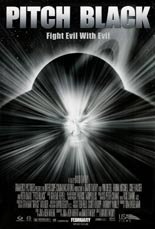
 Pitch Black’s plot can be summarized simply: After crash-landing on a seemingly deserted planet, a group of space travelers happens upon killer aliens that only come at night … and a solar eclipse is about to occur. Indeed, that happens, but once it does, nothing is built upon it.
Radha Mitchell (Silent Hill) is Capt. Carolyn Fry, who leads her shipwrecked charges against apparently insurmountable odds. One of her passengers is the bald, bass-voiced Vin Diesel (The Fast and the Furious), portraying Riddick, some sort of super-criminal with silver eyes who, as luck would have it, can only see in the dark. He’s the one mean guy who you know will find it in his heart to turn nice somewhere during Act 3, at least long enough to save some people.
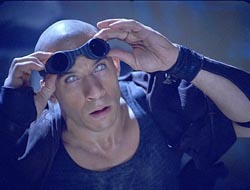 Our survivors find an abandoned ship they believe could be used to escape, if only they can transfer the power source from their now-useless one to this as-yet-unharmed one. As they’re doing so, darkness comes, and so do the aliens. As is rote with today’s technology, the aliens are total creations of CGI, so they never look real, as if you get to see them much at all. Most sightings of these creatures are limited to flying swarms of them, which makes them look like toy jacks. Standing still, they kind of resemble black woodpeckers. Either way, they’re not scary.
Although beloved by enough people to spawn sequels, Pitch Black is just plain void of suspense or imagination — a description befitting of every tired Alien retread since 1979. Directed and co-written by David Twohy (The Arrival), it aims to be arty, given its limited color palette, barren setting and clunky dialogue.
Mitchell can be commended for not patterning the vulnerable Fry after Sigourney Weaver. Diesel, however, is goofy — all attitude, zero ability. Not that he’s given much to do, other than run fast, bare his muscles and shave his head using a shiv and motor oil. Before the story even really gets rolling, Pitch Black reveals itself to be a cheap-looking (despite $23 million), hair-above-amateur production whose only thrill for this viewer arrived when it finally ended. Ditch Pitch. —Rod Lott