Watari, the Ninja Boy is based on a classic Japanese manga, which I could tell just by looking at the kid’s haircut. Played by Kaneko Yoshinobu (who was a different child ninja in the similar, superior Ninja Scope), Watari lives with his sickly grandfather, plays the flute, jumps around, swings on ropes, flies through the air, walks up trees and, in a musical number, even grows to Jolly Green Giant height to touch a rainbow of Skittles.
But mostly, with the aid of his trusty metal ax, whose blade is bigger than his head, Watari spends his days and nights warring against adult ninja and monster ninja who want to kill him. He also decapitates a black cat, but TBH, that pussy had it coming.
Watari undergoes a litany of traumas in these colorful adventures, including surviving an earthquake, sinking in quicksand, finding dead dudes floating in the river, seeing a naked lady and meeting a grown man with lots of eye shadow.
Needless to say, this is one weird kiddie matinee — one that begins with a blue-skinned ninja losing his tongue for breaking the law. It’s also confusing, what with all the Japanese names thrown around of this clan and that clan, and not knowing who belong to which. Even with the benefit of crisp English subtitles, I was all like, whaaaaaaaaa … —Rod Lott
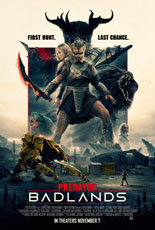
The Predator franchise has always worked for me. Sure, there are a few clunkers in there — Alien vs. Predator and Aliens vs. Predator: Requiem, I’m looking at you — but from the original Predator to the Robert Rodriguez-produced Predators to the gloriously Indigenous-heavy Prey, every film in this roster has been a true popcorn movie.
Add the latest installment, Predator: Badlands, to the ever-growing list of more-than-watchable sequels, because this film not only delves deep into the Predator mythos, but, in the end, it takes the Predator and turns him into a real stand-up guy lonesome scion of alien revenge.
No, really.
The Predators — or, as they’re called now, the Yautja — are in this clan that a little guy named Dax is about to be initiated into. Challenged by his brutish father who, sadly, decapitates his older brother for being weak — Yikes! Are you sure that wasn’t my dad? — Dax crash-lands on the alien world of Ganna, where he’s going to become a man or, you know, die trying.
On the hostile planet — apparently, it’s a real hellscape — he immediately finds vine-like strangling creatures, exploding caterpillars and large plants that shoot out poisonous spikes and immediately paralyze the body. And that’s in the first 15 minutes.
Eventually, he finds an android survivor (Elle Fanning) from a Weyland-Yutani (shades of Alien’s Xenomorphs?) scouting party. Along with a cute rolling-ball creature they call Bud, they try to find the mythical Kalisk that Dax wants to kill to impress his father.
While that’s going on, the android’s identical twin sister and a bunch of space marines find Dax’s ship. They take all the weapons and, of course, want to capture and eviscerate him. They all engage, entangle and enrage with a round of alien psychoanalysis about grief and loss, as well as old-fashioned shoulder cannons and wrist-controlled atom bombs.
With sparse alien dialogue and the mannerisms of a hardened warrior, New Zealand actor Dimitrius Schuster-Koloamatangi is more than serviceable as Dax, alternating between immature warrior to seasoned champion for whom, as the mid-credits scene teases, more adventures will come.
But if anything needs more credit, it is Dan Trachtenberg, directing his third entry in the franchise. Between Prey and the animated Predator: Killer of Killers, he is on a creative streak I am actually down with, giving Dax and all the Yautja actual characteristics that make than more than, well, Predators.
In the end, Predator: Badlands is just a wildly entertaining entry in a nine-movie series that is only picking up camouflaged steam, and I am here for it. —Louis Fowler
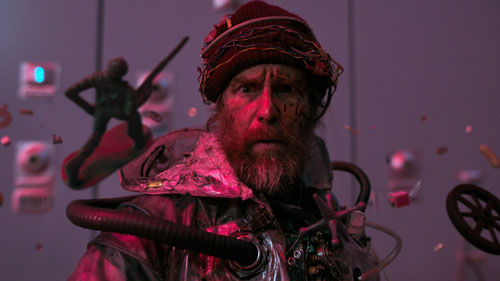
As if you weren’t already aware, our world is, in a word, fucked. Yet hope exists, albeit in the form of a scraggly, smelly and likely unhoused man (Sam Rockwell, Iron Man 2) with explosives strapped to his chest.
Barging into at an L.A. diner one night like a crazy person, he declares he’s from the future and seeking volunteers to help him destroy AI before AI destroys humanity. Seven recruits and 10 minutes later, their revolution begins — with the title singsong-shouted at viewers: Good Luck, Have Fun, Don’t Die! (For these dire times, that resonates harder than “Live, love, laugh.”)
As the man and his charges embark on their mission, director Gore Verbinski flashes back to Weapons-style chapters depicting the events the lead the most recognizable recruits to the diner. Teachers Michael Peña (Ant-Man) and Zazie Beetz (Deadpool 2) flee from students who’ve been algorithm-anesthetized into TikTok zombies. Grieving mother Juno Temple (Venom: The Last Dance) clones her son after he’s killed in a school shooting. And a depressed party rent-a-princess (the ever-winning Haley Lu Richardson, Split) is allergic to cellphones and Wi-Fi.
Like the film overall, these shorter pieces delight at first before running out of steam. This structure makes me believe Good Luck would have worked best as a true anthology, with the Rockwell-led segments doing Cryptkeeper duty as a wraparound. Throughout, but especially in the aforementioned opening scene, Rockwell leverages the fast-talking, smart-ass thing that’s served as his stock in trade for three decades and counting. His manic energy sets the pace for every arm of Verbinski’s epic sci-fi comedy, but attempting to sustain that grows exhausting, much like Y2K — the movie, not the year (although come to think of it …).
Rockwell’s warning to his army that not everyone will make it to the end could hold true for audience members not attuned to its level of quirk. The script by Matthew Robinson (Love and Monsters) is not quite pitch-black satire, but let’s call it close to sunset; among its best ideas is that cloning your kid is hella expensive unless you get “the ads version,” in which your Xeroxed offspring shills a product once a day, “but in his own voice.”
Inevitably, as the chaos continues and the effects overwhelm in what feels like Act 4 or 5, Good Luck, Have Fun, Don’t Die collapses under its own bloat. At 134 minutes, how could it not? (Since earning Disney loads and loads of Pirates booty — as in of the Caribbean — Verbinksi’s rarely met a two-hour running time he didn’t shatter, but I’ll go to my grave defending A Cure for Wellness.) There’s simply too much there here, including a CGI creature’s giant penis slinging while gushing a stream of glitter — a climactic image that reinforces the movie’s message: We’re too distracted to realize how royally we’re getting hosed. —Rod Lott
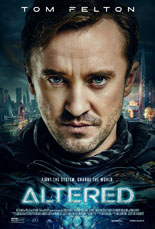
Want to see a great sci-fi movie with Tom Felton that explores themes of human evolution? That’s what Rise of the Planet of the Apesis for, because Altered sure isn’t.
In its dystopia, citizens can opt for incredible DNA enhancements from the Genesis Institute “laboratry” (as is visible in one shot), like the ability to drink through a straw that unfurls from your nostrils or to check the temp of your dinner steak via a simple gaze of your glowing peepers. These upgrades and more can be yours! Unless you’re one of the unfortunate 10% of the population immune to bio-modifications, that is; derisively dubbed “specials,” you losers are segregated from society.
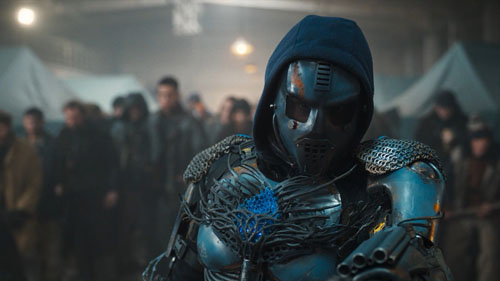
Being paraplegic, Felton’s Leon is one such special. He and his 12-year-old roomie, Chloe (Liza Bugulova, Disney’s The Last Warrior), luck upon a mechanical suit of Dr. Doomy armor that allows Leon to walk again, plus fight bad guys with kitchenware from a Pampered Chef party, and save a politically minded pop star (Aggy K. Adams, Netflix’s The Witcher) from kidnapping.
As if that weren’t enough, Chloe injects the superhero suit with essence from a smuggled flower that converts nuclear energy into pure energy so Leon also can shoot vines and, ultimately, deadly thorns. Now he’s like Spawn, if created by Guerney’s Seed & Nursery. As Leon quips in the film’s climax, “That’s flower power … that’s flower power,” in case you didn’t get it the first time, I guess.
The science-fiction genre is an ideal medium to explore hot-button issues of today under the guise of a tale of a near-future tomorrow. Yet Altered is all toothless, surface-level junk, as if adapted from a tween activist’s change.org petition. Shot in the glorious nation of Kazakhstan, it sounds dubbed in post, despite an English-speaking main cast. The visuals are so inert and uninvolving, I would not be shocked to learn they were generated with a single prompt of an AI tool.
Writer/director Timo Vuorensola would have been much better off utilizing even a smidge of the satire (however mild) from his Nazi UFO breakthrough, Iron Sky. At least then, lines like Felton’s praise to a wind-up mouse, “Good work, Mr. Stinky,” could be laughed with, rather than at. —Rod Lott
In 1987, Baltimore elected its first Black mayor — not that a resident like Conor Marsh (Albert Birney, I Saw the TV Glow) cast his vote. After all, he’s a shut-in who chooses to experience life through screens; when he’s not watching TV, he’s on his computer, earning a meager living by turning people’s photos into ASCII art. Watch, type, sleep, repeat.
One day, a floppy diskette with the game Obex arrives in the mail. The objective: Defeat a soul-eating demon named Ixaroth. The game literally changes Conor’s sad, lonely life! But by kidnapping his dog.
Conor’s mission to save his four-legged best friend takes him outside his comfort zone of dot-matrix printers and computer magazines bagged with shareware, and into the forest. It’s a fantasy world all its own, with an animated fairy, a Zelda-ready elf (Callie Hernandez, Alien: Covenant) and a walking, talking RCA television set (Frank Mosley, Don’t Look in the Basement 2).
Written and directed by Birney himself (Strawberry Mansion), Obex revels in the 8-bit aesthetic. But it’s not all about that. Its sound design, black-and-white visuals and extreme close-ups of cicada bring Pi to mind, not to mention that film’s loner protagonist. Heck, so much absurdity is planted within Obex, it could have oozed from the mind of Pi’s protagonist after his DIY trepanation.
Birney’s film is imaginative throughout, although significantly more winsome in its first half, before Conor ever leaves the house. Not that the video game-inspired environment is a loss. Turns out, a cursor floating in the sky can be a beautiful thing. —Rod Lott