

Category Archives: Sci-Fi & Fantasy

Terminator: Dark Fate (2019)

When Terminator: Dark Fate was released last year, it was met with unbridled hatred from conservatives, which I mostly chocked up to it being a movie featuring three women in the lead roles. Having just seen it though, their hatred of this franchise is more apparent than even that: It casts Latino actors Natalia Reyes as the savior of humanity and Gabriel Luna as its destroyer.

That being said, with a decidedly death-dealing tone toward immigration and their paid foot soldiers, Dark Fate was one of the better science-fiction films of 2019.

With each Terminator film veering off into a new timeline of sorts — it really makes sense if you let it — this one takes place in an alternate present where, a short time after T2, John Connor (Edward Furlong) is blown away by the T-800 (Arnold Schwarzenegger) while on a tropical beach vacation. This gives a returning Sarah Connor (Linda Hamilton) a new purpose, as you could guess.

Meanwhile, Skynet never happened, but a different form of AI, known as the Legion, took its place instead, offering up a new Judgment Day of killer cyborgs warring against surviving humans, many of whom become augmented soldiers. One of them, Grace (Mackenzie Davis), travels back in time to protect Mexican factory worker Dani (Reyes) against a newer Terminator menace (Luna) known as a REV-9.

There’s plenty of what we’ve come to expect from Terminator flicks, including explosive set pieces, constant authority slashings and naked time travelers — as well as a returning Schwarzenegger — that runs this engine well, with the innovation of Deadpool’s Tim Miller behind the camera and a story by returning creator Harlan Ellison James Cameron.

But, you know, the scene where the Terminator does in about 40 or 50 immigration officials … it’s hard to not cheer for that. No MAGA here, ese.
—Louis Fowler
Get it at Amazon.

Exo Man (1977)

Remember the first-act origin of Iron Man, where Robert Downey Jr.’s Tony Stark builds a bulky metal outfit while being held prisoner in Afghanistan? Draw that section out to feature length, reduce the budget to equal a 12-year-old’s allowance and you have Exo Man, a superhero movie made the way they generally were in the 1970s: for prime-time network television.

As wealthy old white men are wont to do, Kermit Haas (José Ferrer, The Swarm) instructs his goons to rob a bank so he can’t be outbid in the upcoming auction of the Gutenberg Bible. At said bank is college professor and physicist Dr. Nicholas Conrad (David Ackroyd, The Dark Secret of Harvest Home), who jumps into action as a good Samaritan and catches a fleeing robber. Naturally, this puts Conrad on the radar of Haas’ right-hand man (The Incredible Hulk’s Jack Colvin in women’s sunglasses); in a subsequent skirmish, Conrad not only gets clobbered, but paralyzed below the waist.

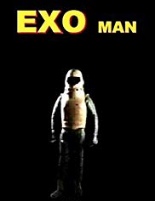
Good thing the doc’s been experimenting on how to alter the structure of matter — or something like that. All that matters is he succeeds — depicted through the not-so-special effects of magnets under the table — which enables him to “walk” again. To justify the title, he constructs a protective suit that makes him look like an unholy blend of a Shop-Vac and Conky from Pee-wee’s Playhouse, then goes out at night to fight crime, one sloooooow and lumbering step at a time. His Kryptonite? Toppling over.
Like Iron Man, Exo Man gives us the claustrophobic, you-are-there shots of Conrad’s super-sweaty face within the unforgiving helmet. Whereas Tony Stark’s is top-o’-line and outfitted with a holographic dashboard, Conrad’s relies on switches and buttons, all marked using an old-school Dymo label maker (and one button misspelled as “MALFUNTION”). As an underdog of a telepic, Exo Man carries a similar ambling, DIY aesthetic and plays the material with utter sincerity. Shot as a pilot, it never went further than this and didn’t deserve to — unlike writer Martin Caidan and director Richard Irving’s previous team-up, The Six Million Dollar Man. —Rod Lott

The Astrologer (1975)

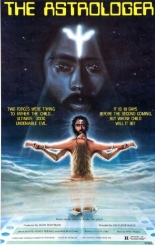
Last weekend, while visiting my daughter at college, she asked if I had heard about the FBI study determining that the famous serial killers were all born under the zodiac signs of Sagittarius, Gemini or Virgo. I had to admit I had not … because, of course, it’s not true (God bless Snopes.com). Turns out, however, that’s more or less the concept at the core of The Astrologer, the ambitious, never ostentatious debut for filmmaker James Glickenhaus (The Exterminator).

Tuned to the frequency of The Final Conflict, the moody end-times piece operates on the idea that astrologer Alexei Abernal (Bob Byrd, meekness personified) has cracked the code of determining the “zodiacal potential” — better get comfy with hearing that phrase — of anyone in the world, simply by knowing one’s birthdate. This has enabled him to open the InterZod organization, secretly funded by the U.S. Department of Defense to keep tabs on burgeoning evil ’round the globe.

That task is extra-critical now that a mere 10 days remain before the second coming of Christ, and Sequel Jesus is in a real My Two Dads sitch, in that he could be fathered by one good dude or one bad mofo. Falling into the latter camp: Kajerste (Mark Buntzman, Posse), a mystic Indian with formidable beware-the-stare powers.

If you’re hoping all that starts to make sense at some point, stop. It doesn’t. And that’s A-OK because Glickenhaus, in adapting his father-in-law’s novel, has layered so much mindfuckery into the mix that the science — pseudo it may be (and, oh, do it be!) — need not hold up in court. Watchers of The Astrologer can make an educated guess as to the 23andMe paternal ID revealed in the final seconds, yet also have no clue of what’s coming in each scene before then. For what is essentially an airport paperback of a motion picture, that’s a laudable achievement.

Glickenhaus overcomes the limitations of a five-figure budget with the simplest of solutions; it’s amazing what a few computer blips and photo-negative transitions can do for bizarro ambience, not to mention a score by The Terminator composer Brad Fiedel and some truly unsettling edits by Victor Zimet (The Sex O’Clock News). Only Glickenhaus’ actors let him down; Byrd hatched no other credits, but as Alexei’s incelibate wife, Playboy centerfold Monica Tidwell (1979’s Nocturna) at least exudes a freckle-faced charm.

The Astrologer is not to be confused with another movie with the same name from the following year. The Astrologer is to be confused with Suicide Cult, an alternate, nonsensical title. The Astrologer also features a groovy fondue pot with real zodiacal potential. —Rod Lott

Get it at Amazon.

The Peanut Butter Solution (1985)

I vaguely remember, as a child, watching a creepy French movie about a child who undergoes immediate baldness and somehow ends up in a slavery ring. In the pre-internet age, however, I was not able to find it and eventually chocked it up to being some sort of a spooky fever dream.

So imagine my surprise when, right there in my mailbox, the French-Canadian film The Peanut Butter Solution shows up, bringing back all of those disturbing memories and, upon actually viewing it, giving me even stranger new ones.

Living in a bizarre, French-influenced town with a depressed-artist father and an Electra-complexed sister, young Billy (Michael Hogan) wakes up one morning to find his hair has completely fallen out. After numerous taunts and barbs from his soccer teammates on the field, as he sleeps, an immolated homeless couple shows up and gives him a nasty recipe for a hair tonic.

As Billy mixes and drinks the titular solution, he begins to grow long luxurious locks. His Asian friend, Connie (Siluck Saysanasy), also uses the formula, but on his pubic area, which is slightly uncomfortable.

The fact, however, that it causes his hair to grow to ridiculous lengths isn’t the weird part; it’s that his art teacher is actually a psychotic brushmaker who has kidnapped most of the neighborhood kids and put them to work in an underground sweatshop manufacturing said brushes.

As I viewed the Solution, I could feel that sense of nocturnal uneasiness come back and disturb me — perhaps even worse this time, as it’s now viewed with adult eyes — but maybe it’s that slight terror that makes some of the best kiddie fare to revisit, especially as a young Celine Dion belts out tunes about the power of being young over the end credits. —Louis Fowler

Get it at Amazon.

Color Out of Space (2019)

H.P. Lovecraft’s short story “The Colour Out of Space” has been filmed several times since its 1927 publication, but none more imaginatively than Richard Stanley’s Color Out of Space. Despite its title being shorn of one vowel and an article of speech, it best captures the cosmic terror of Lovecraft’s classic.

One night, from the stars above the Gardners’ isolated alpaca farm, a meteorite comes crashing into the front yard. The media attention it brings, however limited, is unwanted by family man Nathan (a naturally unrestrained Nicolas Cage), yet a breeze compared to the threats that soon sprout — some quite literally. Infecting the water well — shades of George A. Romero’s The Crazies — the meteorite spreads madness and mayhem, inside and outside the Gardner home, and beyond. To fully align with the movie’s slow-burn cloak of impending dread, viewers are better off not knowing the details of the “how.” Suffice it to say, one late revelation is twisted into such a Cronenbergian knot, it may disturb even the desensitized.

While many will see the meteorite’s invasion as the catalyst for an allegory of American familial dysfunction, it is more interesting to view the object as a representation of cancer — one with fast-spreading reach — as Nathan’s wife (Joely Richardson, Red Sparrow) is herself recovering from the disease as the film opens. That is at least more in line with the ecological bent of Lovecraft’s tale, here embodied by a visiting hydrologist (Elliot Knight, aka TV’s Sinbad) who never changes his Miskatonic University shirt.

That said, you also can enjoy Color Out of Space for its surface-level lysergic trippiness, of which Stanley supplies plenty, making the film a magenta-saturated companion piece to Cage’s Mandy. Returning for his first feature in more than 20 years after his unceremonious firing from 1997’s The Island of Dr. Moreau remake (a whale of a tale told in 2014’s gotta-hear-this Lost Soul documentary) Stanley finally has the opportunity to make good on the enormous promise of his 1990 debut, Hardware. Not only does he not disappoint, but he also finds a way to film the unfilmable aspects of Lovecraft’s story, turning pulp into art. —Rod Lott

Get it at Amazon.