Category Archives: Mystery

Puzzle (1974)

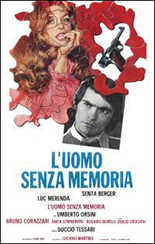
Puzzle’s title refers to the amnesia of Peter (Luc Merenda, Shoot First… Die Later), a man who recalls nothing about himself eight months after a car accident. Shortly after the film begins, he’s fortunate enough to learn that he:
• has a wife named Sara (the splendiferous Senta Berger, Killing Cars)
• was a con artist who pissed off a lot of people
• is in possession of something for which said people are willing to kill

But whom and what? The movie’s very name clues viewers in that the best way to experience Puzzle is to go in knowing as little as possible, so you can investigate as much as Peter. To encourage that, I’ll reveal no further plot. Besides, you already know Chekov’s principle that if a chainsaw is left carelessly on the kitchen table in Act 1, it’s going to come in handy in Act 3, right?

Hitchcockian on paper, Puzzle comes well-constructed by co-writer Ernesto Gastaldi, who’s penned more great gialli than you have fingers, including Torso, All the Colors of the Dark, The Strange Vice of Mrs. Wardh, et al. If the screenplay can be faulted for anything, it’s that having so few characters makes the perp obvious sooner than director Duccio Tessari (The Bloodstained Butterfly) may have liked. Still, the film’s best sequence arrives after the reveal, with suspense simmering toward a strong boil as three separate elements in a room rather ingeniously threaten to place Sara in mortal danger. Tessari pays it off with intense slow-motion shots that make up for questionable close-ups of mouths (complete with crumbs on lips) early on.

Co-stars include Anita Strindberg (Lucio Fulci’s A Lizard in a Woman’s Skin); Bruno Corazzari (Fulci’s The Psychic), whose allergy-ridden character dispenses Kleenex as he does story points; and child Duilio Cruciani (Fulci’s Don’t Torture a Duckling). As usual with the giallo, the setting is so magnificent, Puzzle appears to have been made with the assistance of Italy’s tourism council. —Rod Lott

Get it at Amazon.

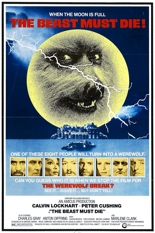
The Beast Must Die (1974)

Ace adventurer Calvin Lockhart is aiming to trap and destroy the most dangerous creature known to man: a large man-dog responsible for numerous killings around Europe in the intriguing werewolf mystery The Beast Must Die.

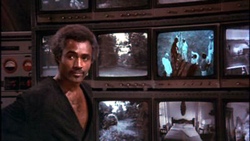
In a remote countryside lair, Lockhart has invited the most interesting of British society for a weekend at his mansion including Peter Cushing, Charles Gray and Michael Gambon. His plan, however, is to use his many modern-day computer devices — modern for 1974, of course — to suss out who the beast that must die is.

An interesting take on the beloved British mystery, horror studio Amicus took time off from its typical anthology films to make this atypical werewolf flick, their final horror film most notable for casting Lockhart — then a solid name from Cotton Comes to Harlem — as the lead, a proto-Blade, supernatural stalker who should have really had his own series of beast-killing movies.

But what The Beast Must Die is probably remembered best for is the supremely silly “Werewolf Break,” wherein a ticking clock with pictures of the cast is shown on the screen as the audience is given 30 seconds to figure out who the beast that must die is. I guessed wrong and I’m sure you will, too. —Louis Fowler

Get it at Amazon.

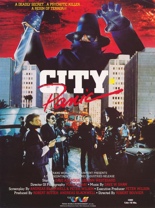
City in Panic (1986)

I’m old enough to remember the fear of AIDS that gripped America — so irrationally hysterical that when Rock Hudson’s HIV-positive status became public, headlines worried whether Linda Evans was next, given the two shared a kiss on an episode of Dynasty. It was a different time — one in which your parents and teachers told you not to utilize public fountains or toilet seats, lest you catch “the gay cancer,” too.

From this frenzied climate a year later emerged City in Panic, a bargain-basement Canadian whodunit originally titled The AIDS Murders until someone realized naming a mystery after its solution maybe wasn’t the wisest of choices.

Also not a great idea: Having your protagonist be a preening cad. FM101 talk-show host Dave Miller (David Adamson, Bionic Showdown: The Six Million Dollar Man and the Bionic Woman) pretentiously yammers on and on with callers about the string of serial murders plaguing Toronto. Curiously, freshman director Robert Bouvier (Avenging Warriors) moves the camera moves around Dave just as Oliver Stone’s would do to Eric Bogosian two years later in Talk Radio. Whereas Talk Radio crackled with electricity, City in Panic is a weak joy buzzer.

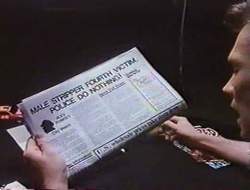
As Dave spouts his tired rants on air (“Bullshit has no conscience!”), he smokes, plays darts, reads comics and toys around with RC cars and robots — each endearing him even less to us, the viewers. We’re stuck with him, just as he’s stuck with his journalistic nemesis, a Truman Capote-esque gossip columnist (one-timer Peter Roberts). You’ll wish Bouvier would spend more time with the murderer, dubbed by the press as “M” for leaving that letter carved into victims’ skin. With dark sunglasses and a buttoned-up trenchcoat, “M” looks not unlike the darker half of Spy vs. Spy and definitely has a type; see if you can figure it out from these dead people:
• a male bodybuilder
• a banana-hammock stripper
• a guy who patronizes public steam baths
• a security guard who sticks his dick through a bathroom-stall glory hole

Yes, you’re on the right track. In offensiveness, City in Panic doesn’t even approach William Friedkin’s Cruising, but its easily guessed twist and shot-for-shot recreation of Psycho’s legendary shower scene help ensure it’s not going to be crowned Mr. Congeniality, either. Cheaper-looking than the similarly plotted Massage Parlor Murders!, the movie sounds even worse, with music overpowering dialogue as if everything were recorded on one track, which is likely the case. That flatness fits the single dimension exhibited by the actors.

FM101’s chipper receptionist may put it best: “Weird show, Dave.” —Rod Lott

Get it at Amazon.

Abrakadabra (2018)

Thirty years ago, Lorenzo Mancini’s magician father was killed onstage during a bullet stunt gone awry. Today, now a magician himself, Mancini (German Baudino, 2009’s Lucky Luke) returns to that very stage with his new show. However, the night before his debut, a woman is found murdered — her head poked into a box pierced by several swords; later, another is decapitated by a guillotine. In the authorities’ eyes, these and other acts of malicious magic implicate Mancini, the self-proclaimed “Master Mind of Mental Mystery.”

Abrakadabra marks the third Italian-language feature for Luciano and Nicolás Onetti, the Argentinian brothers who clearly love the giallo. As with 2013’s Sonno Profondo and 2015’s Francesca, they again aim not for a mere homage, but total authenticity; thus, Abrakadabra has been crafted as if it came from the early 1980s. While the illusion is about 85% there, the checklist of tropes ticks to nearly 100%: disorienting angles, colors oversaturated to an unrealistic hue, ugly furnishings, creepy puppets and propulsive musical cues that sting of novocaine.

The Onettis’ adherence to appearance is impressive enough; that they can this story with a minimal amount of dialogue, even more so. A few seconds shy of 70 minutes, the film is cut mighty lean — perhaps out of necessity, since the identity of the killer is startlingly obvious.

Well, kinda. The ending is coated too thickly with ambiguity to offer full closure. Still, neat trick. —Rod Lott

Get it at Amazon.

The Strange Vice of Mrs. Wardh (1971)

None other than Sigmund Freud kicks off The Strange Vice of Mrs. Wardh via a quote that seems to chastise the audience for its bloodlust — a potentially hypocrtical move for a giallo, if shame were the intended response. Regardless, no record exists of Freud’s thoughts on Edwige Fenech (The Case of the Bloody Iris), but I’d like to think he would have altered his famous line about the cigar.

In the title role, Fenech’s Julie and her tapioca husband (Alberto de Mendoza, A Lizard in Woman’s Skin) return home to Austria from time abroad. No sooner do they step foot in Vienna than the bra-neglecting Julie has an unpleasant encounter with a shit-grinning ex (Ivan Rassimov, The Eerie Midnight Horror Show), followed by a pleasant meet-cute with her pal’s handsome cousin (George Hilton, My Dear Killer). A full-blown affair ensues.

All the while, this being a giallo, beautiful women are killed all over the city by a man whose black-gloved hands clutch — what else? — a sharp, shiny straight razor. Julie becomes his next intended victim, so suspicion falls on each of these three men in her mixed-up, sexed-up life.

And it is just that, whether Julie dreams of having intercourse atop broken glass (if only in dreams) or attending parties in which the female guests rip one another’s paper dresses off. Such swinging shenanigans and their settings contribute to the overall hallucinatory effect of the visuals, as intoxicating as Fenech’s beauty is flawless. This being the first giallo for Sergio Martino (Torso), it’s rather remarkable how right he got it, right out of the gate. Suspense is high, notably in a near-silent sequence of searching by candlelight, and audiences are left guessing and second-guessing, right up to the denouement. By then, The Strange Vice of Mrs. Wardh has done more than enough work to earn its reputation. —Rod Lott

Get it at Amazon.