
Category Archives: Mystery

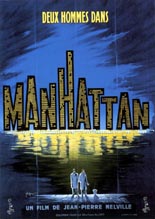
Two Men in Manhattan (1959)

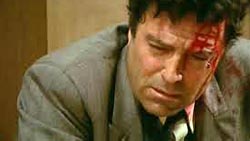
twomenmanhattanTwo Men in Manhattan is as uniquely New York as Martin Scorsese’s Taxi Driver or Sidney Lumet’s Dog Day Afternoon; it just happens to made by the French. Opening with a brassy jazz score — as American an art form as any — un film de Jean-Pierre Melville captures the Big Apple on the brink of Christmas, aka the most wonderful time of the year … unless you happen to be France’s United Nations delegate Fèvre-Berthier.

Absent without explanation for an otherwise unmemorable U.N. vote, Fèvre-Berthier is nowhere to be found, so night-owl journalist Moreau (Melville himself) is tasked with finding him. Taking sleazy photographer Delmas (Pierre Grasset, Rififi) as a booze-soaked sidekick, Moreau presumes that Fèvre-Berthier can be located with ease if they can find the man’s mistress, whomever she may be.

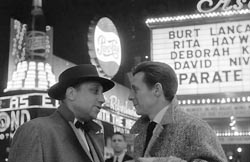
twomenmanhattan1One of the most vital artists of cinema’s French New Wave, Melville (Le Samouraï) shoots the black-and-white film with a tourist’s eye — a focused, determined one vs. easily distracted. On the night of Dec. 23, his Moreau and Delmas run all over the City That Never Sleeps, from tavern to bordello, from the warm studio of Capitol Records to the bustling heart of Times Square. Two Men in Manhattan makes for a pleasurable whirlwind of a roundabout, to a point that the picture’s noir mystery seems almost incidental — an excuse to showcase the still-nascent metropolis. It just so happens that our guide, Melville/Moreau, calibrates audiences’ collective moral compass during the excursion. —Rod Lott

Buy it at Amazon.

Death Occurred Last Night (1970)

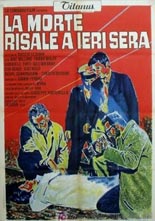
deathoccurredIn Milan, a middle-aged man by the name of Berzaghi (Raf Vallone, 1969’s The Italian Job) is not only widowed, but the sole caregiver for his mentally handicapped daughter, Donatella (Gillian Bray, The Bod Squad). Although she is 25 years old, her mind is stuck at 3; she can’t even put on a brassiere without her father’s help. Innocent flirting on her part is misread as sexual invitation from strangers, so Berzaghi must lock her up in their apartment when he goes to work.

One day, however, he returns to an empty home. The doors and windows remain locked; there’s no sign of forced entry. He fears the worst, as he should: that she has been abducted from his well-intentioned prison to one that has only the worst intentions in mind.

Enter the sinus-infected police captain (Frank Wolff, Once Upon a Time in the West) and his younger, shaggy-haired partner (Gabriele Tinti, Black Emanuelle), who have a feeling Donatella may have been kidnapped into a prostitution ring, so they tour the area’s buy-before-you-try bordellos.

deathoccurred1The mystery of Duccio Tessari’s Death Occurred Last Night is not whether Donatella will be found among the whores, but who will find her and/or her captors first: the police or Berzaghi? The increasingly desperate father doesn’t think the authorities are acting fast enough, so he takes matters into his own vengeful hands.

Tessari (A Pistol for Ringo) directs this grim yet gripping polizia picture with a straightforward objective that makes its story timeless: suspense. So do the colorful supporting players who weave in and out of the story, not always by their own volition, including a suicidal “Negro prostitute,” a former pimp stooping to a less respectable career (that of car salesman) and a teddy bear with an ugly face. However, the show belongs to Wolff and Vallone; the former for portraying how a cop’s professional life infringes upon his personal one, and the latter for showing how an honorable man in his position gives up his own life to focus on that of his only child. —Rod Lott

Buy it at Amazon.

The College-Girl Murders (1967)

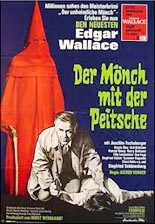
collegegirlmurdersOne of many Edgar Wallace adaptations Alfred Vohrer directed for the big screen, The College-Girl Murders begins with a scene straight out of Business 101: A scientist invents a new, odorless poison that’s 100-percent efficient in causing immediate death in its inhalants. As soon as he sells his find, he’s killed by the buyer.

We know not who this mysterious purchaser is, but we know what he intends to do with it: Annihilate some co-eds. One of those Dr. Mabuse-ian villains who rules over a hideout with a built-in crocodile lair, this enigmatic antagonist has more than one nut doing his bidding, including felons snuck in and out of their prison cells via garbage cans.

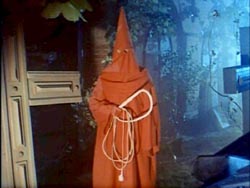
collegegirlmurders1Most notable, however, is a whip-wielding monk clad in hooded duds that look like a Ku Klux Klan uniform accidentally got mixed with a load of reds in the wash. The robed menace runs amok in a girls’ dormitory, planting booby-trapped Bibles that spray the deadly gas upon opening. He then exits via the fireplace, which raises to reveal a secret passageway, natch.

Colorful in look and swinging in sound, The College-Girl Murders is such a blast on several levels that I’m willing to overlook the title’s unnecessary hyphen. The German film marks a solid krimi — not just among the Wallace adaptations, which number so many that they make up their own subgenre, but among the country’s thrillers of that era. It boasts a genuine whodunit plot, lovely ladies ripe for the offing, gadgetry galore and one way-out ending in which the authorities scamper out of frame as soon as they notice a card reading “ENDE” floating in the turtle aquarium behind them. —Rod Lott

Buy it at Amazon.

The Case of the Bloody Iris (1972)

casebloodyirisBruno Nicolai’s theme to The Case of the Bloody Iris is a jaunty, joyful number I never tired of hearing, even when it is not appropriate to the flavor of the scene, which is to say each and every one of its appearances, opening credits included. I hardly minded.

The film itself hits another of my pleasure centers: high-rise settings. In this case, it’s an apartment building home to a couple of recent tenant murders committed by a man in black — and that includes his hat and panty-hosed head, making him look like the DC Comics character The Question, if dipped in India ink. One poor woman was offed in the elevator; the next, tied up and drowned in her own bathtub.

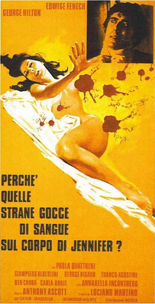
casebloodyiris1On the plus side: Hey, ladies, a vacancy! And in moves Jennifer (Edwige Fenech, Your Vice Is a Locked Room and Only I Have the Key), a lovely young model trying to escape her abusive ex. Making a play for her is the building’s architect (George Hilton, I Am Sartana, Trade Your Guns for a Coffin), a real gentleman, but a real wuss when it comes to the sight of blood. However, when Jennifer’s daffy roommate (Paola Quattrini) becomes the killer’s next victim, the architect is offered up as one of many likely suspects.

For once, the mystery’s solution was not startlingly obvious to me, but maybe I was too busy soaking up the film’s groovy, dreamy visuals to notice. Alternately known by the utterly incredible title of What Are Those Strange Drops of Blood Doing on Jennifer’s Body?, this giallo from Giuliano Carnimeo (Exterminators of the Year 3000) is eye-popping in its Pop Art veneer, its moments of shock and its leading lady, who has the worst luck in keeping her clothes from being torn by the greedy hands of others. —Rod Lott

Buy it at Amazon.

The Psychic (1977)

psychicWhile driving through a tunnel, wealthy newlywed Virginia Ducci (Jennifer O’Neill, Scanners) experiences a terrifying vision of a woman being walled up, “Cask of Amontillado”-style, by a man with a limp. It’s hardly Virginia’s first brush with clairvoyance, having “seen” her own mother’s cliffside plunge to suicide 18 years earlier. (Never does The Psychic top that prologue sequence in shocks.)

As a surprise for her husband (Gianni Garko, Devil Fish), Virginia plans to restore a mansion he hasn’t used since bedding babe after babe in his playboy bachelor days. To her horror, she recognizes a wall there as the one from her blackout dream; sure enough, inside is the skeleton of a female believed to have been in her 20s. When it’s revealed that the mystery woman was one of Mr. Ducci’s numerous conquests, Virginia works with her shrink and authorities to prove her spouse’s innocence and find the true killer, not to mention decipher the remainder of her clue-filled hallucination.

psychic1That’s the problem with The Psychic, a mostly mainstream effort from excess specialist Lucio Fulci (The Beyond): It spells out its own denouement with alarming simplicity. If viewers pay any reasonable degree of attention, they’ll have the ending solved by the second scene — not an exaggeration. I thought surely Fulci’s story would have more to it than that. It did not.

While she is quite the knockout, O’Neill’s abilities as an actress stand in indirect proportion to her looks. Fulci’s camera asks little of her but to stand still with eyes widened and mouth agape, so he can zoom in for a close-up. Over. And over. And over. Just because his film is about a psychic and titled after a psychic doesn’t mean it should settle for predictability. —Rod Lott

Buy it at Amazon.