
Category Archives: Mystery

House of the Long Shadows (1983)

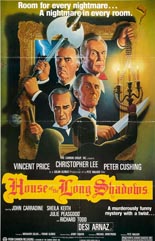
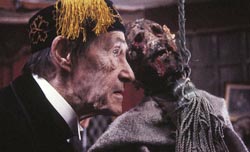
houselongshadowsWhile on a book tour in Great Britain, author Kenneth Magee (Desi Arnaz Jr., 1977’s Joyride) is challenged by his publisher, Sam (Richard Todd, Alfred Hitchcock’s Stage Fright), to write something different from his string of bestselling political thrillers: something epic and all human conditiony, like Emily Brontë’s Wuthering Heights. No prob, says Magee, who bets the Englishman $20,000 that he can turn around a complete manuscript within 24 hours. Ever the gentleman, Sam even offers his client conducive solitude in the House of the Long Shadows, aka Baldpate Manor, a Welsh estate in which no one has resided for 40 years.

Magee arrives, predictably, on a dark and stormy night. But for an abode so empty, there sure are a lot of creepy old people lurking about its unlit hallways and stairwells. None should be there; all reek of sinister motives. With so much distraction and danger, the bad news is that Magee looks to lose that bet; the good news is he won’t notice the financial impact, because he’ll be dead.

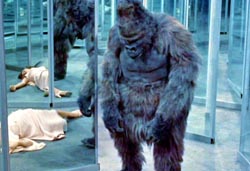
houselongshadows1More prestigious than the average Cannon Films release of the early 1980s, this House finds inspiration in the oft-adapted Broadway classic Seven Keys to Baldpate. It also represents the one and only big-screen meeting of fright-film titans Vincent Price, Peter Cushing, Christopher Lee and John Carradine — sort of like an Avengers for the Famous Monsters of Filmland generation. That alone makes Long Shadows worth a look, but don’t expect much to come of your stay.

The final bow for UK cult director Pete Walker (House of Whipcord), the PG-rated production means well in its old-fashioned adherence to the creaky Old Dark House subgenre and all the Gothic trappings that accompany it. Good intentions do not automatically translate into a good movie, and such is the case here, with a mystery that doesn’t try hard enough to pique audience interest and elements of horror defanged enough for telling ’round a Webelos campfire. It’s as if Walker, never one to shy away from sex or violence, was so out of his element with being inoffensive that he overdid the undercooking. Overall shoddy construction is to blame for the “twist” ending being obvious by the film’s second scene. —Rod Lott

Get it at Amazon.

The Lodger (2009)

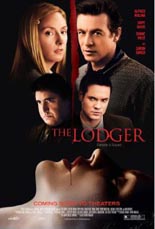
lodgerIn West Hollywood, streetwalkers hit the asphalt as victims of a serial killer — one who may be copycatting the crimes of Jack the Ripper, if the theory of L.A. police detective Manning (Alfred Molina, Spider-Man 2) proves correct. Well, of course it does, and it doesn’t take the removal of one hooker’s reproductive organs to see that!

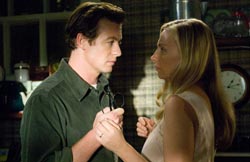
Meanwhile, across town, the mysterious Malcolm (Simon Baker, Land of the Dead) rents the backyard guest house of a clinically depressed and sexually frustrated housewife named Ellen (Hope Davis, Real Steel) and her loutish schlub of a hubby (Donal Logue, Shark Night 3D) for $1,000 a month — brekky included! Claiming to be a writer, Malcolm is comically suspect from the start, insisting he “must not be disturbed,” that he have not only “total privacy,” but possess “the only key.” Ellen’s reaction to this: Get all gussied up and pray for a pity hump.

lodger1If any of The Lodger’s premise sounds familiar, it should; this multiplex-skipping version by David Ondaatje (who wrote and produced in addition to directing) is the fifth of too many movies made from Marie Belloc Lowndes’ 1913 novel, most famously in a 1927 production by Alfred Hitchcock, making his suspense-genre debut. Why Ondaatje even tried is a larger mystery than the one on which the venerable story is built; he brings nothing new to the material but cheap, flashy camera tricks and multiple scenes of internet searches, all of which serve to highlight his film’s immense deficiencies. It’s not that The Lodger is a hoary chestnut, but that Ondaatje has bitten off more than he can chew, even for an expectations-lowered DVD premiere. His first feature (which he has yet to follow up) is overwrought, overcooked and overgrazed with Mozart sauce in an attempt to at least sound dramatic.

Ondaatje’s adaptation holds more poor performances than his name does vowels. As Manning’s partner, The League of Extraordinary Gentlemen’s Shane West is the worst offender, all squints and/or scowls, but that’s modus operandi; ditto Baker’s uncanny ability to be a near-cipher of a screen presence. For being terrific actors, Davis and Molina astonish — and not in the good way — in how astray they seem to be have led. At least Davis gets to go through many of her scenes saying little to nothing; foisted in Molina’s mouth are foolish speeches such as, “Jack the Ripper was the personification of evil … his fucking shadow lurking in the darkest corner of the human mind.”

Had those two amped up the camp elements — and I suspect they wanted to — we’d have a Lodger worth the stay. Oh, it still would be awful, but awful and watchable. As is, the only reward is skipping to the penultimate scene, just to hear RED’s Rebecca Pidgeon enunciate “autoerotic.” —Rod Lott

Get it at Amazon.

Dark Places (2015)

darkplacesIn a rare nexus of art and commerce, Hollywood has turned a best-selling novel by Gillian Flynn into a critically acclaimed, audience-pleasing smash that’s destined to embed itself in our pop-culture consciousness for decades to come.

I speak of Gone Girl, of course. One year later came Dark Places. It premiered on VOD.

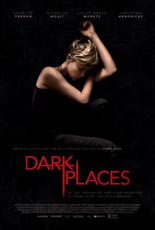
In 1985, Libby Day was just 8 years old when her mother and sister were brutally murdered in what the media dubbed the “Kansas Prairie Massacre,” for which her teen brother, Ben, was convicted. Three decades down the line, Libby (Charlize Theron, Mad Max: Fury Road) is near-penniless after book royalties and funds from kind strangers have dried up. Naturally, she’s estranged from Ben (Corey Stoll, Ant-Man), who remains behind bars.

darkplaces1Dire straits are the lone reason why Libby agrees to be the paid special guest at a meeting of true-crime enthusiasts not only fascinated by her case, but convinced of her brother’s innocence. While the amateur organization is called The Kill Club, Libby’s recruiting member (Theron’s fellow Fury Road passenger Nicholas Hoult) promises, “It’s not as weird as it sounds.”

That, in a nutshell, is Dark Places’ largest problem: It’s not as weird as it sounds. In fact, it’s shockingly average, venturing to locales and situations not nearly as twisted as one hopes for, given the sales success of Flynn’s 2009 sophomore book and its use of the 1980s’ satanic-panic hysteria as a major subplot. A mystery is there, which Libby initially is reluctant to touch, but her manner of investigation is less than compelling and the secrets uncovered, disappointing due to sheer implausibility. Not having read the book, I do not know if blame should be assigned to Flynn or writer/director Gilles Paquet-Brenner, whose 2010 film, the low-key Sarah’s Key, generates markedly more suspense out of its slow-cooker of a story, also blessed with a strong female protagonist.

As usual, Theron gives it her all, even if her ever-the-sourpuss character is less than likable. Doing richer work — and all in flashbacks — is Mad Men resident redhead Christina Hendricks as Libby’s hardscrabble mother. She may have had the edge, with this being her second film in a row playing a financially desperate single mom, following last year’s Lost River. —Rod Lott

Get it at Amazon.

4 Dick Tracy Movies from RKO Pictures

dicktracycueballDick Tracy! Calling Dick Tracy!

Long before Warren Beatty gave us his big-budget, candy-coated adaptation of the legendary and long-running Chester Gould comic strip, Morgan Conway and Ralph Byrd donned the yellow fedora of homicide detective Dick Tracy in a series of four films.

RKO Pictures was “true to the flavor” of the funny papers without resorting to camp. While the studio didn’t exactly nail it, it didn’t botch the job, either. Each pic clocks in at one hour, give or take — just the right length for these none-too-complex crime stories.

dicktracydetectiveDick Tracy, Detective (1945)
With Conway starring, Dick Tracy, Detective is hot on the trail of the slasher Splitface (The Centerfold Girls’ Mike Mazurki), so named for his hideous facial scar. Two die before Tracy starts to get wise, nabbing the villain with the help of wannabe-private eye Junior, and rescuing true love Tess Trueheart (Anne Jeffreys, Zombies on Broadway) in the process.

Dick Tracy’s Dilemma (1947)
Following the theft of a bunch of furs in an insurance scam, square-jawed Tracy (Byrd, who also played the hero in the serials and the TV show) is on the hunt for The Claw, (Jack Lambert, 1946’s The Killers), a burly, hulking bad guy with a metal hook for a hand, in Dick Tracy’s Dilemma. The utensil comes in handy for knocking people out and cutting up their faces. Meanwhile, Tess (Kay Christopher, Gasoline Alley) gets stood up repeatedly because Dick’s priorities are all out of whack, and has to spend much of her time with effeminate actor Vitamin Flintheart (Ian Keith, It Came from Beneath the Sea), who likes to perform Shakespeare monologues. But of course he does. All in all, it’s a painless hour of good-ol’-fashioned fun.

dicktracygruesomeDick Tracy vs. Cueball (1946)
Essentially, Dilemma is a carbon copy of the previous year’s Dick Tracy vs. Cueball, right down to the bumbling cop sidekick who gets hit over the head by the bad guy so often, it’s a wonder he’s alive, still on the force and without a cap in his ass. In Cueball, the main villain is the burly, hulking, bald baddie Cueball (Dick Wessel, TV’s Riverboat), thick-neck-deep in a stolen-diamonds scam. Vitamin even shows up to make some remarks about wanting to be a woman. But of course he does.

Dick Tracy Meets Gruesome (1947)
Finally, in Dick Tracy Meets Gruesome, ex-con Gruesome (Frankenstein’s monster himself, Boris Karloff) leads a trio of bank robbers who commit their crimes thanks to a formula that causes people to freeze. As one might guess, Gruesome is sillier than the others, filled with jokey names like Professor A. Tomic; his assistant, I.M. Learned; and the taxidermist Y. Stuffem. And if Tracy (Byrd) works homicide, what’s he doing investigating a bank robbery?

In all four films, virtually every man wears a hat. —Rod Lott

Get them at Amazon.

The Scarlet Claw (1944)

scarletclawOne from the 14-film Sherlock Holmes franchise’s middle, The Scarlet Claw is the most overtly supernatural of the bunch, but we all know Holmes (Basil Rathbone) isn’t a believer in such things. The same can’t be said for Lord Penrose (Paul Cavanagh, 1953’s House of Wax), whose wife becomes the latest victim of a rumored marsh monster that has the village of La Mort Rouge gripped in fear.

Just like the following year’s Pursuit to Algiers, this flick stands at more of a B level than the earlier pictures, yet at 74 minutes, it’s so quick, it can’t help but be fun. As with all of them, it’s difficult not to want to watch at least two in a row.

scarlettclaw1jpgRathbone makes an excellent Holmes, so much so that we tend to picture him when he think of the character. He enjoys a natural rapport with Nigel Bruce, too, although this Watson of the screen isn’t Sir Arthur Conan Doyle’s Watson of the page; here, the doctor is reduced to a bumbling, occasionally pigheaded sidekick, rather than the detective’s equal. That’s not really a complaint, but an observation.

But here’s one complaint: Typical of the studio pictures of their era, these films are prone to musical numbers in which a character sings an entire song — or several — apparently because audiences liked that sort of thing. —Rod Lott

Get it at Amazon.