
Category Archives: Horror

Flight 7500 (2014)

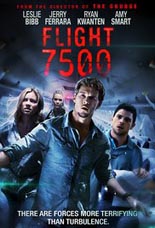
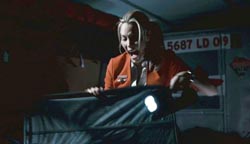
flight7500No offense is meant to Leslie Bibb, a genial actress with bona fide comedic flair (from Talladega Nights to Hell Baby), but she looks as if she were genetically engineered to play a flight attendant. Her striking, all-American features combine for the kind of friendly face commercial air carriers look for when employing ambassadors for beverage service at 37,000 feet. While Bibb’s Laura may be an ideal hire for the fictional Vista Pacific Airlines, she cannot save Flight 7500 from interminable boredom. The film is flawed from its initial taxi down the runway.

Passengers board a red-eye flight that will take them from Los Angeles to Tokyo … or at least that’s the intent. With air travel, so many variables loom as threats: severe weather, mechanical failure and, if your movie’s director is Japanese, a high probability of a supernatural haunting. With The Grudge’s Takashi Shimizu in the proverbial cockpit here, the latter is at play: an invisible force that chokes the life out of frequent fliers in the most predictable and detaching ways.
flight75001One wonders if Shimizu and screenwriter Craig Rosenberg (2009’s The Uninvited, an underrated spooker) have attempted to imbue this routine horror film with a statement on the state of the modern marriage in these United States. Consider that Laura is playing “Coffee, tea or me?” with the married pilot (Jonathon Schaech, The Legend of Hercules), and that the other four main characters are either in a dissolved union (Crank’s Amy Smart and Knights of Badassdom’s Ryan Kwanten) or newly part of one already doomed to collapse (Hall Pass’ Nicky Whelan and Entourage’s Jerry Ferrara).

Or at least I wondered that, because the movie failed to grab me, and when it comes to horror, I’m a fairly easy lay. It’s no wonder Flight 7500 took four years to land a stateside release on DVD, after originally being made for theaters. While Shimizu is a competent filmmaker, this elicits not even a fraction of the fear of his greatest hit (or hits, plural, if you lump in his own remake). While welcome, the ending succeeds only in insulting its audience, followed by an unscary jump scare that doesn’t even make sense within the story’s timeline. —Rod Lott
Get it at Amazon.

Gurozuka (2005)

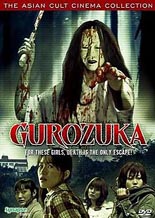
gurozukaWhile not all J-horror entries are required to be compared to Hideo Nakata’s massively influential Ringu (remade for Yanks as The Ring, of course), it’s nigh impossible to discuss Yôichi Nishiyama’s Gurozuka without drawing the comparison. With automatic thanks to a rumored videotape on which the narrative must hinge, the similarities are too strong, ultimately to this film’s detriment.

With an all-female cast, the imported spookshow follows two high school groups collaborating on a project for class: the Movie Club, all two members of it, and the Drama Club, more popular since it numbers a big, fat three. Virtually doubling as cliques, both clubs can be defined by their members’ behavior toward others: respectively, goody-two-shoes and snooty bitches. With teacher Ms. Yoko as their chaperone, the nice girls and mean girls venture deep into the woods to shoot an improvisational film. Looking not unlike an Asian Sarah Palin, Ms. Yoko (Yûko Itô, Bubble Fiction: Boom or Bust) is despised by the girls, who suspect she is having an improper relationship with Takako (Nozomi Andô, Tomie: Forbidden Fruit), the strange and silent pupil tagging along for this field trip.

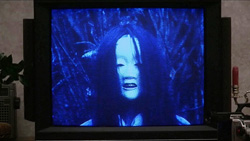
gurozuka1Mind you, the above paragraph delivers far more background than Nishiyama needs to give his audience, other than to set up Takako as a social outcast and, therefore, a de facto red herring. The real story kicks in at the abandoned lodge in which they stay, because that’s where the Movie Clubbers stumble upon the creepy Super 8 footage that serves as the Zapruder film in Gurozuka’s world: a legendary reel depicting — or capturing, hmmm? — a woman in a demon mask slicing up her “co-star”: a fellow student of the schoolgirls who never was heard from again.

Furthermore, this found footage reportedly was shot on the lodge grounds … yet with this being a horror film, “reportedly” can be jettisoned. That demon woman still sports that undeniably unsettling mask and still grasps that same sharp implement and, yep, still remains on-site. I wish there were more to the flick than that, but — as is the case with the majority of J-horror movies — predictability reigns supreme. That’s not to say Gurozuka can’t be enjoyed half-heartedly, provided expectations are cut into simplified fractions; it helps that 84 minutes is all Nishiyama asks of your time for a work so reliant on the ideas of other films before it, including a scene lifted wholesale from Sam Raimi’s The Evil Dead. (Domo arigato, Samuel.) —Rod Lott

Get it at Amazon.

Saturday Morning Mystery (2012)

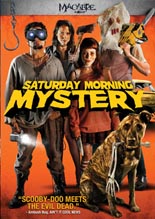
satmornmystZoinks! Spencer Parsons’ Saturday Morning Mystery winkingly makes the opening-credits claim that it is “a real story based on actual televised events.” That is its cheeky way of hinting at — if not quite acknowledging, for legal reasons — that, yes, the movie is perfectly aware its characters and setup resemble TV’s still-chugging Scooby-Doo. That is Saturday Morning Mystery’s point, its selling point and, ultimately, its point of no return.

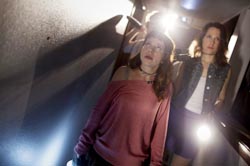
Unknowns Adam Tate, Josephine Decker, Jonny Mars and Ashley Rae Spillers fill the role archetypes of, respectively, Fred, Daphne, Shaggy and Velma. (Hamlet, their nonspeaking Great Dane, plays himself.) The paranormal-hunting foursome is hired to investigate a mansion that once housed a private school with religion-based curriculum; rumors of satanic sacrifice, an open gate to hell and the occasional meddling kid have plagued the site ever since. With Hamlet in tow and on a leash, the group members unload their van, set up their equipment and steel themselves for an unpredictable night.

satmornmyst1Much of what happens in those dark hours would cause William Hanna and Joseph Barbera to turn beet-red, if they were still alive to see it. In other words, the film’s R rating is entirely warranted.

People drawn to Saturday Morning Mystery strictly because of the Scooby-Doo “connection” are bound to be disappointed. Parsons’ work is not a parody of the beloved cartoon; Warner Bros.’ sanctioned pair of live-action comedies better adhere to that description. This is also more or less humorless, despite a sunny, cheerful title that conjures loving images of sugary cereal and hours of entertainment while the parentals slept in. Saturday Morning Mystery is a mumblecore treatment of in-vogue supernatural horror dripping with Gen X nostalgia; therefore, it is less an actual story and more a concept — one that still requires some fleshing out. At least it is interesting in its shortcomings — no easy task, that. —Rod Lott

Get it at Amazon.

Sheitan (2006)

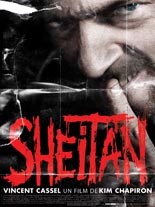
sheitanAsked of its audience in Sheitan’s opening shot, “You ready?” Having already seen the French film, I can answer for you: No, you are most assuredly not ready. You have no idea what’s in store for you, but the next title card may provide a solid hint: “Lord, don’t forgive them, for they know what they do.”

“They” are the gaggle of vaguely young and utterly obnoxious friends who spend the evening of Dec. 23 clubbing and tripping balls. Horniness gets the better of them, which must be why they agree to go the remote country home of the alluring Eve (Roxane Mesquida, Rubber), whom they just met. Initially, it appears the guys have only three items of concern: hangovers, goats blocking the dirt road and competing for Eve’s attention and affections, which is to say her vagina.

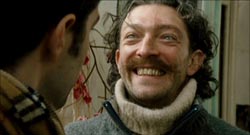
sheitan1But then they meet Joseph, the home’s caretaker. Played by Vincent Cassel (Brotherhood of the Wolf), he possesses overly boisterous hospitality, yet casual racism, a shit-eating grin, a wavering dedication to hygiene and hairpin shifts in mood. His behavior immediately strikes the kids as off-center, to put it mildly. After that, director and co-writer Kim Chapiron (Smart Ass) makes sure to erase “mildly” from his film’s vocab. As Joseph’s true nature is revealed, things escalate on the thermometer of wrongness with the speed of a steroid-ridden rabbit. We would expect nothing less, considering the home’s living room is adjacent to a workshop filled floor-to-ceiling with plastic doll parts.

Sheitan (the title translates to “Satan”) is something of an eye-opener on multiple levels, starting with Cassel. Those of us used to seeing him as wiry and stature-short in his American films (e.g. Black Swan and Ocean’s Twelve) will be taken aback by how burly he appears here, yet his commanding presence isn’t all physical. Cassel embodies a master class on malevolence that penetrates the viewer’s psyche in order to fuck with it for the film’s increasingly anxious entirety, right down to a shocking subliminal frame that interrupts the roll of ending credits.

Ultimately more disturbing than scary, Sheitan toys with you with a calculated menace. Chapiron and company are shrewd enough to front-load the film with laughs so that you’re caught off-guard by the whiplash turns they take. The humor continues, but grows tonally to match the darkness of a rotting lung, making you question if all the sick bastards truly reside on one side of your TV screen. —Rod Lott

Get it at Amazon.

Malatesta’s Carnival of Blood (1973)

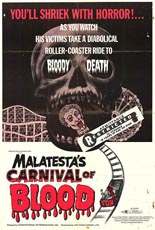
malatestaNot to be confused with 1970’s Carnival of Blood is Malatesta’s Carnival of Blood. Although the two are similar in subject matter and equally penny-pinching, the Pennsylvania-lensed Malatesta is the only one to feature TV’s Fantasy Island sidekick Hervé Villechaize as Bobo the dwarf. In his initial scene, Villechaize delivers what I expect is fairly helpful exposition, yet he is unintelligible. And with that order of business out of the way …

Inventive and impressive, the regional indie begins with the curiously named Mr. Blood (Jerome Dempsey, Network) giving Mr. and Mrs. Norris the nickel tour of the 20-year-old amusement park he manages. With their teen daughter (one-credit pony Janine Carazo) cruising the midway, the Norrises are there under the pretense of working for the fleapit, but in actuality — sssssssssshhhhh! — are sniffing around for their son, who vanished after a visit.

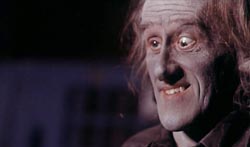
malestesta1From the outset, the title informs viewers that management is not exactly on the up-and-up, starting with Mr. Blood and extending all the way up the org chart to the owner, Malatesta (Daniel Dietrich, 1978’s Dawn of the Dead). This Manos-esque master serves as the man behind the curtain — the robed ringleader to the murderous hippie cannibals who lurk in the limestone caverns underneath the roller-coaster, the Tunnel of Love and other rundown attractions. Eager for flesh, the hungry freaks snatch the customers right out of their rides like so many crumbs of funnel cake. Explains Mr. Blood, not quite as an apology, “Nobody ever told them eating people was wrong.”

And if eating people is wrong, I don’t wanna be right! In his only feature credit as director, Christopher Speeth (DP on the über-obscure Video Wars) had the good fortune of built-in production value by shooting at Willow Grove’s Six Gun Territory, an actual amusement park just a few years away from extinction. With its behind-the-scenes warehouses and chintzy décor of Visqueen and bubble wrap, the near-decrepit place has a lack of polish that actually works to Malatesta’s benefit and fits right in line with Speeth’s long, handheld takes. Carnival funhouses already operate as nightmarish and hallucinatory — another extant gain for the flick.

Perhaps knowingly compensating for poor acting, Speeth squeezes extra practicality just by having his assemblage of cannibals milling in front of such classic silent horrors (read: public domain) as The Cabinet of Dr. Caligari, Nosferatu, The Hunchback of Notre Dame and The Phantom of the Opera projected onto a wall behind them. As with the movie as a whole, the effect works — and better than you’d think. Ask your doctor if Malatesta is right for you. —Rod Lott

Get it at Amazon.