
Category Archives: Horror

The Green Inferno (2013)

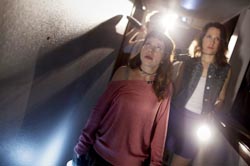
greeninfernoAs far as I know, Eli Roth’s long-on-the-shelf The Green Inferno is the lone 2015 theatrical release to utilize the threat of female genital mutilation as a subplot. Then again, I could be wrong — I still haven’t seen Minions.

Incensed over learning of the barbaric, Third World practice during a class lecture, petulant freshman college student Justine (Roth’s wife, Lorenza Izzo, Knock Knock) joins the campus activist group in order to Change the World, starting with the Amazon rainforest. (“Activism’s so freakin’ gay,” protests her roomie, an emo-pessimist played by singer Sky Ferreira.) Seeing as how good intentions pave the road to hell, the well-meaning Americans’ rickety, Buddy Holly model of a plane crashes in the jungle — one that plays home to a primitive tribe of cannibals. The few survivors are rounded up, caged in bamboo and await mealtime.

F greeninferno1Collegians: It’s what for dinner.

From massive diarrhea to brutal dismemberment, Roth spares his cast — and, thus, the viewer — no humiliation, discomfort or pain-wracked demise, as anyone who has witnessed his Hostel saga knows all too well. Roth takes a lot of crap for reveling in the revolting, yet his films are about more than that and that alone — something that can’t be stated about most of today’s horror. Inferno, in particular, burns bright as an extreme, not-for-most experience that is legitimately disturbing, grimly humorous and frightening to consider — exactly upon which Roth counts. (Hell, I get travel anxiety just visiting Texas.) Only the CGI ants fall short of achieving the visceral reaction he doggedly works toward.

Otherwise, this film feels like one that I should not be watching. I felt the same about “bites” of the fabled Italian cannibal gross-out epics I manage to sample as a teenager — movies Roth is paying tribute to with transparence, so he can take that as a compliment. Lest there is any question about his objective, the end credits provide a veritable RIYL list of the subgenre’s sickest and most notorious offerings. Of considerably less use, those credits include the Twitter handles of cast and crew members, perhaps just to satisfy the gullible in proving the people they saw gutted onscreen are very much among the living. —Rod Lott

Get it at Amazon.

Shriek of the Mutilated (1974)

shriekmutilatedIn Shriek of the Mutilated, one of the few films in which director Michael Findlay does not indulge his psychosexual kinks, college professor Dr. Prell (Alan Brock) takes four of his students on a field trip to Boot Island, in hopes of finding and capturing a yeti. Seven years earlier, a similar sojourn ended in tragedy, but in the immortal words of the great philosopher Shoeshine Boy, aka Underdog, if at first you don’t succeed, try, try again.

Their mission’s HQ is the home of Prell’s fellow academic, Dr. Werner (Tawm Ellis), who employs a mute and “harmless old buzzard” American Indian, Laughing Crow (Ivan Agar, 1968’s Behind Locked Doors), to do his bidding. (His tasks include the preparation of meals; one Laughing Crow recipe is human head stew.) With Prell barking orders, the armed students venture into the woods to rustle up a yeti; I am spoiling nothing by noting that not only do they find their prey, but become the prey.

shriekmutilated1Shriek will make you do just that, with the kind of delight only offered by the well-meaning Bs. While I’m not sure what was up with the decapitation prologue since it has no bearing on the film that follows, Findlay lucked into an actual story — not his usual playing field — but it’s still rife with goofiness. For example, scored by Hot Butter’s novelty hit “Popcorn,” an early party scene has Spencer (Tom Grail), a survivor of Prell’s previous yeti hunt, flip the fuck out when he learns his old prof is still obsessing over such an abominable quest. So naturally, Spencer goes home, slits the throat of his wife (Luci Brandt) and, still clothed, hops in the tub with a can of Coors. While he soaks and scrubs and burps, his not-quite-dead spouse manages to crawl into the bathroom and toss a plugged-in radio in with him. Why this sequence merits inclusion is not worth pursuing.

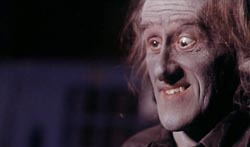
Anyhoo, that yeti: Despite initial camera tricks (Findlay’s wife, Roberta, handled cinematography) to keep him obscured, Shriek of the Mutilated gives viewers plenty of plain-sighted views of the creature with “a rank, foul odor,” so worry not about being gypped. (Worry plenty about amateurish performances, since few cast members have a filmography that goes beyond a credit of one.) The monster looks like Disney’s Shaggy Dog standing upright. The uncredited man within the hirsute suit is producer Ed Adlum, who co-wrote with his Invasion of the Blood Farmers partner, Ed Kelleher, and the two deserve some sort of recognition for their laughable twist ending. I mean, how often can one say it would satisfy the disparate fan bases of Martha Stewart and Herschell Gordon Lewis? —Rod Lott

Get it at Amazon.

Nightmare Weekend (1986)

nightmareweekendNightmare Weekend’s making may qualify as the cinematic equivalent to the child’s party game Telephone: What you say on one end may arrive at the other in a garbled state — perhaps even mutated. In this case, a French crew attempted to make an English-language film, and on the all-American soil of Ocala, Fla. That they failed so spectacularly is exactly why you should watch their doomed enterprise.

Edward Brake (Wellington Meffert — what a name!) is a widowed scientist with 212 patents to his name, including a supercomputer and George, who operates it telepathically and from whom Edward’s hot teenage daughter (Debra Hunter) solicits love advice. George, by the way, is a talking, green-haired hand puppet. Let that soak in before advancing to the next paragraph.

nightmareweekend1Edward’s cunning business associate, Julie Clingstone (Debbie Laster, Bad Girls Dormitory), invites three college girls to the Brake estate for a weekend of research in a personality-reversal project — or so I gathered. The movie is so impossibly incoherent, it is open to the interpretation of Hermann Rorschach’s inkblots. All I know for sure is that Ms. Clingstone makes these Phantasm-sized metal balls pop up at inopportune times (coitus especially), jam themselves into people’s orifices and turn them into murderers. Again, or so I gathered, because to bear witness to Nightmare Weekend is to remain in a narrative haze. Things happen for no reason and then confound further by going without remark, like a tough guy having full-tilt sex with some skank against a pinball machine at the local bar.

That lucky sumbitch is played by Robert John Burke, who would go on to bigger, better parts, like the lead roles of Thinner and Robocop 3. In fact, Nightmare Weekend hosts an inordinate amount of future names, including Dale Midkiff of Pet Sematary, Andrea Thompson of TV’s NYPD Blue and Karen Mayo-Chandler of Jack Nicholson’s bed. On the spectrum’s opposite end, Nightmare Weekend also hosts an inordinate amount of one-and-doners who never had a credit before or after this.

Credited here as “H. Sala,” French director Henri Sala possesses a filmography littered with erotica (e.g. Emanuelle e Lolita), which could explain why so much attention is paid to writhing nude bodies, but Nightmare Weekend resists — if not defies — explanation. That very slovenliness makes it entertaining. Vive le balderdash! —Rod Lott

Get it at Amazon.

Bunnyman (2011)

bunnymanWhile I didn’t see Bunnyman in this fashion, it’s possible to watch nearly all of it on fast-forward and still grasp its goings-on. That’s how little happens in its 90 minutes, and how routine and simplistic what does happen is.

The villainous gimmick of this urban legend-inspired cheapie: The killer is a chainsaw-wielding man in a head-to-toe Easter Bunny outfit. That holds potential as a terrific setup … if Bunnyman were a slasher parody. Alas, it is not.

The target of the silly rabbit (Shattered Lives’ Carl Lindbergh, who also wrote, directed, produced and edited the movie — blame him!) actually numbers several: a Toyota chock-full of dimwitted millennials on a getaway. Hiding in a dump truck, Duel-style, Bunnyman first terrorizes them on the road (his truck roars like a lion) as he terrorizes you, the viewer (enough with the friggin’ horn!). Their strategy to shake him is to pull onto the shoulder and sit and wait, and that move is just as cinematically pulse-pounding as you’d expect. Did Lindbergh shoot that scene in real-time or did it just feel like it?

bunnyman1A bit later, Bunnyman runs one of the poor saps over, killing him. The survivors’ sorrow is awfully short-lived, as they’re soon playfully shoving one another and laughing. Finally, Bunnyman fires up his ’saw and hops down to business. You absolutely won’t care a lick either way. None of the youngsters is afforded any kind of definable personality, much less an introduction; one assumes we’re supposed to root for the Britney Spears lookalike (Cheryl Texiera, Wiener Dog Nationals) simply because she wears cutoff shorts. It’s not enough. Nothing is.

For what it’s worth — again, nothing — Bunnyman has two sequels to date: The Bunnyman Massacre and the soon-to-come Bunnyman III. I refuse to believe any demand existed beyond Lindbergh’s purview. —Rod Lott

Get it at Amazon.

The Hand (1981)

thehandOf Oliver Stone’s pair of forays into the horror genre, The Hand enjoys a higher profile than 1974’s Seizure, yet is half as interesting. A comparison of the titles alone could tell you that.

Fresh from being Dressed to Kill for Brian De Palma, Michael Caine takes pen in hand to portray Jonathan Lansdale, the creator, writer and artist of a syndicated comic strip titled Mandro after its fantasy-adventure hero cast in the Alex Raymond mold. Jonathan relishes the work — for the income, naturally, but also for the vicarious outlet it provides, as his marriage to Anne (Andrea Marcovicci, Larry Cohen’s The Stuff) has curdled.

thehand1The couple is quarreling when Anne’s irresponsible driving results in an accident that causes her hubby’s moneymaker — his right hand — to pop off like a zit that has ripened to a head. While shot convincingly — which is to say gruesomely — in order to make viewers gasp and wince, Jonathan’s appendage assassination becomes peculiarly comedic in a wordless scene soon after that sees Anne and two policemen searching a nearby field for the poor man’s errant mitt (and, in a metaphoric sense, his entire career). Whether Stone intended those few seconds as a joke is unclear, at least in this early stage of his filmography; the mocking, sensory-overload satire of Natural Born Killers was more than a dozen years away.

For the rest of the film, Jonathan is haunted by his disembodied hand. There’s no question these scenes were meant to unsettle and induce shivers in audiences of 1981, just as there’s no question these scenes are laughable today. From a shower handle morphing into an outstretched hand and a pornographic drawing that couldn’t have been his, um, handiwork — or could it? — to suspicious choking murders, our protagonist can’t escape the five fingers of death. By the end, Caine has so committed to the craziness of the piece, he resembles Marty Feldman.

In making the “artistic” choice to shoot the more surreal passages on black-and-white stock, Stone can’t resist squandering the anxiety he worked toward in his direction and script (based on Marc Brandel’s novel). Once the picture drains of color, the surprise factor follows in lockstep. Notable only for seeing a pre-Platoon Stone at work, The Hand is rather pointless. It’s certainly scareless, being an A-list update of such third-finger junk as The Crawling Hand. —Rod Lott

Get it at Amazon.