
Category Archives: Horror

Night Killer (1990)

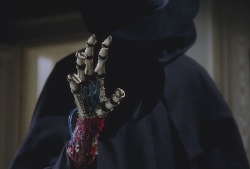
Ladies of Virginia Beach are all atwitter over an unnamed serial rapist/killer terrorizing the community. (Let’s call him Night Killer, since the movie is named just that.) Luckily, he’s easy to spot: He’s the guy in the Toxic Avenger-esque rubber mask with matching rubber hand spouting spiky yellow fingernails long enough to vie for a Guinness World Record. Only if he stood under a neon arrow flashing “GET MURDERED HERE” could he be more identifiable.

His signature move? Punching clean through women’s torsos. Melanie Beck (Tara Buckman, Silent Night, Deadly Night) somehow makes it through a terrifying home-invasion encounter with him, emerging with scraps, bruises and amnesia, but nary an extra hole. After being discharged from the hospital, life for Melanie continues to be a living nightmare, thanks to Night Killer still at large, as well as being stalked — and then abducted and sexually assaulted — by a creepy guy named Axel (Peter Hooten, who donned the cape as 1978’s Dr. Strange).

As a director, Claudio Fragasso (aka Clyde Anderson) is remarkably consistent. However, as other Fragasso films like Beyond Darkness, Monster Dog, Troll 2, et al. raise their right hands and testify, that consistency is a remarkable disdain for reality and rationale — and Night Killer might be his most imbecilic. Nothing happens as it should or would, even when allowing for a moviegoers’ suspension of disbelief. For example — and this is minor, mind you — Melanie reacts to a threatening phone call by looking in the mirror and yanking out her breasts. In fact, it’s just the first of several instances that call for Buckman to bare at least one of them, which accounts for her wardrobe choice of saggy sweaters for easy access; exposure happens so often — perhaps only a single instance merited — that I felt embarrassed for her.

Elsewhere, Melanie lays out a picnic of pills on the shore. In a public bathroom, Axel is forced at gunpoint to strip to the blue banana hammock that passes for his underwear. Seemingly from another movie emerges Blind Vision’s Lee Lively as an apparent stand-in for Donald Pleasence’s signature Halloween role of Dr. Loomis. I’m more than happy to discuss the bonkers twist, but don’t get me started on the choreographer. —Rod Lott

Get it at Amazon.

Pet Sematary (2019)

Love, like or loathe 2017’s It, at least the Stephen King adaptation felt different than the 1990 TV miniseries. The same cannot be said for the Pet Sematary remake, so close to being a beat-for-beat Xerox of the 1989 original that audiences are left wanting a good shake of the toner cartridge. Too bad, because as fondly remembered as that King-penned ’89 film is, room for improvement exists; one flip of the gender doesn’t count.

Casting, however, is a coup. Jason Clarke (Winchester) and Amy Seimetz (Alien: Covenant) make for a personable, believable couple as Dr. Louis and Rachel Creed. Soon after moving to rural Maine with their two kids and a cat named Church, they learn their wooded land leads to a cemetery for childrens’ pets, many of whom become residents after being pancaked on the highway. Just past its gravestones — over that unscalable wall of bramble — lies ancient burial ground imbued with supernatural powers of rejuvenation. Those powers are flawed, which becomes apparent when Louis — presumably inattentive the day in school they read “The Monkey’s Paw” — plants the freshly departed Church there … and Church returns to life as an insufferable, feral asshole in matted fur. When tragedy strikes further, lessons are not learned.

John Lithgow (Obsession) would seem born to inherit and inhabit the role of kindly neighbor Jud Crandall, the kindly neighbor who warns Louis about all of the above, yet aides and abets anyway. Although one of our finest and most versatile actors, Lithgow is not nearly as effective as Fred Gwynne was three decades prior. Perhaps the comparison is unfair, but Lithgow apes Gwynne’s distinctive drawl; before delivering the iconic line of “Sometimes, dead is better,” he dramatically pauses as co-directors Kevin Kölsch and Dennis Widmyer (Holidays) push their camera in, as if signaling to a nostalgic audience, “Get those clappin’ paws ready!”

For all the craft and care Team Kölsch/Widmyer has put into giving the new Pet Sematary a shiny coat, it should be more engaging — even mildly frightening (especially since co-scripter Matt Greenberg wrote one of the scariest King adaptations in 1408). The first film’s surefire scare, Rachel’s physically twisted sister, suffers here from sheer overuse and needless extension. This isn’t a bad movie — just unnecessary. Sometimes, less is better. —Rod Lott

Get it at Amazon.

Luz (2018)

A cabbie walks into a police station, and what happens next is not a joke. The tomboyish driver is Luz (featuring-debuting Luana Velis), and she has flung herself out of her car in the dead of night because she is being pursued by a demon. It happens.

How do authorities handle such a situation? In the case of Luz, the first feature from writer/director Tilman Singer, hypnosis. Under the subconscious-tapping care of Dr. Rossini (Jan Bluthardt, also feature-debuting, in a go-for-broke performance that elicits chills and chuckles), Luz recreates the events that brought her to the station. They are not without merit.

Luz is being sold as a horror movie in the mold of Dario Argento, Lucio Fulci and David Cronenberg. While their influence on Singer can be glimpsed, the pitch may be doing a disservice to the German film in setting audience expectations it cannot possibly meet. Those primed for a possession thriller filtered through those masters’ lenses will be ill-prepped for a near-somniferous pace that makes the slow-burn style of today’s reigning arthouse-horror hits (e.g., Hereditary, It Follows, The Witch) look positively hasty. On top of that, Singer’s cold visuals, sacrilegious agenda, timeline-tinkering and refusal to fill in all the blanks he’s drawn have the potential to frustrate viewers even further.

However, those viewers are not the kind Singer seeks, as his quasi-experimental, oft-transgressive film capitulates to no one. In scenes drawn out longer than they should play — and even in shots that run for several minutes at a time, resisting any urge to cut away — the nonetheless 80-minute Luz initially appears to bear a thick coat of neophyte pretension. Although hardly ostentation-free, its method comes to reveal a WTF-inducing madness for those still around. Recalibrate expectations and you, too, can be among them. —Rod Lott

The New York Ripper (1982)

I’ve seen Citizen Kane once. But Lucio Fulci’s The New York Ripper — as well as many other of Fulci’s flicks — I’ve viewed on VHS, DVD and now Blu-ray, more times than I can even count, many from a very young age that my parents should probably be ashamed of.

The New York Ripper, however, as bloody and gory as you’d imagine, is also Fulci at his most misogynistically goofy, throwing in so many offensive tropes against women that you have to wonder who was the person who hurt him so bad, filling his Italian soul with such anger. I have my theories, and Fulci does a great job of stabbing them all to hell, right in the guts and other assorted parts.

In a hysterical preamble, a possibly homeless man is playing fetch with his dog underneath the Brooklyn Bridge, only instead of a ball, the pooch brings back a largely decayed human hand. From there, we follow jerky police detective Fred (Jack Hedley, For Your Eyes Only) and even jerkier psychotherapist Paul (Paolo Marco, Watch Me When I Kill) as they constantly crack wise while they investigate the bizarre clues that take them on a wild goose chase throughout the city.

Let me rephrase that: a wild duck chase, mostly because the slasher will call and taunt both his victims and police in a creepy, Donald Duck-esque voice — one that I’m sure had the Disney lawyers checking their copyright-law books. From the inner workings of a live sex show on 42nd Street to the scummy apartment of the neighborhood sex freak, every red herring is taken as deviantly far as they can go in a reasonable, somewhat mainstream film.

With a brutally downbeat ending — spoiler alert! — featuring a little girl dying of a childhood illness (natch) and crying for her daddy in a hospital room, there are many times when The New York Ripper is such a down and dirty film, I’m surprised no one is wearing a Make America Great Again hat, each scene pornographically lingering on every physical and mental stab wound with sadistic glee.

The Blu-ray reissue from Blue Underground is an absolute embarrassment of impoverished riches, from the second disc full of fully produced documentaries and interviews, to a copy of the sleaze-funk score by Italy’s answer to Isaac Hayes — at least by me — Francesco De Masi. While many of the stars might be embarrassed to have taken part in — or be taken apart by — The New York Ripper, I’ll proudly set this edition on my shelf next to Zombie, The Beyond and, hell, even Citizen Kane. —Louis Fowler

Get it at Amazon.

Science Crazed (1991)

While the story of Frankenstein has spawned hundreds of feature films, only one is so dreadful to inspire a retroactive hatred of Mary Shelley: Science Crazed. Shot on 16mm in Toronto, it appears to be the only credit that has surfaced for its director, writer, producer and editor, Ron Switzer.

Pray that sentence never requires updating.

Despite promising to rock the world of biological science, Dr. Frank gets booted from the board of the Shelley Institute — a supposedly prestigious organization, yet its exterior screams “Section 8 apartment complex.” Undeterred and still wearing his Jack Nicholson sunglasses, the doctor continues his research — namely, the brunette he has tied to a lawn chair. Prepping a syringe of green fluid, he tells her, “In exactly three hours, you will be pregnant,” followed in 21 hours by birth to a baby boy. Sure as shit, she is and does. She also dies during delivery, and while Frank hardly is the type to adhere to the Hippocratic oath, you’d think he would’ve led with that.

After being zapped with (one presumes) electricity, the newborn grows at a phenomenally accelerated rate into what the credits refer to as “the Fiend” (Tony Della Ventura), a young man with pointy ears, a gimp left foot, a head wrapped in gauze, a torso in a bloody undershirt that exposes one nip, zero speech skills and, as if to mitigate all of the above, quite the set of biceps. Perhaps not believing the muscles to be mitigating enough, the Fiend kills his creator.

Dr. Frank’s assistants (Cameron Klein and Robin Hartsell) call the police … well, kind of. They ring up the local video store and ask for Inspector McCoy (Michael Sommers), a trenchcoat-and-fedora crimefighter who’s chewing Twizzlers as he stares at the VHS box for Rambo: First Blood Part II. Why he takes phone calls there is unexplained, yet makes more sense than much of what follows.

I would say that the remainder of Science Crazed finds the Fiend killing innocent victims; however, it’s more true to say the movie finds us waiting for the Fiend to find innocent victims to kill. Roaring like the MGM lion breathing directly into a tape recorder’s built-in mic, the Fiend slowly shuffles his way down the same hallway over and over and — yep! — over. Meanwhile, in a method of anti-editing, Switzer cuts to lengthy scenes of various unawares going about their business; most notoriously, two ladies exercise and exercise and — yep! — exercise, for more than 10 minutes. To call it “excruciating” is too kind by half.

One such sequence elicits accidental howls, as a woman (scientist? politician? evil incarnate?) writes on notebook paper while we hear her thoughts: “I suggest nerve gas tests be conducted in the following countries: France … Canada … United States … Italy … Japan … South Korea … Taiwan … Germany … Spain … England … Mexico … Australia … Colombia … Holland … Norway …” Now, while those words number a mere 28, Switzer’s balls of low-grade steel elongate the ellipses between them so that it takes the actress three minutes to complete her line, before half-assedly raising her hands as if to shield her face when she notices the Fiend filling up her office door frame.

Without meaning to, Switzer embodies a rule all burgeoning filmmakers should heed: Just because you shoot a ton of coverage doesn’t mean you have to use all of it. Comparing waste to want, Science Crazed runs at a 9-1 ratio — quite a pitiful showing for all of Canada … United States … Italy … —Rod Lott

Get it at Amazon.